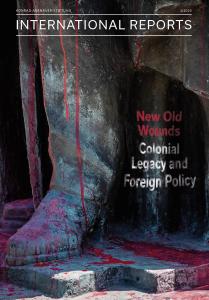
Issue: 2/2025




In a Nutshell
- Although Russia has pursued an imperial policy in its Eurasian neighbourhood since the early 19th century, the country is not perceived as a colonial power in much of postcolonial discourse – partly due to the link between Marxist and postcolonial theory.
- The South Caucasus is a telling example of how Russian and Soviet policy towards what are today Russia’s smaller neighbouring states has exhibited structural features similar to those of Western European colonial powers: political control, economic exploitation, cultural assimilation.
- While Tsarist Russia openly referred to its colonial policy as such, the Soviet Union sought to obscure this policy behind terms such as “solidarity” and “progress”.
- In contrast to the Western discourse, Russia is clearly referred to as a colonial power in the South Caucasus – most strongly in Georgia. In Armenia, Russia was long viewed as a protective power, but this perception is increasingly being called into question.
- The perspective from the South Caucasus deserves greater attention in Western postcolonial debate as it can help challenge Russia’s self-image as the spearhead of anti-colonialism.
Russia as a Blind Spot in Western Debate on Colonialism
It was an international conference hosted by the Konrad-Adenauer-Stiftung in Nairobi in 2022 that prompted Georgian journalist and Coda Story founder Natalia Antelava to reflect on the question as to why we tend not to view Russia as a colonial power. Bringing together editors and journalists from Africa and Eastern Europe, the conference focused on the observation that Russia’s narrative – positioning itself as the Soviet Union’s heir and continuing to oppose the “neocolonial West” – resonates widely in Africa. In a thoughtful essay, Antelava describes growing up in Soviet-era schools in Georgia, immersed in the myth of the Soviet Union as an anti-colonial champion of the oppressed – a perspective that was later reinforced during her studies in the United States. At American universities, colonialism was taught as a form of rule practised by Western powers, primarily in far-off overseas territories. Notably, Russia was absent from this picture.
The postcolonial debate likewise focuses mainly on power structures, subjugation and cultural dominance by Western empires in sub-Saharan Africa, Latin America, Southeast Asia, the Middle East and North Africa. There is rarely any discussion of the fact that Tsarist Russia – and later, the Soviet Union – acted as a colonial power in the Caucasus and Central Asia following patterns similar to those of France, the Netherlands and the British Empire. There are several reasons for this. For seventy years, the Soviet Union positioned itself as a Marxist–Leninist counterweight to the capitalist West and claimed to support national anti-capitalist liberation movements in countries ranging from Angola, Algeria and Eritrea to Cuba, Colombia, Korea, Vietnam and Cambodia, assisting them in their struggle against “Western colonialism”. This resulted in an ideological affinity that still exists today between Marxism and postcolonial theory. The debate shaped by scholars such as Frantz Fanon, Kwame Nkrumah and Samir Amin draws on (neo-)Marxist frameworks in its critique of Western colonialism. A key reference is Lenin’s writing on imperialism as the highest stage of capitalism, in which he describes how after World War I, the capitalist West sought to preserve global inequalities through (neo)colonial practices. This worldview leaves no room for acknowledging that the Soviet Union itself acted as an imperial power in the Caucasus and Central Asia. The Soviet Union is also argued to have been ethnically federal in structure, to have granted extensive sovereignty to the individual Soviet republics and therefore to not be capable of being characterised as a colonial power. What this view overlooks, however, is that the federal structure was purely nominal and that sovereignty existed only on paper. Finally, Russia’s – or the Soviet Union’s – role as a colonial power remains a blind spot because the concept of decolonisation is shaped by Western European scholars, as is the current postcolonial discourse, in which voices from the “Global South” and East remain underrepresented. This situation results in what David Moore calls a “double silence”, in which Western postcolonial studies overlook the post-Soviet states and post-Soviet academic traditions rarely incorporate postcolonial approaches.
The blind spots in Western postcolonial discourse provide the Putin regime with a significant advantage. For some time now, the Russian propaganda machine has been using social media to target especially left-leaning groups in Europe and immigrant communities in the United States with the same recurring anti-colonial message – one that seeks to revive and claim the Soviet Union’s narrative legacy for Moscow. In this way, Russia has been able to position itself as a global voice of anti-colonialism. However, as in other areas, this positioning is based on historical distortion and selective manipulation. In reality, Russia’s own colonial history – as is particularly evident in the Caucasus – stretches back to the early 19th century and forms a continuum that has been virtually uninterrupted to the present day.
Russian colonial rule in the Caucasus was characterised by control, exploitation and repression.
Annexation and Subjugation – the Conquest of the Caucasus
The colonisation of the Caucasus by the Russian Tsarist Empire has to be viewed within the broader context of 19th-century European imperialism. Although colonisation unfolded differently in the North and South Caucasus, it reveals clear parallels with the methods employed by Western colonial powers, such as the British Empire and France. One key date here is 1801, when the Russian Empire under Tsar Alexander I annexed Kartli-Kakheti (present-day eastern Georgia) just a few years after guaranteeing the Georgian kingdom territorial integrity and military protection under the Treaty of Georgievsk. This treaty is comparable with protection agreements such as those signed by the German Empire with its African colonies. A second crucial period in Russia’s colonial history in the Caucasus spans from 1817 to 1864, when the Tsarist Empire waged a series of long, bitter and brutal wars in an effort to subjugate the North Caucasus (in particular what is now Chechnya and Dagestan). This region was home to numerous ethnically and culturally diverse mountain peoples who over the course of nearly half a century of Russian repression repeatedly united in anti-colonial resistance – most effectively under Imam Shamil (1797 to 1871), who sought to defend local autonomy against Russian invasion forces.
Russian colonial rule in the Caucasus was characterised by political control, economic exploitation and cultural repression. Local resistance was met with widespread violence, including mass deportations, forced resettlements and the destruction of local communities. One particularly stark example is the attempted eradication of the Circassians, nearly 97 per cent of whom were killed during the wars (between one and 1.5 million victims).
Education and culture – particularly through systematic Russification – were key instruments of the colonisation of the Caucasus. Local languages such as Georgian and Armenian were marginalised, while Russian-language schools were established on a broad scale. The history of the Tbilisi Opera House – founded in 1851 – offers a clear example of the colonial methods employed by the Russian Empire, as reflected in the words of Mikhail Vorontsov, the Russian Viceroy of the South Caucasus: “I look at the Russian theatre in Tbilisi not as a means of an entertainment and fun, but as an institution that has the significant goals: familiarizing the local people with the Russian language, Russian habits and their gradual merging with Russia.”
Assimilation – or Russification – was a tool used by Russia to consolidate its power. Baku-born author Olga Grjasnowa vividly illustrates this in her novel “The Lost Son”, in which the besieged Caucasian resistance leader Shamil is forced to surrender his son Jamalludin to Russian troops as a hostage during negotiations. Contrary to the agreements, Jamalludin is taken to Saint Petersburg, where the Tsar personally takes him under his wing in an effort to “assimilate” him – with the intention of later sending him back to the Caucasus as a loyal Russian governor. At the Tsarist elite schools, Jamalludin learns Russian, French, English and German – but forgets his native Avar language. After several years, however, Shamil succeeds in securing his son’s release.
Unlike the Russian Empire, Soviet Russia sought to conceal its colonial policy in the region.
The conquest and Russification of the Caucasus were accompanied by the establishment of a colonial administration that was systematically planned and implemented following the annexation of Kartli-Kakheti. In 1828, diplomat and playwright Alexander Griboyedov submitted a proposal to the Tsarist government calling for “many thousands of peasants from central Russia to be resettled in the Caucasus in order to create large colonies there”. With a legal system adapted to the norms of Tsarist Russia, the Caucasus remained under Russian military administration until 1917 – and the imperial court made no effort to conceal the colonial nature of this rule. In 1896, the Tsarist Ministry of the Interior in Saint Petersburg established a Department of Resettlement that between 1907 and 1917 published a journal entitled “Voprosy kolonizatsii” (“Problems of Colonisation”).
Colonisation beneath the Communist Cloak – the Soviet Caucasus
While the Russian Empire not only practised colonialisation, but also openly referred to its occupation of the Caucasus as such, Soviet Russia sought to conceal its colonial policy in the region – even though these policies were in many respects a direct continuation of Tsarist colonialism. This situation is because Vladimir Putin presents the 21st-century Russian Federation as the heir to the Soviet Union while simultaneously denying any “colonial intentions”.
Soviet rhetoric promoted equality, brotherhood and socialist internationalism. Soviet leaders championed peoples’ right to self-determination, and in the 1920s, the policy of korenizatsiya (“indigenisation”) did in fact support the languages and cultures of non-Russian populations. However, this policy was abandoned in the 1930s and was replaced – in the Caucasus as in other Soviet republics – with the establishment of a highly centralised administration. As in the 19th century, the aim was to assimilate and Russify these regions. The fact that the Soviet Union’s approach in the Caucasus resembled the colonial strategies of European powers can be illustrated via three examples:
- The forced collectivisation of agriculture with the creation of kolkhozes and sovkhozes – especially in Armenia and Georgia – led to the alienation and uprooting of rural populations and destroyed traditional ways of life, with effects being comparable to those of land policies pursued by Western European colonial powers. In Azerbaijan, colonial patterns of economic exploitation were particularly evident in the early Soviet period. The profits from the republic’s immense oil wealth – which in the 1940s accounted for over 70 per cent of the Soviet Union’s total oil production – were managed in Moscow without any influence from Azerbaijani officials in Baku. Similar patterns could be observed in the British appropriation of Indian cotton or in the exploitation of vast rubber reserves in the Congo by the Belgian colonial regime.
- From the 1930s onwards, the Soviet Union pursued a policy of Russification in its republics. In the Caucasus, Russian became the official language of administration, education and public life, while the Cyrillic alphabet was introduced in many Turkic-speaking regions of the North Caucasus. Proficiency in Russian became a prerequisite for social mobility. In this respect, Soviet authorities in the Caucasus acted much like the British colonial power in India or the French in Algeria and West Africa, where local languages were suppressed and English or French was imposed as the lingua franca.
Soviet rhetoric promoted equality and independence.
- The Soviet repression of local identities and national movements in the Caucasus also followed colonial patterns. After the August Uprising of 1924, hundreds of Georgian nationalists were imprisoned or executed. Azerbaijanis who opposed Soviet rule and advocated for a stronger Azerbaijani identity were either arrested or disappeared. In the North Caucasus, Soviet authorities sought to annihilate entire peoples, though they ultimately failed to do so: During Stalin’s purges in 1937/1938, an estimated 14,000 Chechens were arrested or murdered, while during “Operation Lentil” in the winter of 1944, some 500,000 Chechens and Ingush were deported to Central Asia, around 300,000 of whom died en route.
Although Soviet rhetoric promoted equality and independence for decades, the actual conditions in the “Caucasian periphery” were marked by Russian dominance, coercion, exploitation and destruction. Once the rhetoric is stripped of its cloak of supposed solidarity and socialist progress, what remains is a bare “manifestation of colonialism” that is comparable with that of the British, French and Dutch colonial powers.
In Armenia, dependence has become Russia’s neocolonial instrument.
Russian Neocolonialism in the Caucasus
The threat and use of force, the establishment of new dependencies – or the restoration of lost ones – and a “divide-and-rule” strategy became key principles of Russian foreign policy both in the late Soviet period and after the Union’s collapse. Bartłomiej Krzysztan describes this as a “neo-colonial policy of maintaining influence by perpetuating conflict and instability”. In the Caucasus, examples include the violent suppression of demonstrations in Baku and Tbilisi (1989/1990), support for the Abkhaz side during the Georgian civil war (1991 to 1993), the two Chechen wars (1994 to 1996 and 1999 to 2009) and the Russo-Georgian war in 2008 – all of which demonstrate how colonial patterns persist. Conversely, in the early 1990s, the first President of the Chechen Republic of Ichkeria, Dzhokhar Dudayev, used anti-colonial rhetoric to call for national liberation – echoing Frantz Fanon’s and Jean-Paul Sartre’s descriptions of Algerian resistance to French colonial rule.
In Armenia, it is dependence that has become Russia’s neocolonial instrument: through the establishment of a Russian military base in Gyumri in northern Armenia, the deployment of Russian border troops at Yerevan Airport and along the borders with Turkey and Iran and the appropriation or control of large parts of Armenia’s economy (including gas pipelines, mines and the railway network). The neocolonial mindset behind this strategy became evident in 2004, when during a visit to Yerevan, Duma speaker Boris Gryzlov referred to Armenia as “Russia’s outpost in the South Caucasus”.
Russian neocolonialism in the Caucasus is a complex phenomenon.
Russia’s simultaneous arming of both Armenia and Azerbaijan for over two decades and its recognition of the Georgian territories of Abkhazia and South Ossetia – in violation of international law – reveal deliberate divide-and-rule tactics designed to preserve leverage in the region. Russian “integration projects” such as the Eurasian Economic Union and the Collective Security Treaty Organisation are best understood as instruments of domination.
Russian neocolonialism in the Caucasus is a complex phenomenon that ranges from political power structures to entrenched mindsets. According to Thornike Gordadze, Russia’s relationship with Chechnya over the past 20 years is reminiscent of its 19th-century colonial policy. Alongside a strong military presence, the region is ruled by co-opted elites. What Tsar Alexander I failed to achieve with Shamil’s son, Putin has managed with Ramzan Kadyrov. Tigran Amiryan in turn describes the colonial mindset of many “relocated Russians” who moved to Yerevan or Tbilisi in 2022/2023 following the start of Russia’s war of aggression against Ukraine. Having brought their Russian comfort zone with them, they view themselves as enlightening or refining the local communities and cultures. They largely refuse to engage in any dialogue about Russia’s colonial policies or about the “recolonisation” of cultures in the South Caucasus.
The Discourses of Colonisation in the South Caucasus
In contrast to the “double silence” described above, the South Caucasus has seen the emergence of discourses that explicitly address Russia’s role as a colonial power. The Russian-Soviet colonial oppression is most actively discussed in Georgia. Russia, it is argued, saw itself as pursuing a mission civilisatrice – much like Western powers – despite in practice bringing violence, discrimination and Russification. One striking example of this is the Museum of Soviet Occupation, which opened in Tbilisi in 2006 and is dedicated to both the history of Georgia’s national liberation movement and the victims of Soviet repression. Postcolonial discourse in Georgia is not confined to academic circles: Indeed, it is also voiced in connection with contemporary political struggles. The slogan “Down with Russian colonialism” featured prominently in the protests against the so-called foreign agent law (aka the “Russian law”) in 2024 and also later in demonstrations opposing the de facto suspension of Georgia’s EU accession process. Moreover, the fact that Russia has occupied around 20 per cent of Georgian territory since 2008 has contributed to a strong awareness among Georgians of living in a postcolonial state – not in a purely temporal sense, but as a space in which colonial structures have been not overcome, but rather superimposed, displaced and reactivated. The Georgian perspective is not limited to the country’s own experience: In fact, Russia’s colonial past is also understood in a regional context across the Caucasus. Georgia is the only country in the world that has officially recognised the genocide of the Circassians, having done so in 2011.
The reassessment of Russian-Armenian relations is still in its early stages in Armenia.
In Armenia, by contrast, the dominant narrative long portrayed Russia and the Soviet Union more as a “protective power” than as a colonial one. This perception rests largely on the idea of Russia as the “saviour” of the Armenian nation during the genocide in 1914/1915. According to this view, not only do Armenians owe their survival to Russia, but without Russia’s protection, Armenia’s very existence would still be under threat today, with the country being left defenceless against Turkey and Azerbaijan. Only more recently – especially since the Second Nagorno-Karabakh War in 2020 – have more voices begun to speak out, naming Soviet-era colonial structures as the root cause of current conflict. These voices describe how post-Soviet Russian-Armenian relations display many features of postcolonial dependency. In Armenia, too, there has been a shift in how the events of the 19th century are interpreted. A new history textbook for year eight pupils sparked diplomatic tensions with Moscow in 2024 because it described Armenia’s 1829 incorporation into the Russian Empire as an “annexation” – the first time this term has been used officially. Russia’s foreign ministry responded by publishing excerpts from the relevant chapter online, stamping them as “fake”. The use of the term “annexation”, the ministry said, was “provocative”, claiming instead that Armenia’s incorporation into the empire had had “enormous significance for the future restoration of Armenian statehood”. Just days later, Armenia’s Ministry of Education announced that the relevant section of the textbook had been revised, with the word “annexation” having been removed. Current academic and public discourse in Armenia shows that the reassessment of Russian-Armenian relations – especially with regard to their colonial character – is still very much in its early stages.
Conclusion: Gaining a Strategic Edge in the Discourse over Neocolonial Russia
On 15 to 16 February 2024, the ruling party “United Russia” hosted an international forum in Moscow entitled “For the Freedom of Nations”, inviting nearly 400 delegates from Africa, Asia, the Middle East, Latin America and Europe. In his opening speech, Vladimir Putin declared, “Our country has done a great deal to dismantle the colonial system and support national liberation movements”. Just one week earlier, an article published in the Armenian journal Hraparak claimed that the West’s main objective was to gain “neocolonial control over the Caucasus and Central Asia”.
These quotations clearly demonstrate that Russian propaganda seeks to sow discord among the ranks of its adversary through lies, disinformation and manipulation. That adversary is Europe in geographic terms – and liberal democracies in systematic terms. Although the methods are traditional, they have been vastly amplified by social media. However, the EU is struggling to respond in a way that is timely and – more importantly – effective. Projects such as EUvsDisinfo are well-intentioned, but they fall short.
If the new German government is seeking to change course politically, then a shift in discourse is also needed when it comes to postcolonialism, especially in areas in which academic debate influences political decision-making. A strategy paper by the Konrad-Adenauer-Stiftung on realigning German development cooperation calls for greater awareness of the notion that elements of postcolonial theory may “play into the hands of systemic rivals seeking to delegitimise the rules-based world order and foster anti-Western sentiment”. This is also an appeal to take a closer look at Russia in an effort to historically designate the nation as a colonial power and to expose its current neocolonial policies. We have much to learn from the debates in the South Caucasus. The view from Armenia or Georgia – countries with centuries of direct experience as Russia’s neighbours – is clearer, sharper and literally unobstructed. It is in the West’s interest to listen. Together, we should strive to counter Russian narratives more effectively in the postcolonialism debate and to gain a strategic edge in the discourse.
– translated from German –
Stephan Malerius is Head of the Konrad-Adenauer-Stiftung’s EU Projects Department. Until April 2025, he was Head of the Konrad-Adenauer-Stiftung’s Regional Programme Political Dialogue South Caucasus, based in Tbilisi.
Florian Binder is a Scientific Associate at the Konrad-Adenauer-Stiftung’s Regional Programme Political Dialogue South Caucasus.
Choose PDF format for the full version of this article including references.