






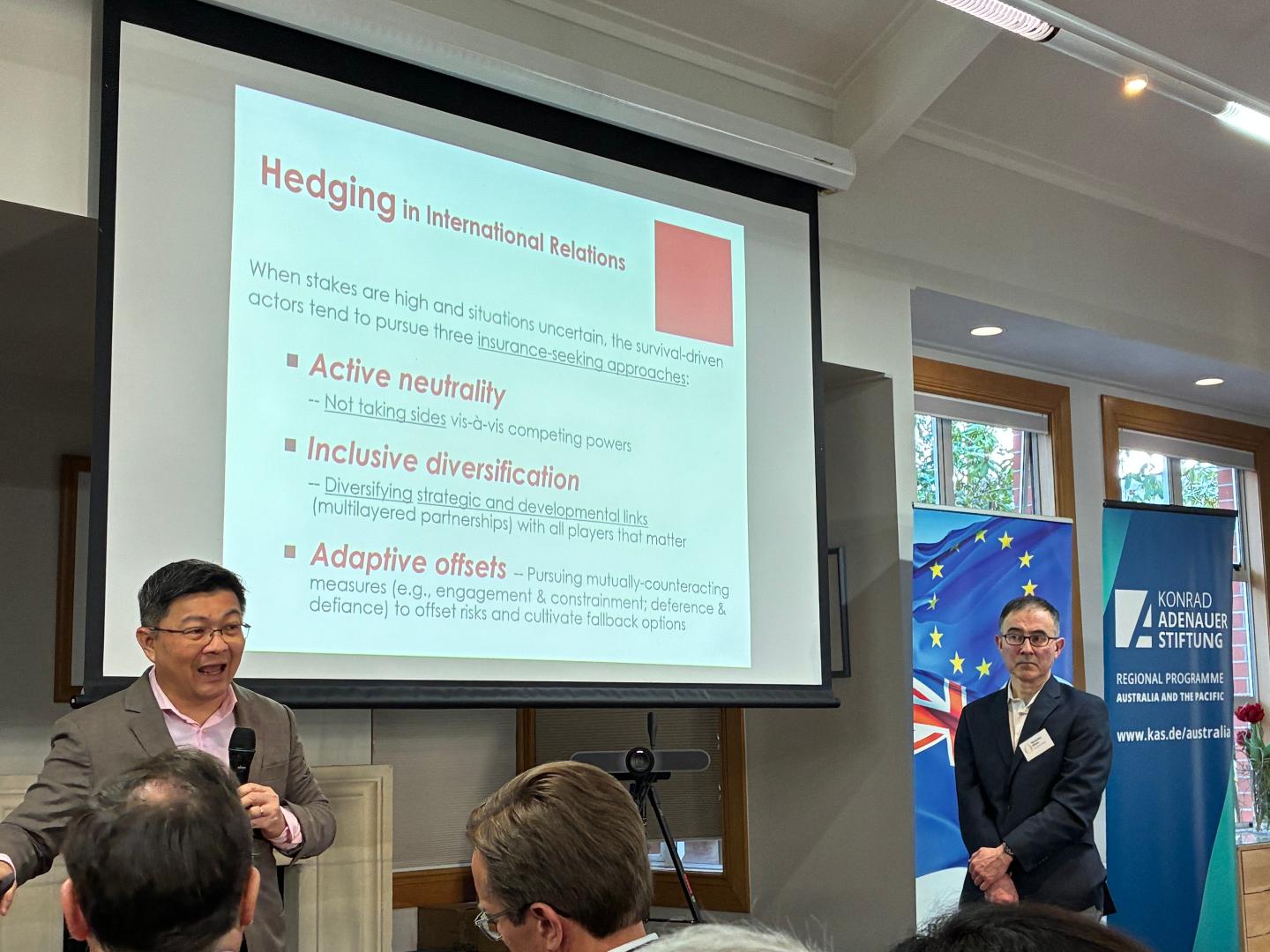
Themed ‘Small Powers and Strategic Competition in the Indo-Pacific’, the first day of the conference featured numerous expert speakers, including Patrick Koellner from the University of Hamburg, who provided the audience with an understanding of the varying definitions of ‘small powers’ and ‘agency’ that exist in international relations theory. Kai He from Griffith University gave his account of small powers and the international order transition, referring to diplomacy as the weapon of the weak, and proposing for small states to avoid entanglement in military competition, to selectively engage in institutional competition, and to actively defend and shape the international order. Sandra Tarte from the University of the South Pacific (USP) shared her thoughts on Fiji’s role in advancing regional stability in an era of geopolitical competition and tension, referring inter alia to the concept of ‘ocean of peace’ offered by the Prime Minister of Fiji, Sitiveni Rabuka. Sarina Theys from USP spoke to the agency of Pacific Island states in addressing climate change, naming as an example the Falepili Union between Australia and Tuvalu. The second day of the conference featured amongst others Nilanthi Samaranayake who presented her research on the approach of select small East Asian countries to strategic competition in the Indian Ocean, including Sri Lanka’s management of its relations with India (eg by way of a protocol of prior consultation on Chinese shipping vessels visiting its ports). Kuik Cheng-Kwee from the National University of Malaysia inter alia discussed whether the notion of ‘small powers’ was an oxymoron, noting that small states did not usually have the means to determine the outcome based on their needs, but could achieve agency collectively (eg ASEAN). Anna Powles from Massey University focused on the 2050 Blue Pacific Strategy as a response to rising geopolitical competition and an effort to reorder security in the Pacific Region. Whilst the Pacific Islands States’ foreign policy of ‘friends to all, enemy to none’ was a useful tool, the conversation about regional power was unresolved to date, and tensions remained between the three subregions, as evidenced, for example, by the ‘Micronexit.
The keynote address was given in absentia by the Minister for Foreign Affairs, Winston Peters, who outlined New Zealand’s independent foreign policy in general and its Pacific Reset in particular, emphasizing that small states did matter, and that their voices should be heard. Hosted by KAS Australia, the expert speakers and some of the attendees also had the opportunity to continue their discussions over a conference dinner.

주제
이 시리즈에 대해
콘라드-아데나워-재단은 자체의 교육원, 교육센터, 해외대표부 등을 통해 매년 수천개가 넘는 다양한 주제의 행사를 진행하고 있습니다. www.kas.de 에서는 귀하에게 선정된 콘퍼런스, 이벤트, 심포지엄 등에 관한 정보를 신속하게 그리고 독점적으로 제공합니다. 이 웹사이트를 통해 귀하는 행사의 요약된 내용 뿐 아니라 사진, 강연원고, 비디오 녹화 또는 오디오 녹음과 같은 추가자료들을 접할 수 있습니다.