Breadcrumb

Asset Publisher

The current issue

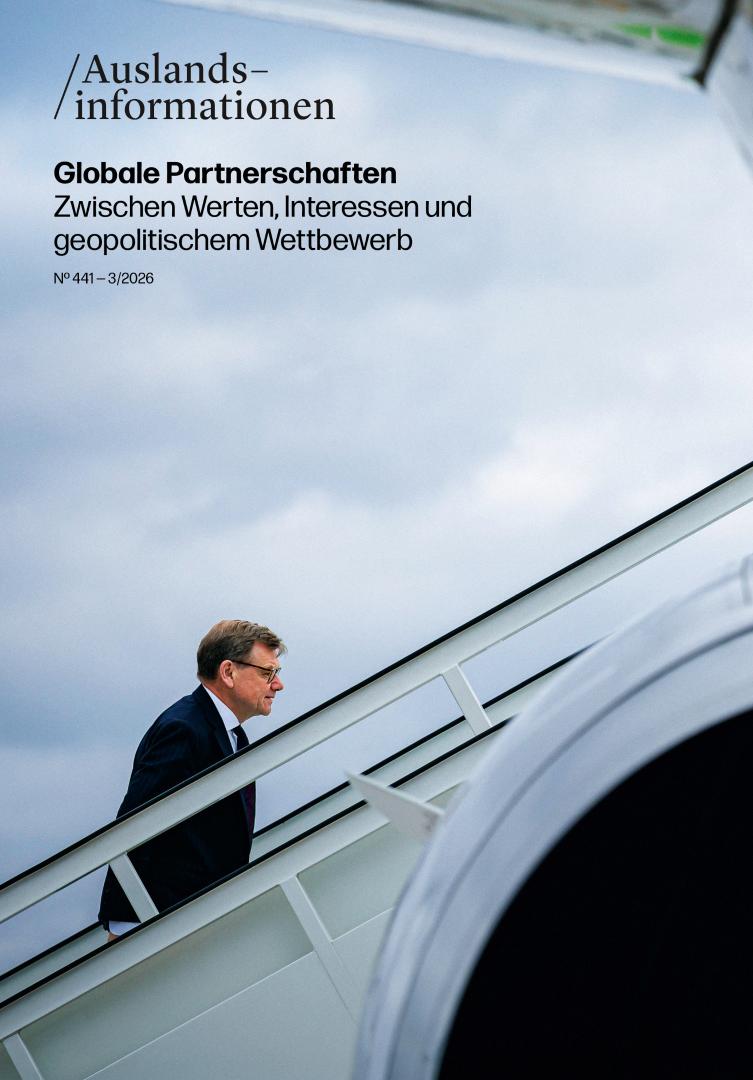
Cover International Reports 04/2025

America First – Again. How the World Is Dealing with Donald Trump’s Foreign Policy

Donald Trump has been back in the White House for almost a year. Many in Germany and Europe had feared this return, and they were not alone in this fear – consider Canada or Mexico, for example. But there were also those who had placed great hopes in Trump's second presidency: in the Gulf states, for example, or in Israel. What has the first year of Trump 2.0 actually brought for the different countries and regions of the world? Here is a tentative assessment.

View table of contents

Content

America First – Again. How the World Is Dealing with Donald Trump's Foreign Policy

  • Editorial of the issue: “America First – Again”

    The 2024 US elections have had a lasting impact on the security policy debate in Europe. One year on, it is evident that Trump’s foreign policy remains difficult to predict and is often transactional and unilateral in nature. In this edition, we examine the responses of various states – from Canada and Mexico to Israel, the Gulf states, and Vietnam. What patterns can be identified, and what consequences arise from them for Germany and Europe?

    by Gerhard Wahlers

  • Israel’s View of Trump 2.0

    Backing with Side Effects

    Although the US is significantly expanding its military support for Israel, the growing dominance of unilateral actions suggests that the previous balance between joint strategic planning and national interest-driven policies is disappearing, which could permanently change the regional security architecture. Can a reliable alliance between the US and Israel continue to exist under these conditions?

    by Michael Rimmel

  • The First Year of Trump’s Second Term from the Gulf Perspective

    Honeymoon and Black Eyes

    After a promising start to US-Gulf relations under President Trump, security setbacks soon followed. Military escalations and diverging strategic priorities raise questions about the resilience of personal networks. What consequences will this have for the region’s stability?

    by Philipp Dienstbier

  • How Mexico’s President Is Dealing with the New US Policy

    The Trump Whisperer

    Donald Trump is putting Mexico under pressure – with tariffs, threats, and demands. President Sheinbaum responds calmly, yet her room for manoeuvre is narrow. She relies on pragmatic diplomacy to avoid escalation while firmly asserting national sovereignty. Between economic dependence and political self-determination, Mexico must navigate a risky balancing act. Can this strategy truly safeguard its interests without jeopardising relations with its powerful northern neighbour?

    by Maximilian Strobel

  • Canada’s Relations with the United States under Donald Trump

    Elbows Up, Elbows Down

    Canada faces a historic test: Following Trump’s re-election, tensions with the United States are intensifying, and Prime Minister Carney is forging new alliances in Europe and the Indo-Pacific. How will Canada succeed in balancing economic independence with geopolitical security? And what consequences will this shift have for the country’s future?

    by Bernd Althusmann

  • Vietnam’s Relations with the United States under Trump 2.0

    A Balancing Act between Closeness and Independence

    As Washington halts aid programmes addressing war legacies such as “Agent Orange” and raises tariffs, Hanoi is rolling out the red carpet for the Trump family’s private ventures. With the fast-tracking approval for a luxury golf resort, Vietnam seeks to mitigate tensions and avert further damage. But can this blend of geopolitics and personal favours truly secure the future of bilateral relations?

    by Lewe Paul

  • US–Taiwan Relations under Trump 2.0

    Return to Strategic Ambiguity

    For Donald Trump, the United States is no longer a protective power but an insurance company – and Taiwan is expected to pay the premium. This forces the island republic into a precarious balancing act between military build-up and the sell-off of key technologies. When the most important ally becomes unreliable, new strategies are needed. Discover how Taiwan is attempting to break free from its one-sided dependence – and why its gaze may increasingly turn towards Europe.

    by Marcin Jerzewski

  • Exploring the Impact of Trump’s Protectionism on African Markets

    From Preferential Trade to Tariffs

    The end of AGOA and new US tariffs mark a turning point for African markets: Amid risks, new dependencies, and opportunities for partnerships with the EU and China, African states must realign their trade strategies. How are the affected countries responding to the changing rules of the game? What prospects are emerging for Africa’s economy after the expiry of AGOA?

    by Anja Berretta, Chantelle Moyo, Jule Steinmann

  • The Impact of US Policy on Global Health

    When All Concerns Are Trumped

    The global health architecture is undergoing a fundamental transformation that will decide whether stability and security can be preserved. With the United States withdrawing from key institutions, decades of progress are at risk, and other nations are forced to step forward. What future awaits global health policy when long-cherished certainties vanish? Could this be the moment for a reset of the international health architecture?

    by Andrea Ellen Ostheimer

Asset Publisher

Media library

New episode of "Auslandsinfo.Spotlight"

The First Year of Trump’s Second Term from the Gulf Perspective

Euphoria, disillusionment and the question of how strategic priorities are shifting between Washington and the Gulf states. Does this bring new opportunities for Europe?

New episode of "Auslandsinfo.Spotlight"

Youth protests in Kenya: On resistance, causes and their significance for Europe

In protest against new tax burdens, Kenya's Generation Z has been demonstrating since 2024—loudly, creatively, and digitally connected—for participation, transparency, and justice.

New episode of "International Reports"

Rethinking German Development Cooperation

German development cooperation should be more strategic and more closely aligned with economic interests. Why it is important to be open about our interests.

New Episode of „Auslandsinfo.Spotlight"

Global competition: Why Europe is losing competitiveness

Germany is losing influence in the global competition. Why partner countries view Europe critically and what needs to change.

New Episode of „Auslandsinfo.Spotlight"

Republic of Moldova – A new beginning in the shadow of Russian influence

The Republic of Moldova has once again voted pro-European – despite disinformation and Russian pressure. What does this new beginning mean for Europe's stability and security?

New episode of „Auslandsinfo.Spotlight"

Poland: Europe's new power in the East

Poland is rearming and seeking a political fresh start with Brussels and Berlin. Under Prime Minister Donald Tusk, the country is assuming a key role in Europe's security.

New episode of "International Reports"

New Old Dependencies? Trade with Africa

Africa’s economy is transforming: new partners like China are gaining influence as many nations strengthen their independence from the West through their own strategies.

Auslandsinfo.Spotlight: New episode online

Turkish development cooperation: nation branding and new alliances

Turkey combines humanitarian values with strategic interests in its development aid. Dr Ellinor Zeino, Head of our foreign office in Turkey, explains opportunities and obstacles.

New episode of „International Reports“

A History of Oppression: Russia as a Colonial Power in the Caucasus

Russia’s colonial past in the South Caucasus still shapes conflicts today. Georgia, Armenia and Azerbaijan remain caught between major powers and historic legacies.

New episode of „Auslandsinfo. Spotlight“

In the changing world order: Brazil's role as a middle power

As a middle power between the US, China, and the EU, Brazil is seeking its place in the changing world order. What consequences does this have for Europe?

Asset Publisher

About this series

International Reports (IR) is the Konrad-Adenauer-Stiftung's periodical on international politics. It offers political analyses by our experts in Berlin and from more than 100 offices across all regions of the world. Contributions by named authors do not necessarily reflect the opinions of the editorial team.

Order details

Our periodical on international politics is published four times a year. We provide you with background information on what is happening in the world – free of charge. Use our registration form and with just a few clicks you can read the digital version of our political journal or order the print version in German or English.

Editor

Dr. Gerhard Wahlers

ISBN

0177-7521

Benjamin Gaul
Benjamin Gaul
Head of the Department International Reports and Communication
benjamin.gaul@kas.de +49 30 26996 3584

Dr. Sören Soika

Dr
Editor-in-Chief International Reports (Ai)
soeren.soika@kas.de +49 30 26996 3388
Rana Taskoparan
Rana Taskoparan
Policy Advisor for Communication and Marketing
rana.taskoparan@kas.de +49 30 26 996 3623
Magdalena Falkner
Magda Falkner_Portrait
Multimedia editor
magdalena.falkner@kas.de +49 30 26996-3585

Breadcrumb