



Asset Publisher

Country Reports

Short political reports of the KAS offices abroad

Asset Publisher

IMAGO / ZUMA Press Wire

Thailand vor den Wahlen

Richtungswechsel oder Status Quo?

Am 8. Februar 2026 wird in Thailand eine neue Regierung gewählt, weniger als drei Jahre seit dem letzten regulären Urnengang. Notwendig wurden die vorgezogenen Neuwahlen durch die Amtsenthebung von Premierministerin Paetongtarn Shinawatra im August 2025, in deren Folge eine Minderheitsregierung unter Anutin Charnvirakul, dem dritten Premierminister seit 2023, geschäftsführend und befristet die Geschicke übernahm. Diese Zeit geht nun zu Ende – am 12. Dezember 2025 wurde das Parlament aufgelöst, im Januar der Wahltermin bekannt gegeben. Zudem findet am selben Tag ein Referendum zum Für und Wider einer Verfassungsreform statt, die über die grundsätzliche politische Architektur des Landes langfristig entscheidet. Was steht auf dem Spiel, welche Szenarien zeichnen sich ab und was bedeutet das für die Zukunft des Landes? Ein Überblick.

KAS/Althusmann

Is a ‘world order in upheaval’ leading Canada into a new leadershiprole?

Why geopolitical upheavals will redefine Canada's role in the international world order and in the transatlantic alliance

The ongoing trade war with the United States remains one of the country’s greatest challenges. Canada therefore intends to further expand its partnerships with Europe and the Indo‑Pacific region. As early as November 2025, Carney spoke of an epochal rupture and a shift toward a new world order that may be shaped by serious conflicts and a closer alignment among middle powers. The anticipated withdrawal of the United States could herald profound changes to the “old NATO” and necessitate a new security architecture. Canada will now have to demonstrate its readiness to assume greater responsibility and leadership as a middle power. However, the challenges facing the incumbent Carney government remain enormous—particularly on the domestic front. High unemployment, especially among younger generations, a shortage of affordable housing, and substantial defence spending require clear answers and a decisive political course. Prime Minister Carney and his minority government must deliver.

IMAGO / ZUMA Press Wire

Local elections in France in 2026

A barometer for the presidential elections

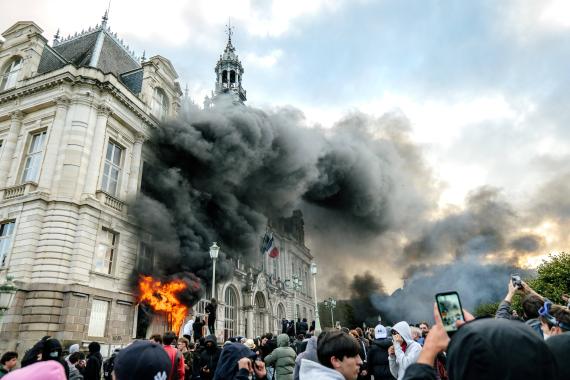
In March 2026, six years after the last election, local representatives will be re-elected in France. As the last nationwide direct elections before the 2027 presidential election, the parties attach particular importance to this vote, even though local election results traditionally only reflect national sentiment to a limited extent. However, given the unstable national political situation in which this year's local elections will take place, this trend could change. Since the dissolution of the National Assembly in 2024, political control at the state level has been weakened, parliamentary majorities remain unstable and confidence in national institutions is under great pressure. It therefore seems that the political significance of the local elections could have a greater impact at the national level this time or be influenced by it. Accordingly, the focus is shifting to the local authorities: in 2026, they will become key touchstones of political credibility, capacity to act and organisation.

IMAGO / Zoonar

Mexico Outlook 2026

Mexico under stress: threat of US intervention, erosion of democracy and fragile security

ince the US military intervention in Venezuela, possible US operations in Mexico are no longer considered mere threats. Announcements from Washington are now also perceived in Mexico as a real political risk scenario, presenting President Sheinbaum with a foreign and domestic policy test. At the same time, the country is undergoing a period of profound institutional upheaval. Following the far-reaching weakening of constitutional structures in 2025, the announced electoral reform could also bring the legislature under the de facto control of the ruling party in 2026. If this plan is implemented, it would further substantially damage the already fragile democratic balance. At the same time, the security situation presents a mixed picture. While the number of registered homicides is declining, the number of disappearances continues to rise. At the same time, the population's sense of insecurity remains high.

IMAGO / Bashir Daher

New Yemen, new Gulf

The war in Yemen and the rift between Riyadh and Abu Dhabi

In the wake of the dramatic events in the Yemeni civil war at the turn of the year, the cards have been reshuffled between the regional powers Saudi Arabia and the United Arab Emirates (UAE). The military offensive by Emirati-backed separatists and the counterattack by the Yemeni government allied with Saudi Arabia are more than just another chapter in the war – they have caused tensions between the two Gulf monarchies to boil over. Not only has the long-simmering animosity between Riyadh and Abu Dhabi fully come to surface, but the conflict also makes another round of confrontations in the Gulf more likely. Moreover, it raises fundamental questions about stability in the Middle East, for which the Gulf states were in fact considered guarantors. In the Gulf, a new phase of politics could be dawning, with two opposing poles of the Gulf Cooperation Council (GCC) pursuing conflicting regional visions with the help of different coalition partners. Likewise, the breakdown of the former Saudi-UAE alliance is not without consequences for Europe's foreign policy in the Middle East, which so far relied on both protagonists as anchors of stability.

IMAGO / Xinhua

Right-wing populism wins elections in Costa Rica

The continuity of ‘Chavismo’ as an epoch-making turning point

Laura Fernández of the Pueblo Soberano (‘Sovereign People’) party wins the presidential election in the first round with 48.33% of the vote and secures a majority of seats in parliament for her party. The candidate of the long-established Partido Liberación Nacional (PLN) achieved a historically good result, but was still significantly behind the frontrunner. The presidential and parliamentary elections on 1 February 2026 thus mark a historic turning point in Costa Rica's political history. The country, which for decades was considered a democratic exception in Central America, has experienced an election that goes far beyond the decision on individuals and party colours. At stake was the fundamental question of how Costa Rica should be governed in the future: through institutional dialogue, separation of powers and consensus – or through power-concentrated politics based on confrontation and structural system change.

IMAGO / Xinhua

The 14th National Congress of the Communist Party of Vietnam

New Mandate, New Benchmarks - General Secretary To Lam and His Epoch Making Reform Agenda

The 14th National Congress of the Communist Party of Vietnam took place in Hanoi from 19 to 23 January 2026. At the country’s most important political event, more than 1,500 delegates elected a new 200 member Central Committee for the next five years, from which the members of the Politburo are drawn. This year’s Party Congress was pivotal for Vietnam’s development strategy, as it put to the test the most comprehensive reforms since the country’s economic opening in 1986.

Michael Rimmel

Israel's scars after October 7: The return of the hostages and the national trauma

How the Hamas attack exposes social fault lines and calls old principles into question

On January 26, 2026, the remains of Ran Gvili, the last Israeli hostage in the hands of Palestinian terrorists, returned to Israel. The police officer, who belonged to an elite unit, had been fighting Hamas on October 7, 2023, when he was killed by terrorists and abducted to the Gaza Strip.  With the return of his body, there are no Israeli hostages in the hands of Hamas for the first time since 2014. Now his family and the entire community can say goodbye. Ran Gvili symbolizes the two traumas Israel has suffered since October 7, 2023. The first trauma, the attack on October 7 that left over 1,200 dead, was followed by the second, the taking of 251 hostages, some of whom were held captive by Hamas for two years.  It is clear that October 7 was not the beginning, but rather a dramatic escalation of an already familiar pattern.

IMAGO / Avalon.red

U.S. Perspectives One Year Into Trump’s Second Term

“Move Fast and Break Things”

Showing strength, challenging traditions, and putting America’s interests—along with his own—first: the first year of President Trump’s second term has been a whirlwind of national and international change. Nowhere is this more evident than in foreign policy, where he has profoundly reshaped the role of the United States and challenged the existing order.

IMAGO / Xinhua

EU-Jordan Summit

A Symbolic Step for a Strategic Partnership

With the first bilateral summit between the EU and Jordan, both sides sent a signal of their intention to deepen the partnership at a time of heightened regional instability in the Middle East. Through its support for Jordan, the EU aims to strengthen the country in its stabilising role in the region and to contribute to Jordan’s internal stability, particularly by supporting economic resilience and growth. For the EU, the deepening of relations also provides an opportunity to position itself as a reliable partner and actor in the Middle East against the backdrop of an increasingly unpredictable US foreign policy.

Asset Publisher

About this series

The Konrad-Adenauer-Stiftung is a political foundation. Our offices abroad are in charge of over 200 projects in more than 120 countries. The country reports offer current analyses, exclusive evaluations, background information and forecasts - provided by our international staff.

Order details

Editor

Konrad-Adenauer-Stiftung e.V.