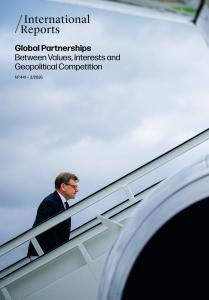
Issue: 3/2026




Dear readers,
The importance of reliable partnerships has grown significantly in response to international developments in recent years. These partnerships are not merely a diplomatic add-on, but a prerequisite for political agency in an increasingly fragmented world shaped by military conflicts, geopolitical shifts, economic uncertainty, energy and climate crises, and migration. As an export-oriented economy and a key player in Europe, Germany is particularly dependent on cooperation and reliable partners. Germany’s unsuccessful bid for a non-permanent seat on the UN Security Council recently demonstrated one thing: International support is not automatic; rather, it must be actively earned and strategically cultivated.
But what makes a reliable partner today? How can partnerships be shaped to create added value for both sides? And what do other countries expect of Germany and Europe if they are to be regarded as credible partners? This issue explores these questions through the lens of different regions and countries around the world, though it can cover only a selection of the international actors that warrant ongoing attention. We focus on regions where the reconfiguration of international relations is particularly evident as well as on parts of the world that have thus far received less attention.
The way partnerships are evolving in response to changing geopolitical conditions is already evident in European practice. These partnerships are becoming broader and more strategic, less exclusively driven by normative considerations, and more closely aligned with interests and tangible outcomes – without abandoning the commitment to values-based action. Olaf Wientzek and Sven Nicolay examine how this transformation is unfolding. Whether this new approach will prove successful depends on whether it genuinely enables more effective cooperation or – in the case of the Pact for the Mediterranean – merely creates additional bureaucracy – an open question explored by Lukas Kupfernagel in his contribution.
At the same time, it is clear that partnership policy has long extended beyond traditional foreign and security policy issues. This is particularly true of migration, which has become a key area of international cooperation. Caroline Schmidt analyses why migration policy challenges can now only be addressed effectively through cooperation with other countries.
The understanding of these relationships is also changing among countries that are already partners: Indeed, many view themselves no longer as recipients of international cooperation, but as independent actors that strategically balance their external relationships. Kenya is a case in point: Thomas B. Amolo and Mathias Kamp describe how the country is making increasingly confident use of multilateral opportunities.
This change in perspective also draws attention to countries that have often remained in the shadow of more traditional crisis regions. Based on the example of the Gulf of Guinea, Stefanie Brinkel and Anna Lena Sabroso-Wasserfall explain why a number of growth-oriented and comparatively stable West African countries deserve greater attention as long-term partners.
At the same time, current geopolitical upheavals are reshaping the strategic importance of entire world regions. Areas long regarded as peripheral are becoming central arenas for competition over energy, raw materials, trade, and influence. This is true, for example, of Central Asia, which is increasingly emerging as a focal point of geopolitical competition given the interests of Russia, China, and Western actors. André Algermißen explains why Europe needs to act more quickly and more visibly in the region. The trade in raw materials demonstrates the opportunity costs of failing to take the necessary action. In many resource-rich countries, European actors compete not only with China, Russia, and Turkey, but often also with one another. Looking ahead, the key challenge is not to leave the field to individual European states, but rather to make better use of Europe’s collective strengths by means of a “Team Europe” approach that combines competition with strategic cooperation in areas of shared interest.
Geopolitical tensions are additionally reshaping the logic of international cooperation in the Indo-Pacific region. Meanwhile, security considerations are increasingly shaping economic and political cooperation. Australia is a good example here: Christian E. Rieck and Sabina Wölkner analyse how the country is evolving into a more active security actor and is driving forward new forms of cooperation. New opportunities are also emerging in Latin America, where economic interests, political alignment, and strategic openness are creating new opportunities for cooperation. Carmen Dragon illustrates this using the example of Argentina, which is increasingly positioning itself as an attractive partner for Europe, particularly in the fields of energy, raw materials, science, and technology.
All the articles make one thing clear: Partnerships are neither self-evident nor free of conflict. They call for political commitment, economic investment, and a willingness to accommodate differing interests. In order for countries to be able to respond swiftly and flexibly to crises and change while at the same time striking the right balance between transactional and long-term partnerships, the current geopolitical landscape requires partnerships to be shaped strategically and with a medium-term perspective rather than to be judged solely through the lens of short-term developments. For Germany and Europe, this means redefining their role in an increasingly multipolar world – not as actors that set values and interests against one another, but as countries that can translate these values and interests into resilient, long-term cooperation. Reliable partnerships are not forged and developed solely at the government level; rather, they also depend on cooperation between parliamentary, business, and civil society actors – including organisations such as the Konrad-Adenauer-Stiftung, whose international engagement makes an important contribution.
I wish you a thought-provoking and engaging read.

Caroline Kanter is Editor of International Reports and Head of the Division European and International Cooperation of the Konrad-Adenauer-Stiftung.