




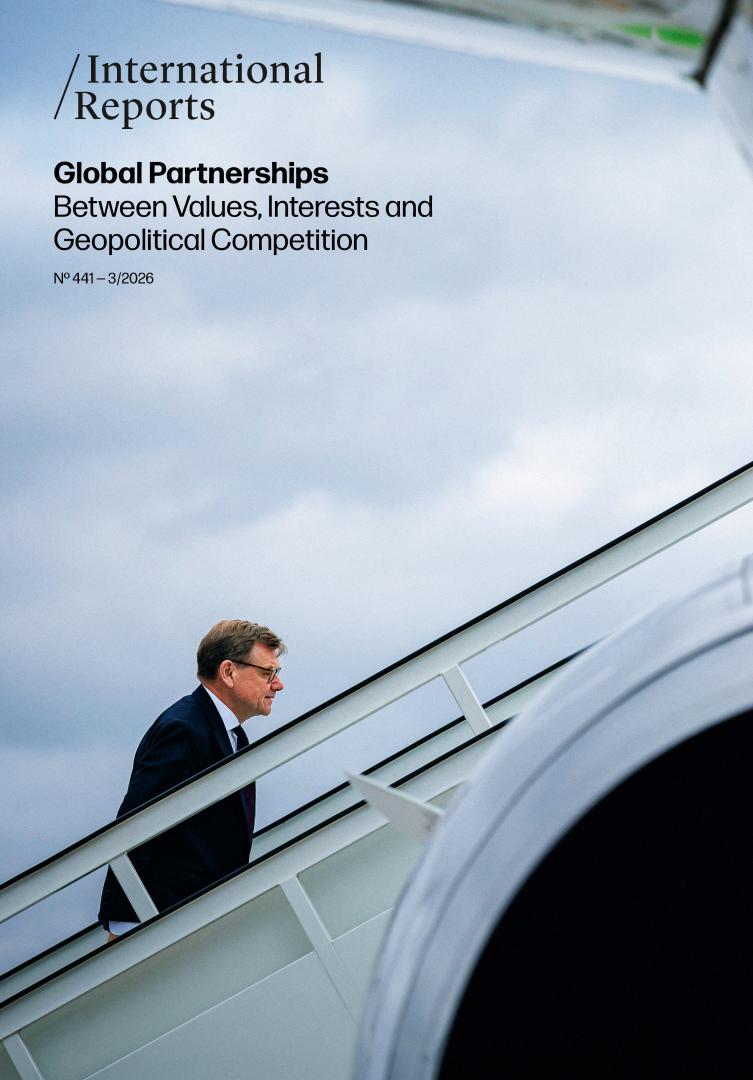
Geopolitical rivalries are intensifying, new centres of power are emerging, and traditional alliances are being called into question. Against this backdrop, global partnerships are becoming increasingly important. But how can these partnerships be shaped in times of geopolitical upheaval? Which countries and regions will become more important for Germany and Europe in the years ahead? What do potential partners expect from cooperation, and how can relationships be built to endure beyond short-term interests? In this issue, we take a closer look at selected countries, regions and actors that are gaining importance as partners for Germany and Europe.
View table of contentsGlobal Partnerships – Between Values, Interests and Geopolitical Competition
Content
Global Partnerships – Between Values, Interests and Geopolitical Competition
-
Editorial of the issue: “Global Partnerships”
Between Values, Interests and Geopolitical Competition
The international order is undergoing profound changes. New centres of power are emerging, traditional alliances are being reassessed, and strategic partnerships are becoming increasingly important across the globe. From Latin America and Africa to the Mediterranean region, Central Asia and the Indo-Pacific, Germany and Europe face the challenge of rethinking their foreign relations. Which regions are becoming more relevant, what interests are at stake, and how can Europe strengthen its position in an increasingly multipolar world?
-
The EU’s Partnership Policy in Transition
Adapting to a Geopolitically Turbulent World
The European Union is reshaping its partnership policy in response to growing geopolitical competition, economic uncertainty and security challenges. Initiatives such as Global Gateway, new trade agreements and strategic partnerships reflect this shift towards a more interest-driven approach. Can the EU combine geopolitical pragmatism with its commitment to European values and credibility on the global stage?
-
Prospects for Closer German–Argentine Cooperation in an Era of Global Diversification
Pampas and Partnership
Argentina is becoming increasingly important for Germany and Europe as they seek to diversify supply chains and strengthen strategic partnerships. Energy cooperation, critical raw materials and innovation offer significant opportunities for closer ties. What role can Argentina play in Europe’s economic and geopolitical future, and how can risks be managed alongside new opportunities?
-
Partnership Opportunities in the Gulf of Guinea
Raw Materials, Migration, Security
Europe’s view of West Africa is often shaped by crises in the Sahel, overlooking the opportunities offered by the Gulf of Guinea states. With growing importance for security, trade, raw materials and migration, these countries are becoming increasingly relevant strategic partners. What opportunities does deeper engagement create, and what are the risks of inaction?
-
Kenya’s Global Player Ambitions
A Strategic Opportunity for Germany
As global power dynamics shift, Germany is seeking stronger partnerships across Africa. Kenya stands out as a stable, influential and internationally engaged actor with shared interests in security, climate, migration and economic development. Could a closer partnership between Germany and Kenya become a model for a more strategic European approach to Africa?
-
The Pact for the Mediterranean as a Building Block for Diversifying European Partnerships
More than Just a New Label?
With the Pact for the Mediterranean, the EU aims to strategically redefine its relations with its southern neighbours. Yet geopolitical competition, growing expectations among partner countries and past setbacks place clear limits on what can be achieved. Can Europe build credible partnerships based on equality, and what role can Germany play in this effort?
-
Central Asia between Russia, China, and the West
At the Heart of Geopolitical Competition
Central Asia is emerging as a key region linking Europe and Asia in an era of geopolitical change. Energy resources, critical raw materials, security cooperation and new trade routes are increasing its strategic significance for Germany and the European Union. What opportunities does this create, and how can Europe strengthen its role in a region shaped by competitive global powers?
-
Why Australia’s New Foreign Policy Role Creates Opportunities for Germany
A Partnership for a New Era
Australia is emerging from the constraints of its geographic position and playing an increasingly active role in the Indo-Pacific. As competition between the major powers intensifies, Canberra is redefining its geopolitical role in the region, opening new opportunities for cooperation with Europe and especially Germany. What opportunities does this strategic shift in Australia’s foreign policy create for German foreign, security and development policy?
-
The Foreign Policy Dimension of Germany’s New Approach to Migration
Migration Policy is Partnership Policy
Migration is increasingly shaping Germany’s foreign policy agenda. Managing irregular migration, supporting protection systems and attracting skilled workers all depend on reliable international partnerships. Which forms of cooperation are proving effective, and where do current approaches fall short? An analysis of how migration policy is becoming a strategic foreign policy challenge for Germany and Europe.
About this series
International Reports (IR) is the Konrad-Adenauer-Stiftung's periodical on international politics. It offers political analyses by our experts in Berlin and from more than 100 offices across all regions of the world. Contributions by named authors do not necessarily reflect the opinions of the editorial team.
Order details
Our periodical on international politics is published four times a year. We provide you with background information on what is happening in the world – free of charge. Use our registration form and with just a few clicks you can read the digital version of our political journal or order the print version in German or English.
Editor
Caroline Kanter
ISBN
0177-7521
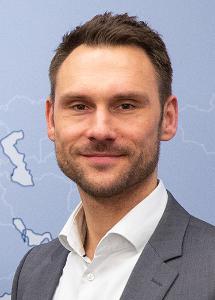
Benjamin Gaul
 benjamin.gaul@kas.de
+49 30 26996 3584
benjamin.gaul@kas.de
+49 30 26996 3584
Head of the Department International Reports and Communication

Rana Taskoparan
 rana.taskoparan@kas.de
+49 30 26 996 3623
rana.taskoparan@kas.de
+49 30 26 996 3623
Policy Advisor for Communication and Marketing
Magdalena Falkner
 magdalena.falkner@kas.de
+49 30 26996-3585
magdalena.falkner@kas.de
+49 30 26996-3585
Multimedia Editor International Reports