Issue: 1/2026




In a Nutshell
- Romania is undergoing a profound political shift. The established parties of the PSD, the PNL, and the USR are losing trust on a massive scale, while the right-wing populist AUR is emerging as the dominant force. The success of the AUR is based on nationalist narratives, anti-system rhetoric, and skilful use of social media that breaks with traditional campaign patterns.
- Polarisation has a strong sociological dimension. The AUR achieves its highest scores in rural regions and among less educated voters, while urban and academic milieus tend to support the PNL and USR. Age and gender differences further reinforce fragmentation, with the PSD performing particularly well among older voters.
- A growing factor is the diaspora, which is becoming increasingly politically mobilised and often responds strongly to populist candidates in elections. The AUR’s online campaigns reach this target group particularly effectively and underscore the strategic importance of digital platforms.
- The political centre is facing a crisis of confidence. In order to curb the rise of radical forces, Romania needs transparent governance, visible reforms, and communication that conveys security, dignity, and credible prospects for the future. Without convincing answers, democratic erosion looms.
For almost two decades, Europe has been living in crisis mode: a financial crisis, the pandemic, a war in the neighbourhood, energy and inflation shocks, as well as fears related to migration and technological acceleration. These ongoing crises have reshaped the political landscape: Traditional centrist parties are losing ground, while populist and radical forces are growing. Romania is following this pattern with some delay, but with similar dynamics.
Romania’s austerity course in response to the 2008 financial crisis damaged trust in political elites because many people felt that the burdens were not distributed fairly across society. After 2020, the pandemic, inflation, and the war in Ukraine intensified social fatigue as well as the already-latent distrust of the “system” – a diffuse term referring to opaque power networks that are perceived as undermining a democratic order based on the separation of powers. The consequence: The Social Democrats (PSD)1, the National Liberals (PNL; a member of the European People’s Party), and the reform-oriented USR have lost substantial credibility, while the right-wing populist Alianţa pentru Unirea Românilor (Alliance for the Union of Romanians; AUR) and other radical parties have gained strength. In the parliamentary elections of 1 December 2024, the AUR became the dominant far-right force, winning 91 of 464 seats. Today, at the beginning of 2026, a grand centrist coalition governs under President Nicușor Dan and PNL Prime Minister Ilie Bolojan – theoretically an “expanded centre”. However, polls have for some time placed the AUR clearly ahead, at around 40 per cent. Further, smaller far-right parties are adding to this trend.
Who are the right-wing populist players in Romania, and what is their strategy?
The largest party with a right-wing populist profile is the AUR. In 2025 polling, it hovered at around 40 per cent. Its candidate and party leader, George Simion, received 46.4 per cent in the second round of the presidential election in spring 2025 – after having received just under 41 per cent in the first round. Although Nicușor Dan ultimately clearly won, with 53.6 per cent, having secured only around 21 per cent in the first round,2 Simion’s strong lead in the initial vote illustrates the fragility of Romania’s political situation. The presidential elections had to be completely re-run after the Constitutional Court annulled the election following the first round of voting in November 2024 due to allegations of electoral manipulation and distortion of equal opportunities of candidates, including through social networks and undeclared sources of funding.
The AUR presents itself as the party of the dissatisfied and disadvantaged, as an opponent of the established parties, and as a defender of traditional values. It describes itself as follows: “The party is new, but the struggle is old! The Alliance for the Unity of Romanians (AUR) was founded on 1 December 2019. We value family, fatherland, faith, and freedom. Are you tired of watching Romania’s resources being plundered without restraint? Are you tired of seeing Romanians forced to seek work abroad? Are you tired of seeing everything we value about our country and our people trampled underfoot? Are you tired of choosing between ‘bad’ and ‘very bad’? So are we. That is why we founded this party.”3
Political scientists Sorina Soare and Claudiu Tufiș classify the party as follows: “The [AUR’s] programme combines key elements of nativism, authoritarianism and populism. Without fundamentally questioning the legitimacy of the democratic constitutional order, the party directs its criticism at specific manifestations of liberal democracy. It defines ‘the people’ in populist-nativist terms and portrays foreign individuals and cultures as threats to the homogeneity of an organically conceived community.”4
An independent “anti-system candidate”, the previously little-known and initially underestimated Călin Georgescu also ran in the subsequently annulled first round of the presidential election in 2024.5 His campaign combined anti-Western and pro-Russian narratives with elements inspired by the fascist Romanian Legionary movement6 that were presented in spiritually mystical language, emphasising Romania’s uniqueness due to its location in the Carpathians.
The AUR deploys similar narratives – albeit with a different tone. One element is the emphasis on the national dimension. On the most recent national holiday, 1 December 2025, party leader George Simion had his leadership confirmed at a party congress in Alba Iulia in northwestern Romania. He had travelled in a “March of Unity” to the city, where Transylvania had united with Romania on 1 December 1918 – an act that marked the founding of the modern Romanian state. Through this symbolism, Simion presented himself as a champion of the “true Romania” – a claim that Călin Georgescu also sought to appropriate with his own march in Alba Iulia on the same day.
Simion’s appeal to national themes does not contradict narratives that glorify the communist past. As Stefan Baghiu writes, “[i]f you step out of the established middle-class spaces and socialize with the 45+ population in Romania’s towns and villages, including factory workers, old ladies selling in the market, pensioners, and Roma on the outskirts of post-industrial cities, you encounter the same significant social reality: for them, the communist period meant a significantly better life than today”.7
Many in the Romanian diaspora are receptive to messages emphasising its members’ value and distinctiveness.
Particularly noteworthy is the AUR’s attempt to address everything “Romanian” beyond the country’s borders. The party advocates unification with the Republic of Moldova, where Romanian is also spoken. Above all, it targets the votes of the large Romanian diaspora, which – as the electoral support for Călin Georgescu illustrates – is in parts highly receptive to messages emphasising its members’ value and distinctiveness as Romanians.
The AUR is not the only actor in the populist party landscape: Other parties with similar themes but with a much smaller role include S.O.S România, which attracted attention by showcasing itself theatrically in the European Parliament, where it has been represented since 2024. On 18 July 2024, MEP Diana Șoșoacă was expelled from the chamber during a plenary session after having disrupted the proceedings. Wearing a mock muzzle, she shouted phrases such as “You have killed people” and “I was elected by Romanians”. Romania’s Constitutional Court barred the MEP – classified as far-right and pro-Russian – from the presidential election scheduled for late November 2024 in a controversial ruling from October 2024. According to the Court, Șoșoacă’s public statements demonstrated that she was incapable of upholding the oath of office to respect the constitution and protect democracy.8
A sociological map of party preferences
Opinion polls show that approval ratings for the right-wing populist AUR – as well as for other parties – vary significantly depending on sociological background, as illustrated in Figure 1. A survey conducted by the Romanian research institute INSCOP in late October / early November 2025, for example, produced the following ranking across all respondents among Romania’s major parties: AUR 38 per cent, PSD 19.5 per cent, PNL 14.6 per cent, and USR 12.3 per cent.
In rural areas, however, the AUR dominates, with 49 per cent, while in urban areas, it achieves 30 per cent.9 The lower the level of education, the greater the inclination towards the AUR and the Social Democratic PSD. With rising levels of education, the national-liberal PNL and the reform-oriented USR gain support.10 The AUR’s strident rhetoric resonates most strongly with men. The PSD, by contrast, is chosen disproportionately often by women.11 Age differences are also pronounced. Young people aged 18 to 29 are comparatively sceptical of the AUR, with a theoretical support level of “only” 34 per cent. The PSD reaches just nine per cent in this group. Among those aged 30 to 44, the AUR leads, with 50 per cent. The PSD scores eight per cent in this cohort – more than ten points below its overall result. This is a clear indication that the AUR is drawing heavily on the PSD electorate. Voters aged 45 to 59 roughly mirror the overall average. Among those aged 60 and above, the PSD clearly leads, with 38 per cent, while the AUR reaches only 28 per cent. Traditional conservative voters remain anchored in familiar positions. At the same time, the PSD faces a demographic outlook problem.12
Fig. 1: Party preferences in Romania, autumn 2025
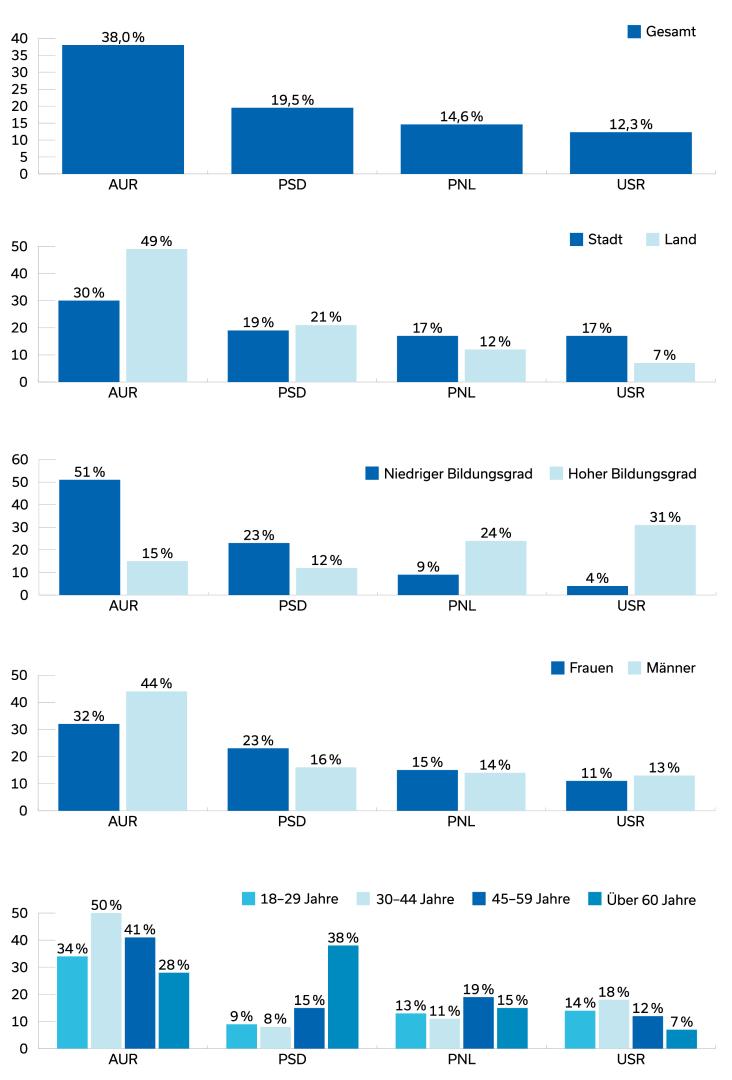
Source: own illustration based on INSCOP Research 2025, n. 9–12. Shown are all the parties that reached at least 10 per cent in the overall assessment.
The diaspora as an emerging democratic challenge
The Romanian diaspora poses a challenge of its own. In the subsequently annulled presidential election in autumn 2024, 821,135 voters from abroad were registered,13 with a majority supporting far-right politician Călin Georgescu. Six months later, interest in Romania’s elections had increased markedly. The diaspora was mobilised in particular in the second round – that is, in the run-off between the initially leading George Simion (41 per cent) and the now-incumbent Nicușor Dan (21 per cent in the first round). Almost twice as many voters went to the polls.14 Romanians in Hungary, Moldova, and other Central and Eastern European countries – as well as in Denmark, Portugal, and the Netherlands – voted for Dan, in some cases by a significant majority. Simion won the round in most countries of “old Europe” and in Norway.15 In Germany, around 278,000 voters (68 per cent) with Romanian citizenship backed Simion – an even greater proportion than in the United Kingdom, where slightly fewer Romanians voted. Spain also ranks among the diaspora countries with a strong tilt towards Simion, albeit with lower overall numbers.
The strong diaspora swing towards Georgescu in 2024 appears to mark the beginning of a political “awakening”, particularly among Romanians living elsewhere in Europe. Of roughly 11.64 million voters, around 1.64 million ballots cast in 2025 – that is, approximately 14.3 per cent – were based outside Romania.16 Democratic parties would therefore be well advised to keep the diaspora firmly in view, especially in online campaigns. Romanian government delegations now regularly engage with diaspora representatives. It is also important to analyse which narratives resonate in which countries – and whether stereotypes about Romanians in host societies may potentially influence protest voting behaviour.17 Here, the AUR has recognised its potential and is exploiting it skilfully. Social media transcends geographical boundaries and operates free from the physical limits of analogue campaigning.
The Journal of Contemporary Central and Eastern Europe18 published an analysis of right-wing populist online campaigning in April 2025. In this analysis, the authors trace the effective intertwining of viral campaigns, membership recruitment, and campaign financing through the monetisation of online success: Politics is becoming a “social media spectacle”, they write. “The traditional parties? They look lost, unable to adapt to a world where the rules of the game are being rewritten in real time.”19
Political environment and the strategies of traditional parties
The protest tapped by the AUR and, for example, S.O.S. România, has not arisen in a vacuum. The financial and economic crisis, the COVID-19 pandemic, extreme income disparities, a deeply rooted sense of injustice, low levels of education and living standards – especially in rural areas – and – despite successful digital initiatives – comparatively weak digital literacy all form part of the breeding ground for uncertainty and dissatisfaction. Added to this is the persistent fear that Russia’s war against Ukraine could spill over, fuelled by repeated drone incursions into Romanian airspace.
Democracy only began to gather momentum slowly after 1989.
The AUR also exploits another vulnerability in Romanian society: Like all intelligence services in totalitarian and authoritarian systems, the Securitate relied on control through the systematic cultivation of mistrust. The scars were not borne only by the dead, the imprisoned, and the tortured and their families; rather, surveillance and betrayal penetrated deeply into the most intimate spheres of family life.20 This decades-long experience did not come to an abrupt and definitive end – as it did in eastern Germany after the fall of the Berlin Wall, for example. Well into the years after 1989/90 and even into the present, credible reports persist of state-backed actors entering private spaces simply to leave subtle signs – a chair placed on a table, an object appearing in a private car – all signalling: “We were here”.
At the same time, trust in democratic institutions remains under considerable pressure – regardless of educational background. Democracy only began to gather momentum slowly after 1989. The National Council for the Study of the Securitate Archives (Consiliul Naţional pentru Studierea Arhivelor Securităţii, CNSAS) was not established until around 25 years ago – that is, more than one decade after the fall of the communist dictatorship. The old elites of the repressive Securitate apparatus – which had secured Nicolae Ceaușescu’s rule until the 1989 revolution – thus had more than ten years to keep their dossiers hidden. To this day, the CNSAS continues to demand the transfer of files that have still not been fully handed over. In this sense, the early post-1989 phase of Romanian democracy might be described as a form of “managed democracy”.
The current conflict over pensions – coupled with major dysfunctions and corruption in the justice system – is compounded by paralysis within parts of the governing coalition and by the rivalry between the president and prime minister – popularly described as a “war of the palaces”.
Under Sorin Grindeanu, who was confirmed as party leader on 7 November 2025, the PSD appears to have opted to mimic the AUR’s criticism of the government and the “system parties”. Grindeanu has repeatedly flirted publicly with the idea of breaking up the current moderate coalition of which the PSD is a part. The motive is clear: It is primarily PSD voters who are defecting to the AUR. The “independent” candidate for mayor of Bucharest backed by the AUR – talk show host Anca Alexandrescu, who ran for the “Justice for Bucharest” alliance – also has a long track record of working with the PSD at multiple levels. The AUR is therefore the most direct threat to the PSD – and might even replace it. There is little evidence that the Social Democrats have developed an effective, self-defined strategy to counter this challenge. At the same time, the AUR has made clear that it is not available for a coalition with the PSD.
After having been co-founded by today’s President Nicușor Dan, the USR set out to tackle what it views as Romania’s core governance problems: corruption, over-bureaucratisation, and excessive state interference, often associated with the entrenched networks of the PSD and PNL. At the European level, the USR belongs to the Renew group. It has established itself primarily among the well-educated urban middle classes but has struggled to reach broader voter segments, whether through its fact-based messaging or via its overall political style. Depending on the poll, the USR currently stands at just over ten per cent – with a tendency to shrink rather than grow. It is part of the governing coalition. The fact that the Romanian defence minister whom the party nominated – Ionuţ Moșteanu – was forced to resign in late November 2025 after false information about his university degree was found in his CV was a bitter blow to a party that claims to be “without criminals”. This blend of a technocratic approach and the loss of personal trust is weighing heavily on the USR.
Under its leader, Prime Minister Ilie Bolojan, the PNL currently presents itself as a “clean-up party”. In order to keep the budget deficit under control, it is imposing austerity measures on the public. Lower pay is looming over public-sector employees, and VAT was raised from 19 to 21 per cent on 1 August 2025.21 Property tax and vehicle tax have risen by up to 70 per cent since January 2026. The cap on electricity prices was lifted in mid-2025, and the cap on gas prices was due to expire at the end of March 2026, thereby relieving the state budget by several billion lei. The current dispute over pensions for members of the judiciary is less about economics than about symbolism. It is not only lower-income groups who are expected to contribute to saving. What is missing is a narrative of solidarity and a positive promise for the future. Ilie Bolojan thus comes across more as a decisive manager than as an empathetic communicator.
President Dan is also not providing a better “packaging” of government policy. His personal credibility is suffering due to his need to repeatedly negotiate compromises with coalition partners who pull in different directions.22 Without a determined and cohesive government, the AUR has ample opportunities to exploit public unease for its own political purposes.
The quality of governance determines credibility.
Outlook and need for action
The political centre in Romania is under pressure, as is a democracy that appears vulnerable. The core question is no longer whether the centre is losing support, but whether it can regain it at all. A look at other European countries such as the Netherlands indicates that the centre can recover when it becomes clear that it is not merely concerned with holding on to power. A number of conditions are key here.
First, the quality of governance determines credibility. Transparency, reliability, and visible results matter: tangible progress on infrastructure projects, investment in the energy sector, serious education reforms, and an end to budgetary waste. A sound development plan through to the 2028 election year that is both clearly communicated and well structured could build trust if priorities are bundled, goals are realistic and measurable, and commitments are stated in verifiable terms.
Second, the centre should take people’s fears and emotions seriously and address them proactively. Populist success cannot be explained solely by disinformation or manipulation; rather, it is rooted in real-life experience: material insecurity, social inequality, emigration, questions of identity, and the feeling of not being heard politically. By contrast, the political centre rarely communicates openly in Romania, sometimes ignoring issues that are painful for the population, and frequently resorting to technocratic clichés and lacking empathy: about resilience funds, the number of new motorway kilometres, percentages of the budget deficit, and tax rates. These issues are important, but they only indirectly impact on people’s day-to-day lives. Anyone who wants to regain trust must speak about dignity, security, and the future: secure jobs, affordable energy, functioning schools, and the prospect that effort will pay off. Politics is not only about administration: Indeed, it is also about meaning, fostering a sense of belonging, and working together for a “better Romania”.
Ultimately, the country needs renewal rather than cartel politics. Grand coalitions can guarantee stability, but they bear an inherent risk: If they look like a power pact among established parties, which has been Romania’s experience in recent years, they feed precisely the anti-establishment narratives from which radical forces benefit. In Romania, this risk is particularly pronounced because the current coalition – and each of its member parties – has thus far made little effort to bring forward new faces, independent experts, or visible actors from civil society, business, or the diaspora. In so doing, these actors reinforce the narrative of a closed political system that simply administers itself. For parties such as the AUR, which portrays itself as the voice of the “excluded”, this is a strategic gift.
Romania therefore stands at a crossroads. Either the grand coalition can harden into a “club of the old parties”, thereby accelerating the further rise of the AUR and other protest forces, or it can use its current position of power to bring about a credible restart. In order to do so, democratic parties must renew themselves in terms of personnel and practise internal party democracy rather than relying on informal power structures. Government representatives should address emotions and communicate with empathy. They need to name concerns, hardships, and shortcomings while offering a credible perspective on security, respect, and national dignity. This should be embedded in a narrative that is both patriotic and pro-European – that is, one that does not stop at “Brussels” but that instead shows that Romania is transforming itself and helping to shape Europe.
Pressure in Romania is further intensified by the deftly exploited manipulative mechanisms of the major online communication platforms. As a strategically vital country on NATO’s eastern flank with a long border with Ukraine and access to the Black Sea, Romania is very much in the sights of those who oppose European freedom.
Alongside domestic political answers, the country additionally needs a broader public debate about how the terror of the Securitate has shaped people’s basic outlook and the pervasive mistrust that runs through all areas of society. This makes it essential to establish – or improve – the transparency of state action. All democratic parties should initiate processes that may be uncomfortable even for themselves. The press and civil society must insist on this. In Germany, it was the Federal Constitutional Court that repeatedly admonished the parties and helped make Germany one of the most transparent countries in terms of party financing. However, Romania’s judicial bodies are currently in a deep crisis themselves and cannot provide such an impetus.
In short, Romania is experiencing a multiple crisis of confidence. Yet mistrust is the invisible enemy of freedom and democracy. Elections are the granting of trust for a limited period. Institutionalised checks and balances create deliberate tensions that are resolved not least through transparent procedures, thereby building trust in institutions. Without trust, democracy does not stand a chance.
– translated from German –
Dr Stefan Hofmann is Head of the Konrad-Adenauer-Stiftung’s Romania Office.
Mihai Marc is Project Coordinator at the Konrad-Adenauer-Stiftung’s Romania Office.
- PSD: Partidul Social Democrat, a member of the European socialist party family; PNL: Partidul Național Liberal, a member of the EPP; USR: Uniunea Salvați România (Save Romania Union), part of Renew Europe; AUR: Alianța pentru Unirea Românilor (Alliance for the Union of Romanians), affiliated at the European level with the European Conservatives and Reformists Group (ECR).↩︎
- Statista Research Department 2025: Rumänien: Ergebnis der Präsidentschaftswahlen in Rumänien (04. Mai and 18. Mai) 2025, 1 Dec 2025, in: https://ogy.de/85d0 [28 Dec 2025].↩︎
- Alianța pentru Unirea Românilor: Partidul e nou, dar lupta e veche, in: https://ogy.de/7jw6 [21 Dec 2025].↩︎
- Soare, Sorina / Tufiș, Claudiu D. 2023: Saved by the diaspora? The case of the Alliance for the Union of Romanians, European Political Science 22: 1, pp. 101–118, in: https://ogy.de/q56g [23 Dec 2025].↩︎
- Plate, Katja Christina 2024: Presidential elections annulled after hybrid attack, Country Reports, Konrad-Adenauer-Stiftung, 11 Dec 2024, in: https://ogy.de/cnzt [7 Jan 2026].↩︎
- The Legionary Movement (also known as the Iron Guard) was an ultranationalist, fascist, and strongly antisemitic organisation active in Romania between the 1920s and early 1940s. It combined Orthodox mysticism with paramilitary violence and at times played a significant political role.↩︎
- Baghiu, Stefan 2025: Loony platform politics: the Romanian far-right performance and the digital dystopia of 2024, Journal of Contemporary Central and Eastern Europe 33: 1, pp. 235–249, here: p. 238, in: https://ogy.de/it6o [7 Jan 2026].↩︎
- Die Presse 2024: Rumänisches Verfassungsgericht schließt Rechtsextremistin von Präsidentenwahl aus, 8 Oct 2024, in: https://ogy.de/yblw [23 Dec 2025].↩︎
- INSCOP Research 2025: Cum votează românii în funcție de mediul de rezidență, 13 Nov 2025, in: https://ogy.de/lz33 [23 Dec 2025].↩︎
- INSCOP Research 2025: Cum votează românii în funcție de educație, 12 Nov 2025, in: https://ogy.de/hmjd [11 Feb 2026].↩︎
- INSCOP Research 2025: Cum votează românii în funcție de gen, 11 Nov 2025, in: https://ogy.de/fz4x [23 Dec 2025].↩︎
- INSCOP Research 2025: Cum votează românii în funcție de vârstă, 10 Nov 2025, in: https://ogy.de/ivq7 [23 Dec 2025].↩︎
- Code for Romania 2024: Alegeri prezidențiale 2024, 26 Nov 2024, in: https://ogy.de/ivee [5 Feb 2026].↩︎
- Chas Pravdy 2025: Der Anstieg der Beteiligung der rumänischen Diaspora in die zweite Wahlrunde des Präsidenten: Die Wahlbeteiligung ist fast doppelt so hoch wie in der ersten Runde, 17 May 2025, in: https://ogy.de/2sjp [23 Dec 2025].↩︎
- Prezență vot 2025: Alegeri prezidențiale – Tur 2. Hartă străinătate, 18 May 2025, in: https://ogy.de/rjr8 [23 Dec 2025].↩︎
- Code for Romania 2025: Alegeri prezidențiale 2025, 22 May 2025, in: https://ogy.de/tos0 [5 Feb 2026].↩︎
- Mateescu, Barbu 2026: The ignored diaspora, Konrad-Adenauer-Stiftung, 26 Jan 2026, in: https://ogy.de/g8ds [11 Mar 2026].↩︎
- Baghiu 2025, n. 7, pp. 235 ff.↩︎
- Ibid.↩︎
- Mix, Pia 2024: Wie rumäniendeutsche Schriftsteller und Wissenschaftler von der Securitate bespitzelt wurden, Siebenbürgische Zeitung, 18 May 2024, in: https://ogy.de/mfgy [11 Feb 2026].↩︎
- EY 2025: Romanian tax changes introduced by new fiscal and budgetary measures, 30 Jul 2025, in: https://ogy.de/dmyn [5 Feb 2026].↩︎
- Although the president is constitutionally responsible primarily for foreign policy and performs the role of commander-in-chief of the armed forces in addition to being required to maintain party-political neutrality, the public associate his directly legitimised mandate with the expectation of active, visible leadership. As a directly elected head of state, he is seen not only as the guardian of institutional balance, but also as an operational actor who engages in key political processes and assumes responsibility beyond ceremonial functions. ↩︎