Asset Publisher

International Reports and Communication

Asset Publisher

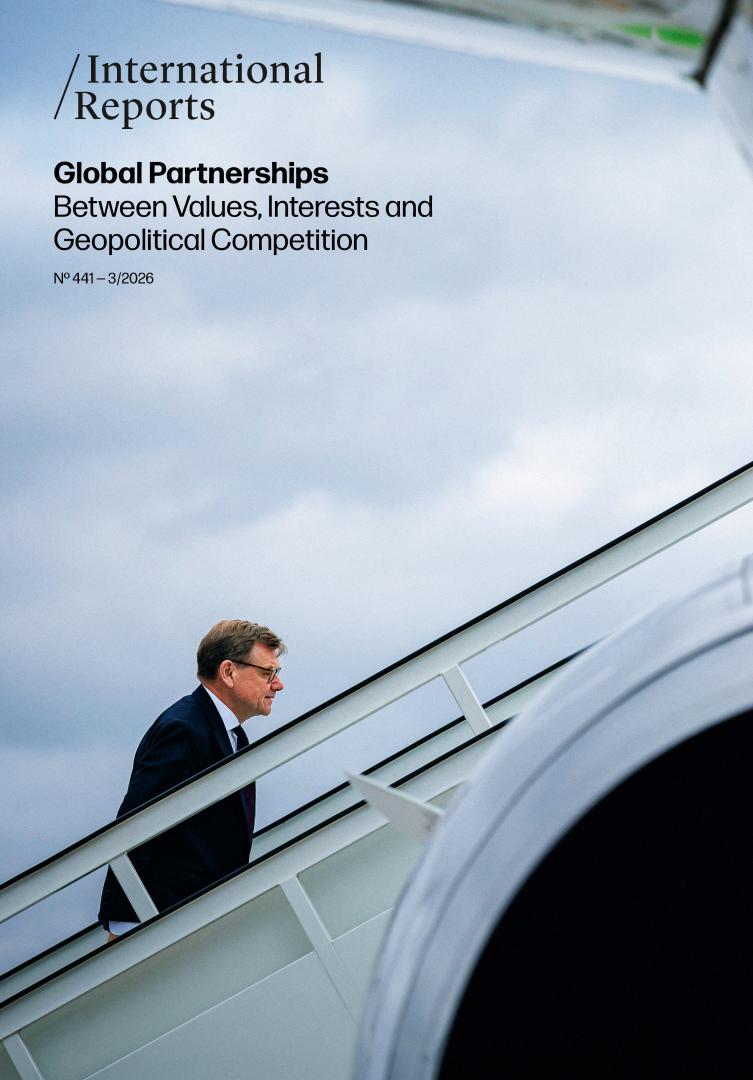
The International Reports and Communication department in the European and International Cooperation division is responsible for the International Reports (Ai) of the Konrad-Adenauer-Stiftung (KAS), a journal on international issues, foreign policy and development cooperation published four times a year. In addition to the printed edition, the Ai also offer an information platform on the international work of our over 100 Foundation offices on the website www.auslandsinformationen.de.

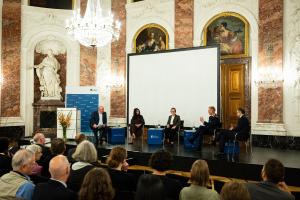
Freedom of the press and freedom of opinion are fundamental prerequisites for the functioning of a democracy and thus a focal point of our work abroad, which finds expression in the form of international media programmes at our offices in Johannesburg, Singapore and Sofia. The International Reports and Communication department is responsible for the coordination of these activities, as well as for the annual F.A.Z.-KAS debate organised jointly with the Frankfurter Allgemeine Zeitung newspaper, the aim of which is to give greater weight to important discussions on foreign policy issues in Germany.

The department is also the point of contact for our Foundation offices and consults and supports them in the areas of social media strategies and multimedia formats.

Asset Publisher

The current issue

Cover of the issue

The Centre-Right – A Look at Conservative and Christian Democratic Parties Worldwide

Centre-right parties across the globe are under pressure – particularly from right-wing populist challengers. In this issue, we contextualise the German debate on how to handle far-right parties within an international framework, illustrating how conservative and Christian democratic actors in Europe, Latin America, Africa, and Asia are responding to new political dynamics. Which strategies work – inclusion, exclusion, or a clear course of one's own? And what does this mean for the future of democratic centre-right politics?

View table of contents

Content

The Centre-Right – A Look at Conservative and Christian Democratic Parties Worldwide

  • Editorial of the issue: “The Centre-Right”

    Across many European and international democracies, centre-right parties are facing increasing pressure from right-wing populist forces. Who is challenging Christian democratic and conservative parties across Europe and beyond – and how are they responding? International examples show that these challenges are diverse and cannot be addressed by simple strategies of either exclusion or accommodation alone. Centre-right parties tend to succeed when they develop a clear profile and offer convincing responses to societal challenges.

    by Caroline Kanter

  • “We have our seismographs all around the world.”

    An Interview with Caroline Kanter

    Europe’s role in an increasingly unpredictable world is under scrutiny: Caroline Kanter, Head of the Konrad-Adenauer-Stiftung’s European and International Cooperation Department, on changing transatlantic relations, the need for new partnerships, the EU’s geopolitical tasks, and the impact the Foundation can have through its global network. What geopolitical opportunities and risks does she identify for the EU, and how can Europe win back lost trust?

    by Sören Soika, Magdalena Falkner

  • Reflections on How to Deal with Far-Right Parties in Europe

    Door Open or Door Closed?

    The rise of right-wing populist parties is fundamentally altering the political balance of power in Europe, confronting centre-right parties with the difficult question of how to respond. At the same time, it becomes clear that far-right parties differ significantly in their programmes and political positions — for instance regarding the EU, Russia, and the rule of law. Blanket strategies therefore fall short. What options remain for the political centre to remain politically viable under these conditions in the long term?

    by Sebastian Enskat, M.A.

  • The Growing Success of Right-Wing Populists Is Exposing Democratic Deficits in Romania

    Crisis of Confidence and a Disoriented Centre

    The annulment of Romania’s 2024 presidential election and the rise of the right-wing populist AUR reflect a profound political and social crisis, in which historical wounds inflicted by the Securitate, current social tensions, and manipulative social media campaigns are inextricably intertwined. At the same time, societal fault lines and a politicised diaspora are shifting the balance of power ever further towards the fringes. What steps can traditional parties take to regain lost trust in the face of this gradual erosion of democracy?

    by Stefan Hofmann, Mihai Marc

  • Latin America’s Party Landscape Shifts to the Right

    Polarisation, Populism, Pragmatism

    In Latin America, disillusionment with the political left and self-inflicted government crises have triggered a deep political shift. Conservative, libertarian, and right-wing populist forces are increasingly winning elections by emphasising security, economic reform, and a confrontational stance towards the elites. Yet is the region facing a lasting conservative turn, or merely the next swing of its political pendulum? And how can traditional centre-right parties remain competitive against their more radical rivals?

    by Henning Suhr

  • Polarisation and the Political Centre in Japan

    How the Liberal Democratic Party Staged Its Comeback

    In Japan’s 2026 lower house elections, the Liberal Democratic Party secured a historic landslide victory, gaining an unprecedented parliamentary majority. By pivoting to a new right-conservative agenda under Sanae Takaichi and promising economic reform, the party successfully held its ground against populist rivals. But what does this triumph signify for the political centre, the rise of new right-wing movements, and the demands of the electorate?

    by Paul Linnarz

  • The Challenges of Polarisation Facing the Conservative Side of South Korean Politics

    A Political K-Drama Stuck on Repeat

    South Korea is regarded as a stable democracy – yet social polarisation, economic pressure, and partisan power struggles are intensifying tensions within the country. The conservative camp in particular is facing a profound crisis of identity and leadership. What differences exist between the South Korean and German party systems – and what lessons can be drawn from them?

    by Henrik Braun

  • South Africa’s Fragile Political Centre

    Between Polarisation and Populism

    South Africa’s political centre is searching for direction in the face of growing populism, social inequality, and a fracturing party landscape. While the Democratic Alliance has the potential to become a catch-all party, reaching voters across classic class and social divides, the question remains: what strategies are needed to secure a majority for centre-right parties?

    by Gregor Jaecke, Christoph Wiedenroth

  • How Can Centre-Right Parties Hold Their Ground in Africa?

    A Look at the Democracy Union of Africa

    Amidst the withdrawal of Western partners, the growing influence of authoritarian powers, and the dominance of left-wing parties, Africa’s centre-right parties are searching for a new sense of direction. Despite repression and electoral manipulation, citizens – particularly Generation Z – relentlessly demand freedom, transparency, and political participation. For centre-right and conservative forces, this raises the pressing question of how to provide credible responses. What role does the Democracy Union of Africa play in this context, and does it possess the potential to revitalise the conservative camp?

    by Holger Dix, Henri Bohnet

  • Morocco’s Political Centre in a Hybrid System

    Between Party Pluralism and Monarchical Influence

    Democratic institutions do exist in Morocco – yet political power remains heavily concentrated in the monarch’s hands. Caught between monarchical supremacy and the demands of ‘Generation Z 212’ for genuine participation, Morocco’s centre-right parties are attempting to assert themselves. How much influence do they truly wield? Can mainstream forces succeed in regaining the trust of the youth – and what is at stake in the 2026 parliamentary elections?

    by Steven Höfner

Asset Publisher

Asset Publisher

Management

Management Benjamin Gaul
Benjamin Gaul
Head of the Department International Reports and Communication
benjamin.gaul@kas.de +49 30 26996 3584

Team

Team member

Dr. Sören Soika

Dr
Editor-in-Chief International Reports (Ai)
soeren.soika@kas.de +49 30 26996 3388
Team member Rana Taskoparan
Rana Taskoparan
Policy Advisor for Communication and Marketing
rana.taskoparan@kas.de +49 30 26 996 3623
Team member Magdalena Falkner
Magda Falkner_Portrait
Multimedia editor
magdalena.falkner@kas.de +49 30 26996-3585
Contact

Maxi-Laura Krüger

Maxi-Laura Krüger bild
Secretary / Assistant
Maxi-Laura.Krueger@kas.de +49 30 26996-3384 +49 30 26996-53384

Asset Publisher

Media library

New Episode of "Auslandsinfo.Spotlight"

Conflict and control: Jihadists, military regimes and international interests in the Sahel region

Military regimes are consolidating their power, while international players such as the USA, Russia, Turkey and the Gulf states are systematically expanding their influence.

New Episode of "Auslandsinfo.Spotlight"

Drones, AI, and a New Era – Ulrike Franke on the Future of Warfare

Drones, data, and AI are transforming warfare. Dr. Ulrike Franke explains what lessons the war in Ukraine holds for European security and military innovation.

New Episode of „International Reports“

Backing with Side Effects: Israel’s View of Trump 2.0

The second administration of Donald Trump reshapes US–Israel ties, prompting debate over policy shifts, regional security and rising political divides

New Episode of "Auslandsinfo.Spotlight"

How the Baltic states live with pressure from Russia

What can we learn from the Baltic states in terms of cyber defence, reserves and resilience? How vulnerable are our critical infrastructures at present?

New Episode of "Auslandsinfo.Spotlight"

An election with a signal effect: right-wing populism gains ground in Costa Rica

Costa Rica confirms its right-wing populist course: Laura Fernández wins the election and secures a parliamentary majority. What does this mean for democracy and Europe?

New Episode of „International Reports“

Asia’s relations with the United States under Trump 2.0

Balancing act between closeness and independence: Vietnam and Asia are adjusting their relations with the US and relying on flexible strategies in turbulent times.

New episode of "Auslandsinfo.Spotlight"

Ice, power, military – why Greenland is suddenly so important

What is Donald Trump's real interest in Greenland? And what does all this mean for Europe, NATO and the people who live there?

New Episode of "Auslandsinfo.Spotlight"

America for Americans? Latin America and the new US security strategy

With its new security strategy, the US is strengthening its claim to the Western Hemisphere. What does this mean for the region and for Europe?

New episode of "Auslandsinfo.Spotlight"

The First Year of Trump’s Second Term from the Gulf Perspective

Euphoria, disillusionment and the question of how strategic priorities are shifting between Washington and the Gulf states. Does this bring new opportunities for Europe?

New episode of "Auslandsinfo.Spotlight"

Youth protests in Kenya: On resistance, causes and their significance for Europe

In protest against new tax burdens, Kenya's Generation Z has been demonstrating since 2024—loudly, creatively, and digitally connected—for participation, transparency, and justice.

New episode of "International Reports"

Rethinking German Development Cooperation

German development cooperation should be more strategic and more closely aligned with economic interests. Why it is important to be open about our interests.

New Episode of „Auslandsinfo.Spotlight"

Global competition: Why Europe is losing competitiveness

Germany is losing influence in the global competition. Why partner countries view Europe critically and what needs to change.

New Episode of „Auslandsinfo.Spotlight"

Economic miracle or gamble? Milei's election victory and the new Argentina

Under President Milei, Argentina is pursuing a strict reform course, supported by US aid. Inflation is falling, but social burdens are rising at the same time.

New Episode of „Auslandsinfo.Spotlight"

Republic of Moldova – A new beginning in the shadow of Russian influence

The Republic of Moldova has once again voted pro-European – despite disinformation and Russian pressure. What does this new beginning mean for Europe's stability and security?

New episode of "International Reports"

New Old Dependencies? Trade with Africa

Africa’s economy is transforming: new partners like China are gaining influence as many nations strengthen their independence from the West through their own strategies.

Auslandsinfo.Spotlight: New episode online

Turkish development cooperation: nation branding and new alliances

Turkey combines humanitarian values with strategic interests in its development aid. Dr Ellinor Zeino, Head of our foreign office in Turkey, explains opportunities and obstacles.

New episode of „International Reports“

A History of Oppression: Russia as a Colonial Power in the Caucasus

Russia’s colonial past in the South Caucasus still shapes conflicts today. Georgia, Armenia and Azerbaijan remain caught between major powers and historic legacies.

New episode of „Auslandsinfo. Spotlight“

In the changing world order: Brazil's role as a middle power

As a middle power between the US, China, and the EU, Brazil is seeking its place in the changing world order. What consequences does this have for Europe?

New episode of „Auslandsinfo. Spotlight“

Brexit reset? The United Kingdom's rapprochement with Europe

Under Prime Minister Starmer, the United Kingdom is moving closer to Europe again. What does this mean for the EU and Germany?

New episode of „Auslandsinfo. Spotlight“

Brexit reset? The United Kingdom's rapprochement with Europe

Under Prime Minister Starmer, the United Kingdom is moving closer to Europe again. What does this mean for the EU and Germany?

New episode of „Auslandsinfo. Spotlight“

New old wounds: Postcolonial Discourses

Postcolonialism: From theoretical concept to political controversy. How colonial heritage shapes today's debates and where the approach itself becomes a criticism.

New episode of “International Reports”

Maritime security: the Russian ‘shadow fleet’ and the protection of critical infrastructure

Foreign policy tensions are also having an impact on the world's oceans. Russia's „shadow fleet“ threatens underwater cables & pipelines. How well prepared is Germany?

New episode of „Auslandsinfo. Spotlight“

Tensions with the USA - Canada's view towards Europe

Canada's relationship with the USA is becoming more difficult. Prime Minister Mark Carney now wants to realign the country's foreign policy - with a stronger focus on Europe.

New episode of “International Reports”

Why Lake Chad Offers Ideal Conditions for Islamist Terrorists

Lake Chad's shrinkage created islands and streams—ideal terrain for jihadists spreading across Niger, Nigeria, Chad, and Cameroon, fueled by poverty and climate change.

New episode of „Auslandsinfo. Spotlight“

Ecuador: In the stranglehold of the drug cartels

Ecuador is turning from a tourist destination into a drug hub. Gangs rule Guayaquil, violence is escalating and Europe's cocaine consumption plays a central role.

Asset Publisher