






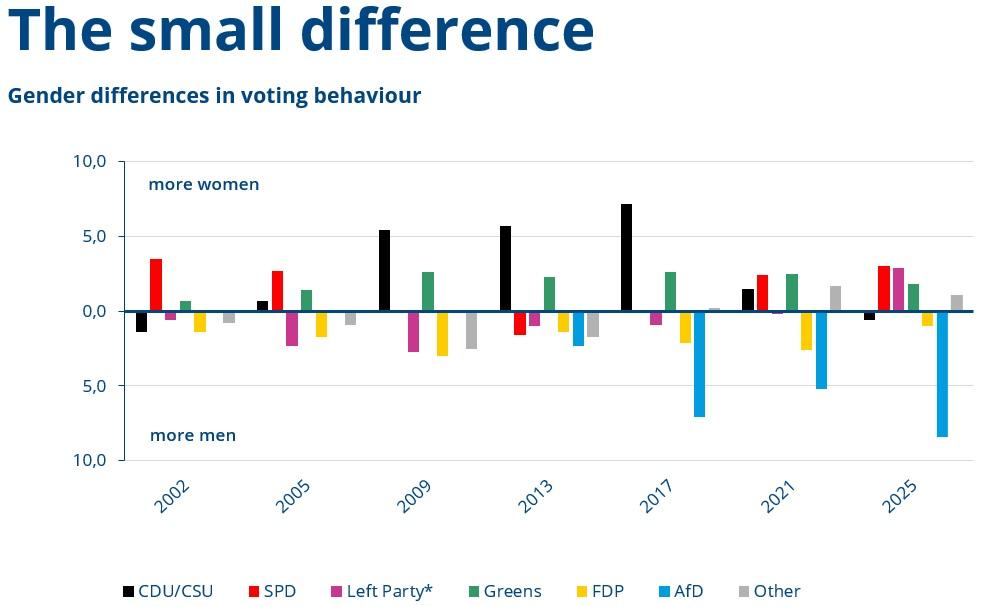
Women vote differently from men. The differences are subtle, but significant. A look at the most recent federal elections shows that some differences are consistent, whilst others fluctuate. The FDP consistently attracts slightly more male voters than female voters, whilst the Greens are consistently slightly more successful among women. The AfD attracts significantly more men than women. This, too, is a consistent pattern.
In 2002 and 2005, the CDU/CSU had a similar number of female and male voters. In the following three federal elections in 2009, 2013 and 2017, significantly more women than men voted for the Union. In 2021 and 2025, the gender gap in the CDU/CSU’s results is small again. Among the SPD’s electorate, women are sometimes in the majority (2002, 2005, 2021, 2025), and at other times the numbers are roughly equal. The Left Party has shifted from attracting more men to attracting more women.
The gender differences are not directly dependent on the gender of the front-runner candidates. Angela Merkel was voted for by more women than men, but not in her first election. The gender difference among the Greens has not changed between having a female front-runner and a male front-runner. Voters are not that simple.
You can read more about current trends in voting behaviour in the study “Voting behaviour by age and gender“ (only in German).