






Asset Publisher

Publications

Asset Publisher

Smarterpix / vepar5

2026 Parliamentary Elections in Slovenia - Between Fragmentation and Consolidation

A close election with limited coalition options

The parliamentary elections on March 22, 2026, mark a politically significant moment for Slovenia. For the first time in nearly two decades, a government served its full term and stood for re-election. While the election results confirm a high level of voter turnout, they also reveal the structural limitations of the political camps as well as the growing importance of smaller players in a fragmented party system. While Gibanje Svoboda (GS) under Prime Minister Robert Golob remains the strongest force with a narrow lead, the center-left camp no longer holds a comfortable majority as it did previously. The center-right bloc centered on Janez Janša’s Slovenian Democratic Party (SDS, EPP) achieved a stable but barely expandable result, as key coalition partners continue to keep their distance. At the same time, new or resurgent parties are entering parliament—including Resni.ca and the Democrats—further fragmenting the political landscape. Forming a government is likely to be more challenging than in 2022 due to limited compatibility between parties and mutual exclusions. The coming weeks will therefore be shaped less by the election result itself than by the ability of the parties to negotiate viable coalitions.

Citizenship and Participation in Local Governance: Lessons Learned from University Students

This book is a continuation of the workshop series “Citizenship and Participation in Local Governance,” synthesising lessons learned from the perspectives and reflections of students and faculty members from various universities. It also compiles fundamental knowledge on citizenship, civic engagement, and local governance in a single volume.

A workbook for lower local councillors in Uganda

The primary goal of the workbook is to provide lower local councillors with the essential insights, legal frameworks, and practical skills needed to become effective public duty-bearers. It addresses a critical gap in capacity building, as most government and civil society resources have historically focused on higher-level local government actors.

Handbook for Local Government Actors

Handbook for Upper Local Government Actors

It serves as a practical reference for navigating the legal and policy frameworks governing decentralised service delivery. The handbook specifically focuses on strengthening performance through community engagement, gender inclusion, and adherence to national audit and financial regulations. It also provides detailed insights into the roles of various oversight entities, such as the Inspectorate of Government and the Office of the Auditor General, to ensure transparency in local administrations. It simplifies complex legal mandates, including the Local Government Act and Public Finance Management Act, into actionable steps for planning, budgeting, and revenue mobilization. Furthermore, the handbook integrates strategies for gender-responsive programming and rights-based approaches to ensure that marginalized groups are actively involved in local decision-making processes. By bridging the gap between national policy and grassroots implementation, the text empowers officials to improve service delivery and foster greater public trust in local governance.

Visualised Workbook for Lower Local Councillors in Uganda

Perspectives, Laws and operational guidelines for Lower local Councillors in Uganda

The Visualised Workbook for Lower Local Councillors is a highly accessible, illustrated guide created to bridge the knowledge gap for LC I, II, and III leaders in Uganda. It simplifies the legal and operational mandates of the Local Government Act into practical, step-by-step instructions for effective community leadership. This resource is a vital tool for ensuring that even the most localized tiers of government can operate with transparency, efficiency, and legal compliance.

KAS African Law Study Library, Volume 4 of 2025

This publication brings together key insights from the Leaders for Justice Workshops (2022–2024), convened by the Konrad Adenauer Stiftung Rule of Law Programme for Sub-Saharan Africa. It reflects a sustained exchange among African legal practitioners and scholars on pressing rule of law challenges across the region. The contributions examine governance, accountability, and institutional resilience in sectors such as natural resources, labour, environmental law, and digital regulation. They further engage with complex legal questions arising in conflict-affected and fragile contexts. Collectively, the volume showcases policy-relevant, comparative scholarship by a new generation of African legal professionals committed to strengthening the rule of law.

Das Ende der Rohstoffpartnerschafts-Illusion?

Die bilateralen Rohstoffpartnerschaften Deutschlands mit der Mongolei und Kasachstan im Fokus – Bilanz und mögliche Weichenstellungen nach vorne

Das Papier liefert eine nüchterne, faktenbasierte und zugleich strategisch zugespitzte Bilanz von knapp 15 Jahren deutscher Rohstoffpartnerschaften mit der Mongolei und Kasachstan. Dabei wird auch die Frage gestellt, ob dieses Instrument in seiner bisherigen Form den geopolitischen Realitäten überhaupt noch gerecht wird. Dabei zeigt es klar, dass zwischen politischem Anspruch und wirtschaftlicher Wirklichkeit eine erhebliche Lücke besteht. Es gibt weder konkrete Projekte noch Lieferbeziehungen, in denen die Partnerschaften die erhoffte Wirkung entfalten konnten. Die strukturellen Abhängigkeiten, insbesondere von China, bestehen fort. Auf dieser Grundlage entwickelt das Papier keine abstrakte Kritik, sondern leitet konkrete strategische Optionen für die deutsche und europäische Rohstoffpolitik ab – von einem „Weiter so“ bis hin zu einer deutlich ambitionierteren, integrierten geoökonomischen Strategie. Damit soll die Analyse Impulse für eine realistischere, interessengeleitete und operativ unterlegte Rohstoffpolitik geben, die politische Steuerung, wirtschaftliches Engagement und geopolitisches Denken stärker zusammenführt.

IMAGO / Zoonar

Bulgaria on the Eve of the Parliamentary Elections on 19 April

The new alliance “Progressive Bulgaria” of former President Radev shakes up the existing party system

With yet another round of early parliamentary elections on 19 April 2026, Bulgaria is heading into its eighth parliamentary vote since 2021. Following the spectacular resignation of President Rumen Radev, his new alliance, “Progressive Bulgaria”, is shaking up the political landscape. Its declared goal: the complete “dismantling” of the oligarchy. Whether Radev’s alliance can put an end to the persistent political instability—or whether this instability will intensify further—remains unclear.

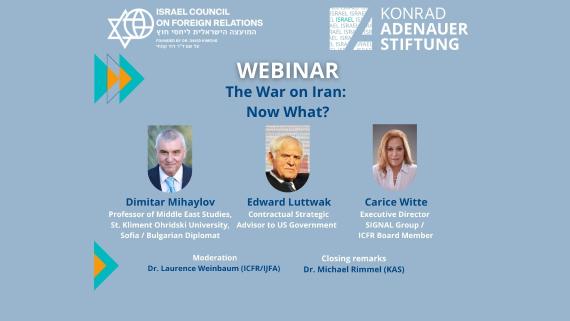
The War on Iran: Where we stand and where we are heading

Webinar in cooperation with the Israel Council on Foreign Relations (ICFR) on the current situation of the war in the Middle East and possible future scenarios.

Multipolarity and the Rise of a Geopolitical Europe: ASEAN’s Strategic Choices and Thailand’s Path Forward

The proceedings on key insights, debates, and challenges

The content is based on the discussion on 12 December 2025, “Multipolarity and the Rise of a Geopolitical Europe: ASEAN’s Strategic Choices and Thailand’s Path Forward." The seminar examined the implications for ASEAN and Thailand, particularly in balancing strategic autonomy with deeper cooperation across trade, digital governance, green transition, and regulatory alignment. The paper also provides an executive summary in both Thai and English and synthesizes policy recommendations to guide Thailand’s future engagement with the EU. The discussion was organized by the Institute of Democratization Studies, with support from KAS Thailand.

Asset Publisher

Facts and Findings

Selected contributions to the series with international relevance

The series informs in a concentrated form about important positions of the Konrad-Adenauer-Stiftung on current topics. The individual issues present key findings and recommendations, offer brief analyses, explain the Foundation's further plans and name KAS contact persons.  

International Reports

Journal for international issues, foreign policy and development cooperation

International Reports (IR) is the Konrad-Adenauer-Stiftung's periodical on international politics. It offers political analyses by our experts in Berlin and from more than 100 offices across all regions of the world. Contributions by named authors do not necessarily reflect the opinions of the editorial team.

EPP Party Barometer

The Situation of the European People's Party in the EU

The EPP Party Barometer illustrates the current situation of the EPP party family in the EU. On a non-regular basis, it provides a concise overview of current election results, polls from the member states and the composition of the party family.

Interviews

In our series "Interviews", talks and discussions are held with experts from the Konrad-Adenauer-Stiftung e.V. on various topics.

in short

Concise, reduced to the essentials, but always highly topical. In our series “in short”, our experts summarise an issue or problem on a maximum of two pages.

Country Reports

Short political reports of the KAS offices abroad

The Konrad-Adenauer-Stiftung is a political foundation. Our offices abroad are in charge of over 200 projects in more than 120 countries. The country reports offer current analyses, exclusive evaluations, background information and forecasts - provided by our international staff.

Event Reports

The Konrad-Adenauer-Stiftung, its educational institutions, centres and foreign offices, offer several thousand events on various subjects each year. We provide up to date and exclusive reports on selected conferences, events and symposia at www.kas.de. In addition to a summary of the contents, you can also find additional material such as pictures, speeches, videos or audio clips.