






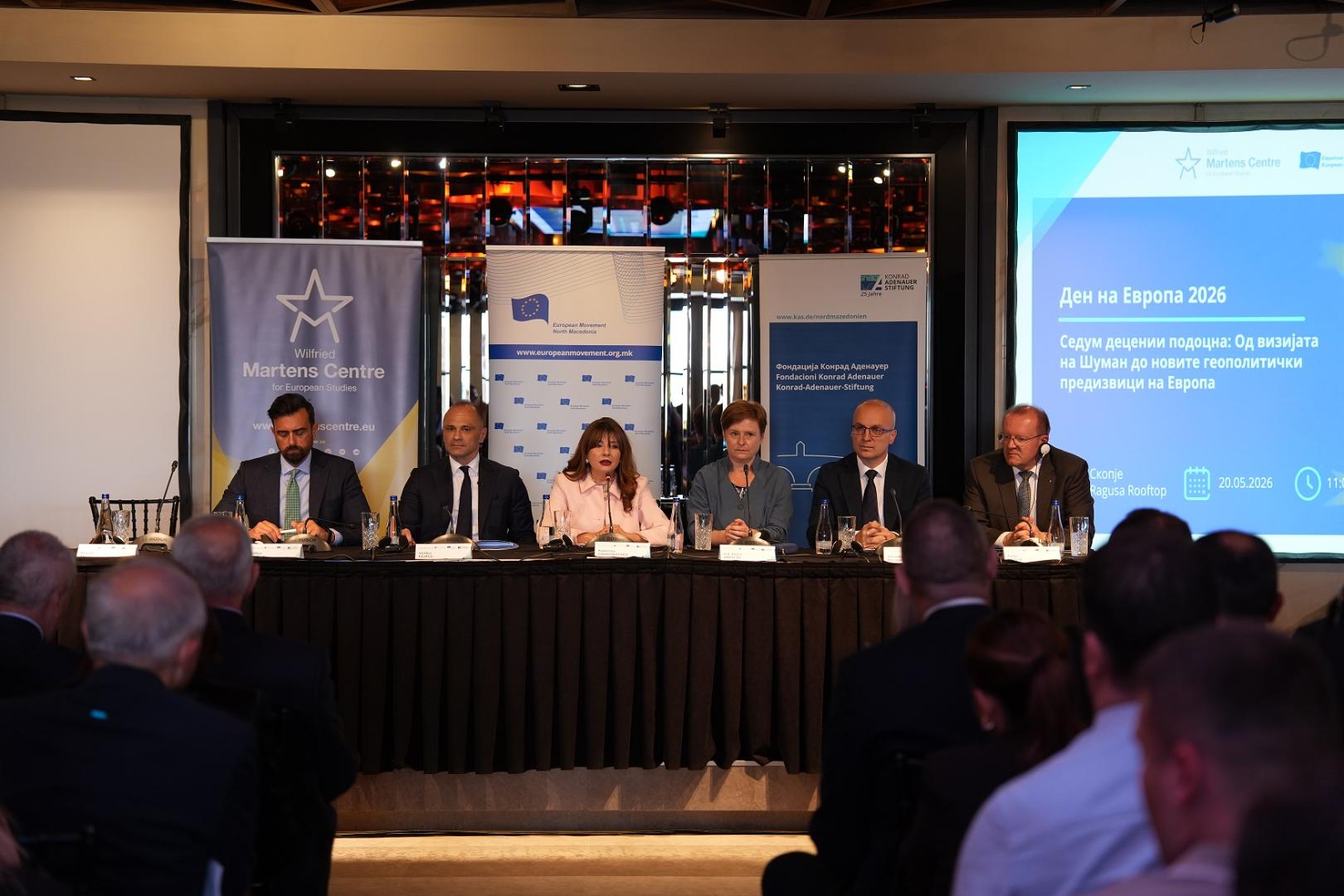
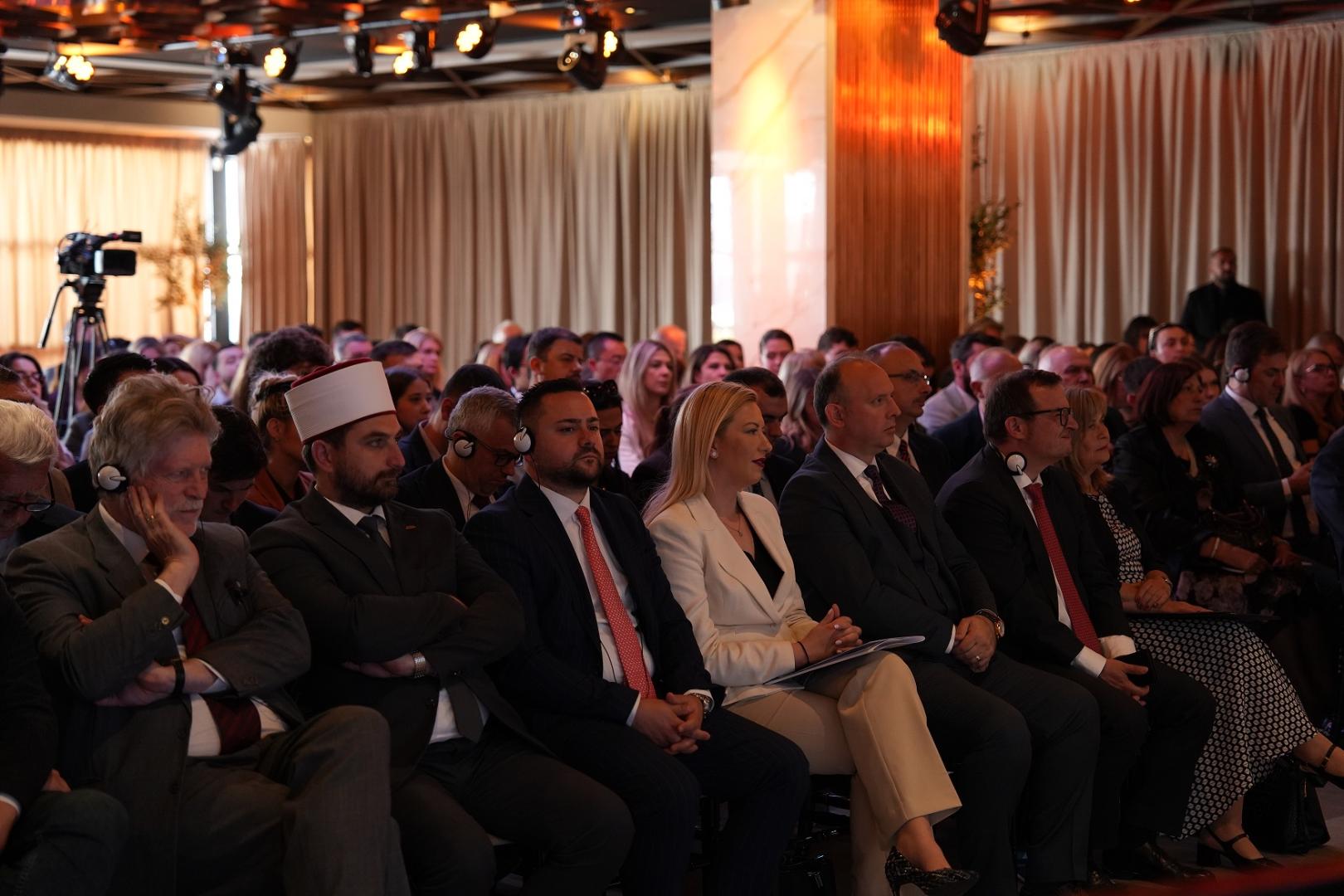
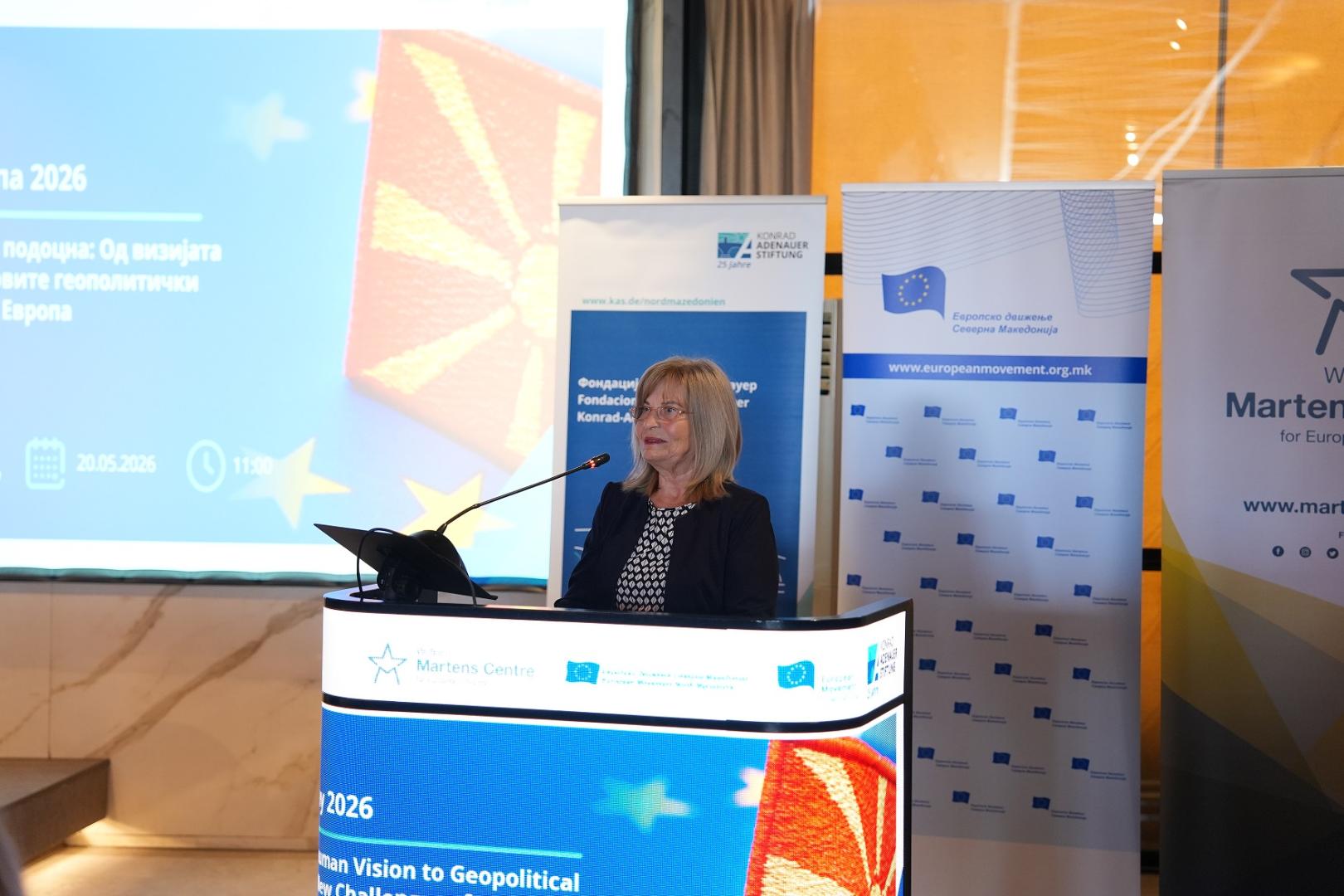
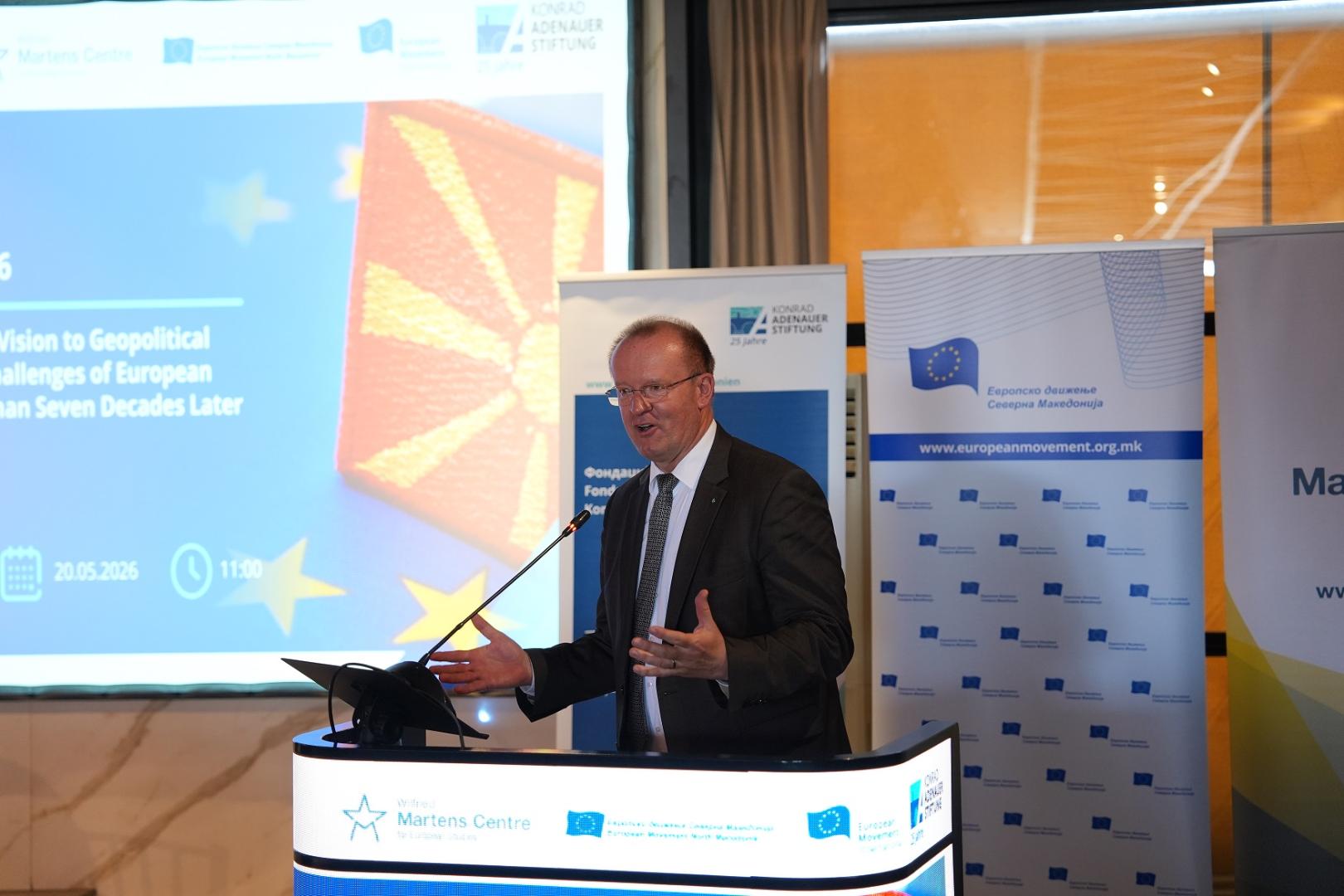
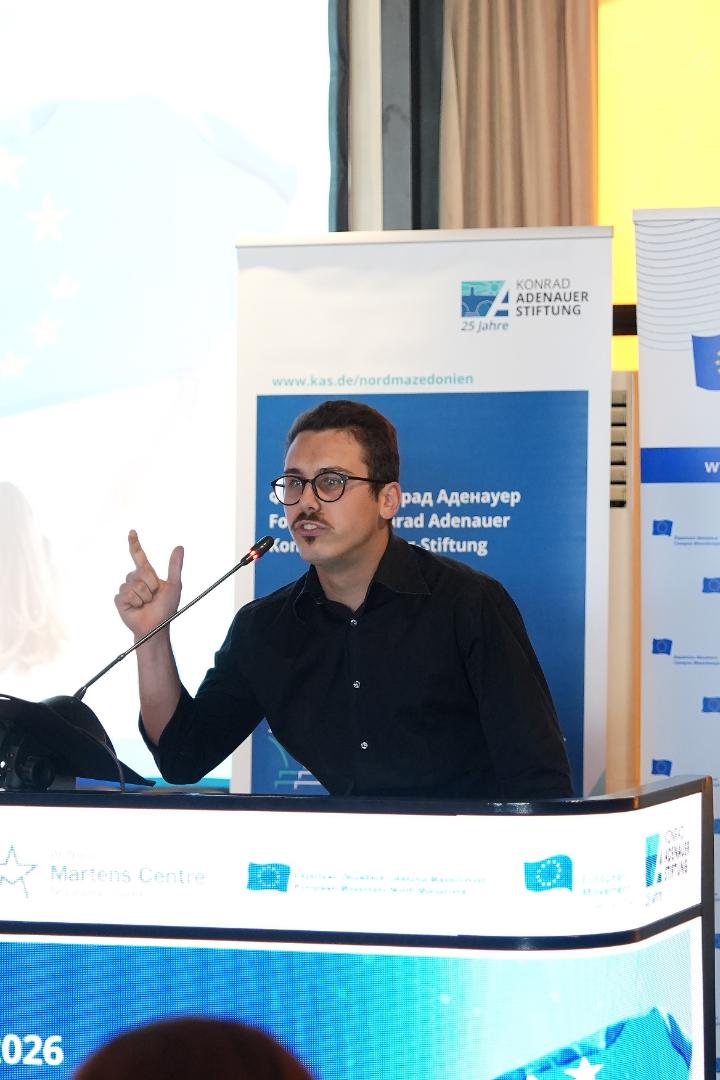
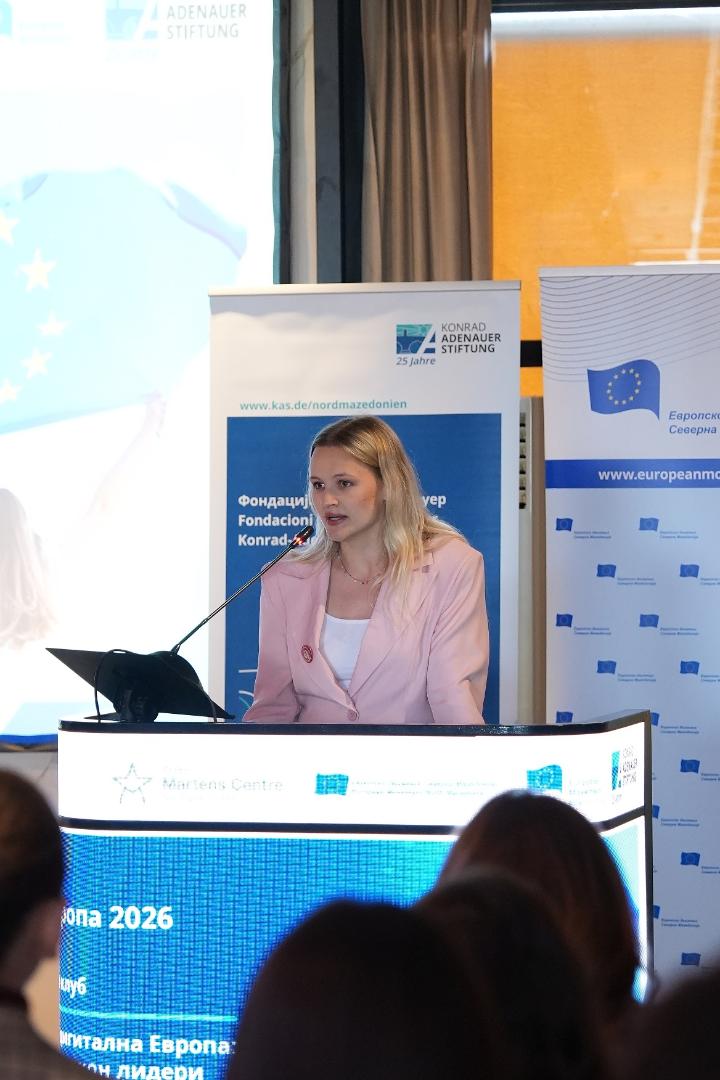
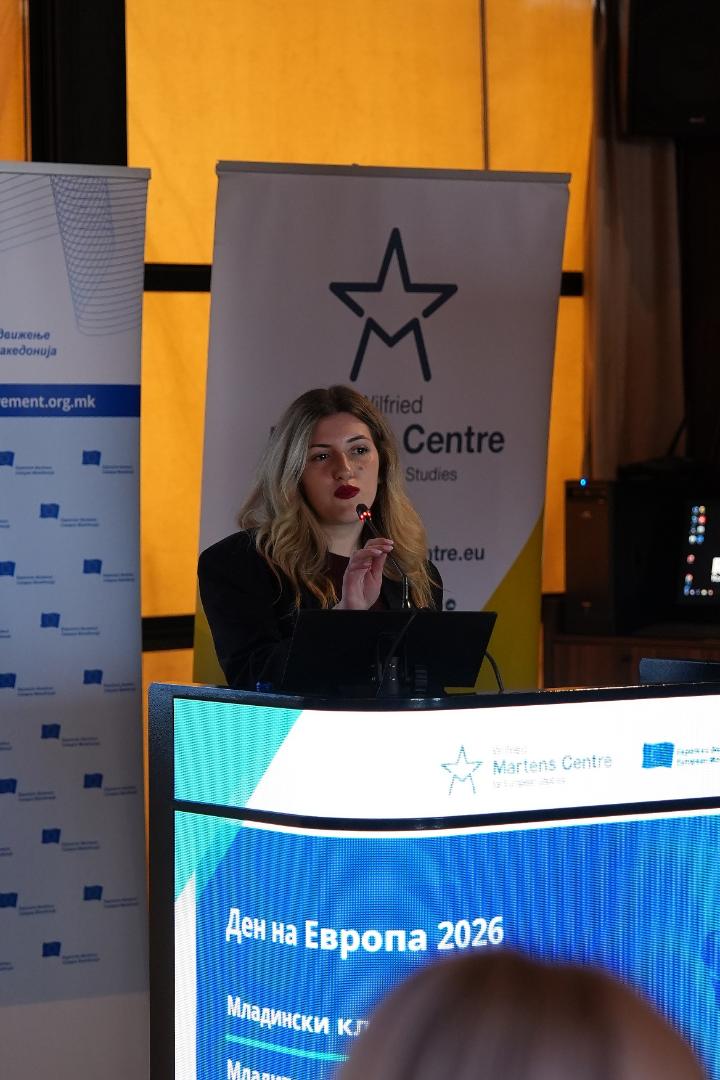
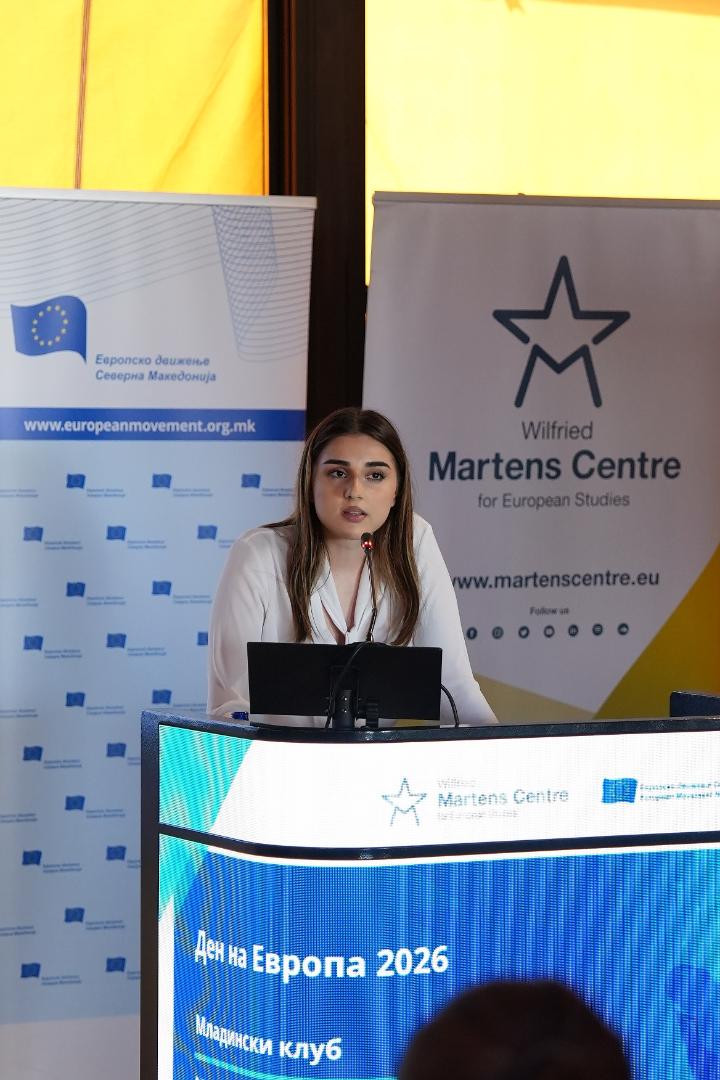
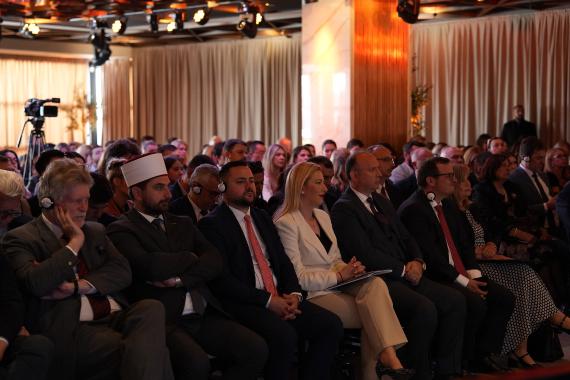
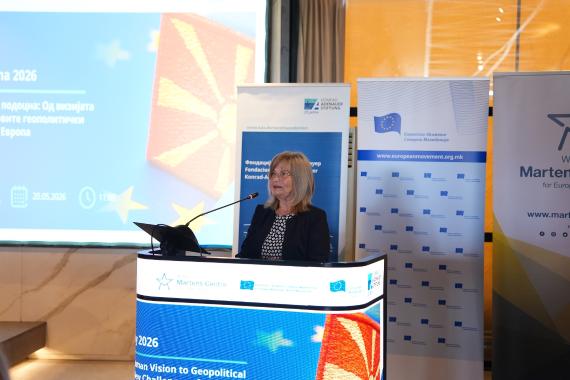
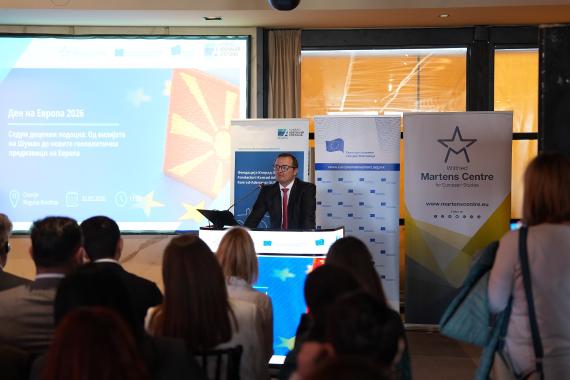
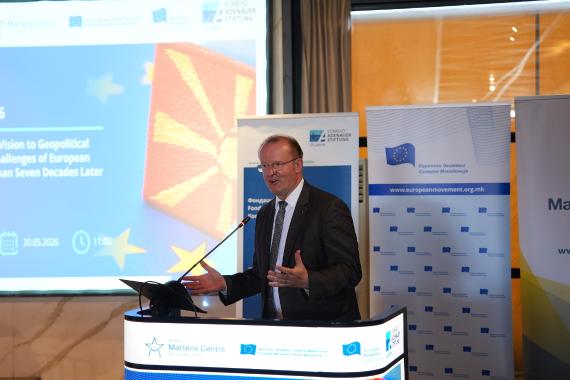
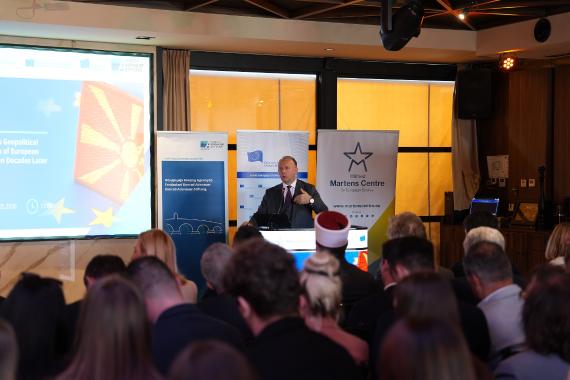
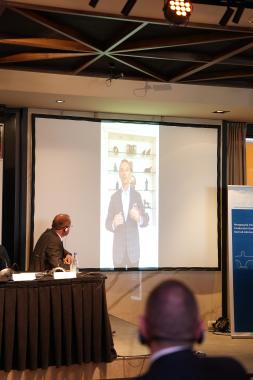
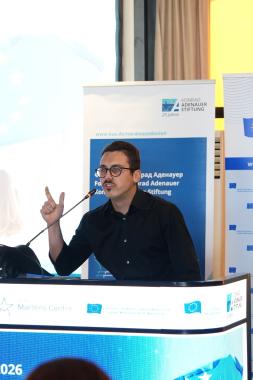
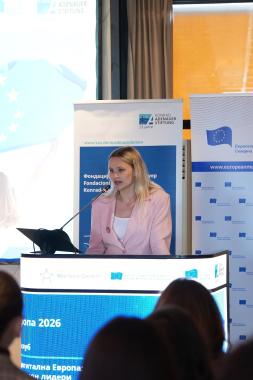
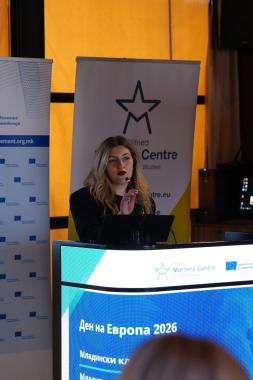
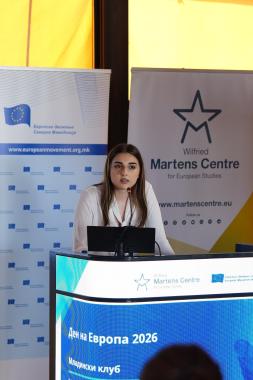
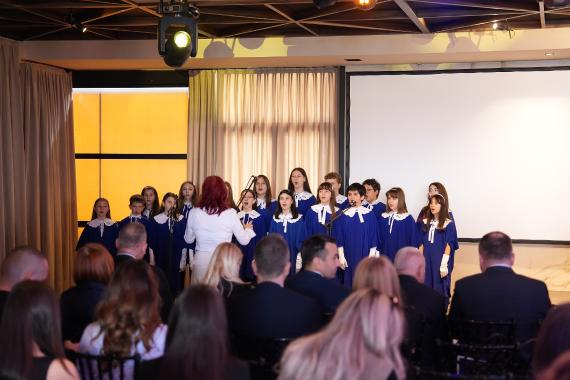
The conference was opened by the President of the European Movement in North Macedonia, Mileva Gjurovska, who emphasised that Europe Day stands as a symbol of peace, solidarity and the unity of European peoples. She noted that today's European context is defined by serious geopolitical and security challenges, calling for renewed political energy and stronger European cooperation. Gjurovska underlined that enlargement policy is once again gaining strategic significance for the European Union and urged Western Balkan countries to actively seize the current momentum to accelerate reforms and advance towards membership.
The official representative of the Konrad Adenauer Foundation, Daniel Braun, emphasized that it is a particular pleasure that this year as well the Konrad Adenauer Foundation has the opportunity to mark Europe Day together with its partners, the European Movement and the Wilfried Martens Centre for European Studies from Brussels. He stressed that North Macedonia and the EU are jointly facing major challenges, which is why cooperation on the European continent is of particular importance. At the same time, he expressed satisfaction that the conference enables an open discussion on current topics with high representatives from the country and Europe.
In his address, Peter Hefele, Policy Director at the Wilfried Martens Centre for European Studies, warned that the so-called “momentum” for enlargement will not last long and that political circumstances in Europe may change rapidly. According to him, the window of opportunity is open, but not unlimited, and the candidate countries should make use of the favourable conditions while they still exist.
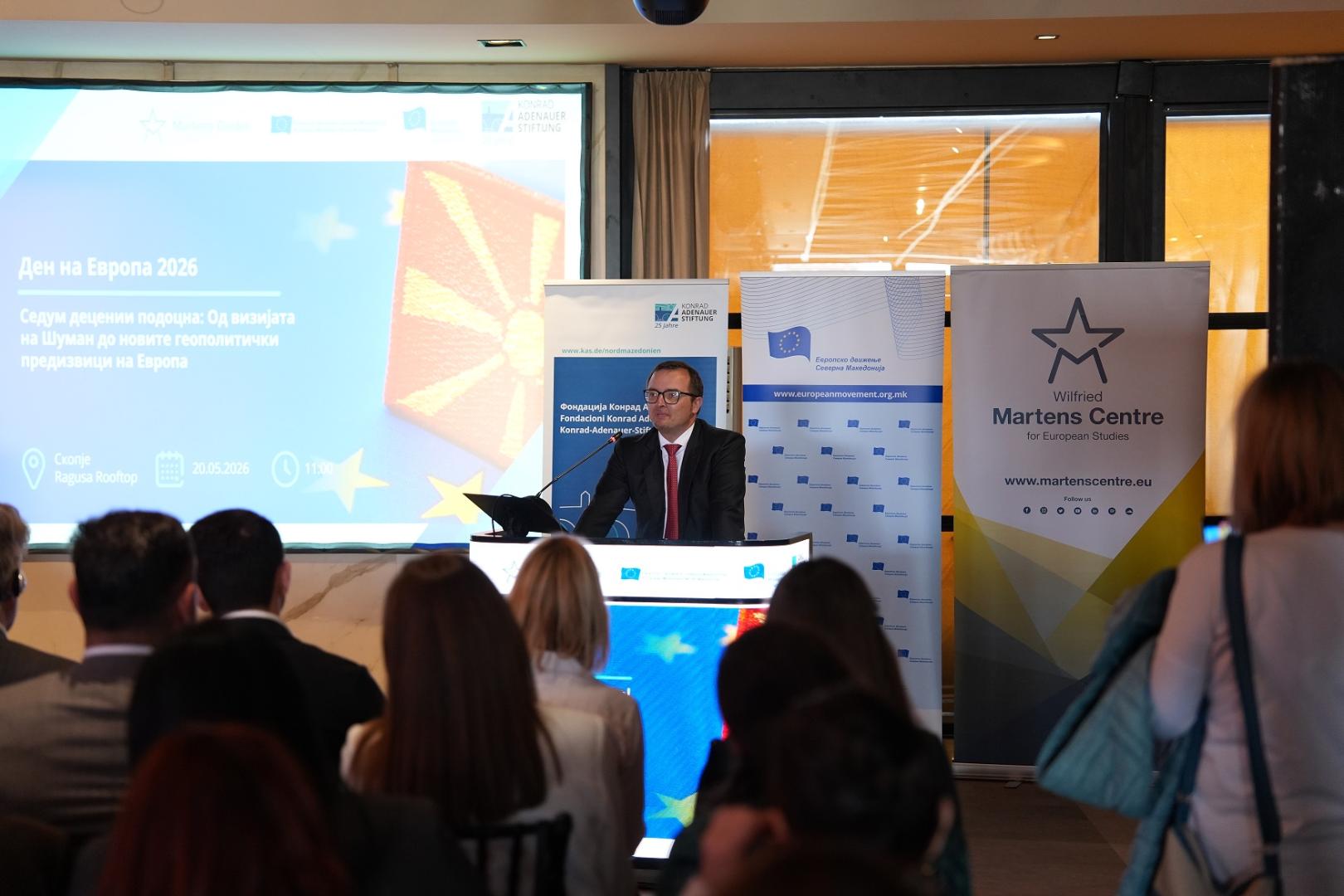
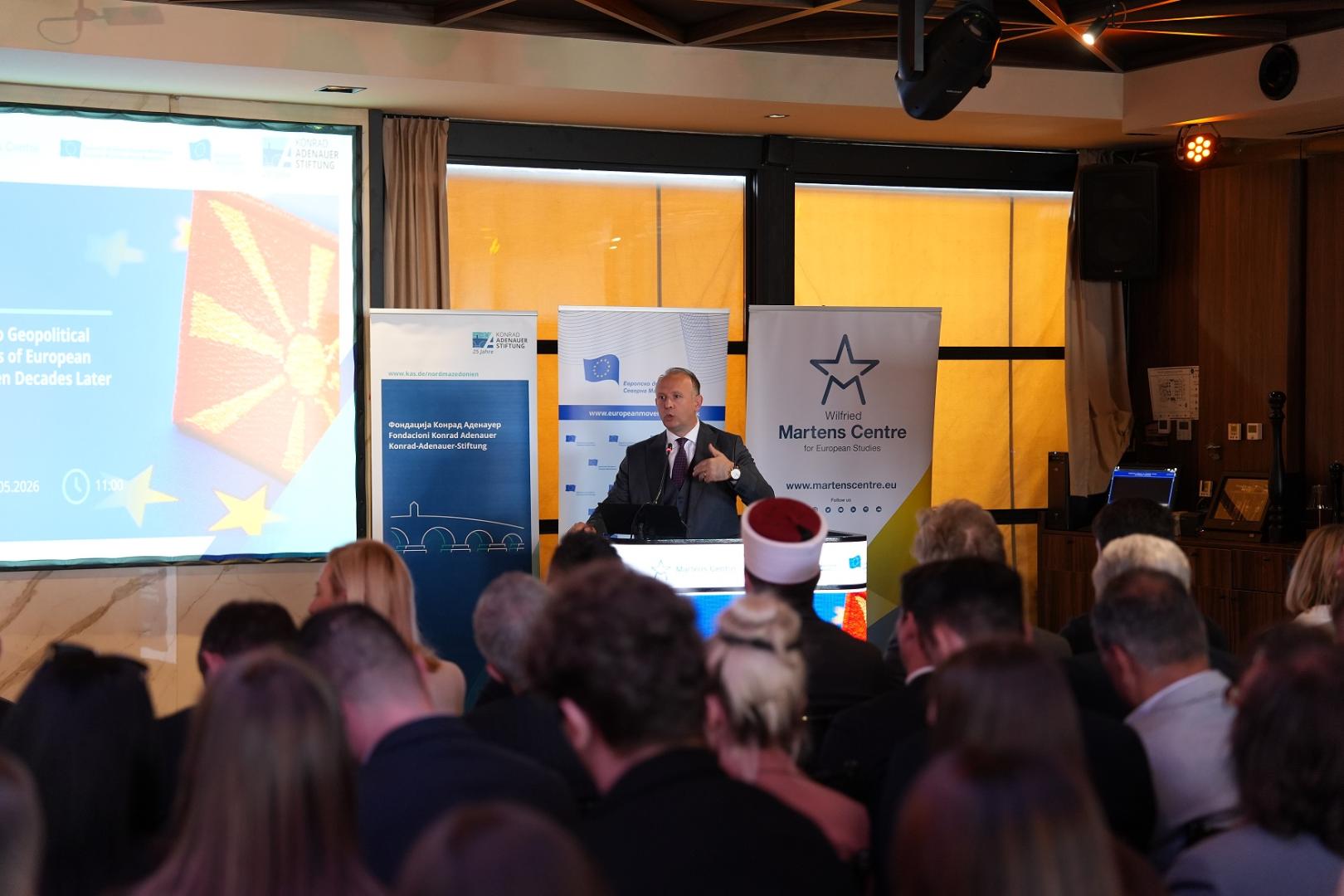
The keynote address at the event was delivered by the President of the Assembly of the Republic of North Macedonia, Afrim Gashi, who reaffirmed that European integration remains the country's strategic commitment and its only viable long-term path for political, economic and institutional development. He stressed that the accession process should not be viewed merely as an administrative or technical exercise, but as a genuine transformation of society, one grounded in European values, institutional accountability, democratic culture and the rule of law.
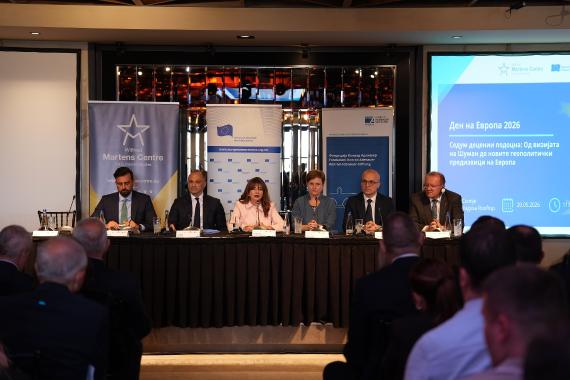
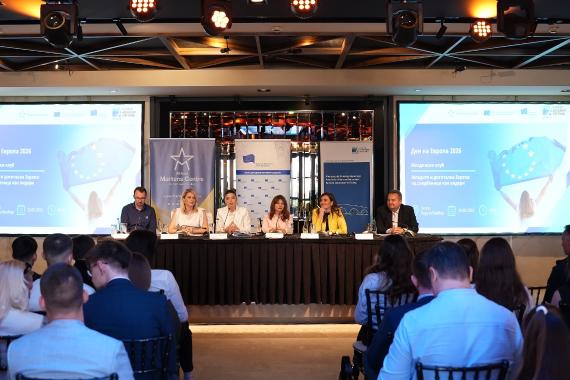
The central part of the event was the panel discussion entitled “From Vision to Geopolitical Response: Reassessing EU Enlargement in a New Geopolitical Era”. The panellists discussed the changing geopolitical circumstances in Europe, the impact of global security crises on the enlargement policy, and the need for the European Union to demonstrate greater political determination towards the candidate countries.
German Ambassador Petra Drexler opened the discussion by stressing that the integration of the Western Balkans represents a strategic interest for the European Union and a key factor for regional stability and security. She underlined that while the EU must remain a credible partner for candidate countries, reform progress and adherence to European standards are an indispensable prerequisite for advancement.
This was further emphasised by Steffen Hudolin from the Delegation of the European Union to North Macedonia, who stressed that the current moment opens new opportunities for enlargement, but that the success of the process depends on concrete results in the areas of rule of law, public administration reform, the fight against corruption and the strengthening of institutions.
Antonijo Miloshoski, Vice President of the Assembly and Chair of the Committee on European Affairs, referred to the different views and approaches towards enlargement within the European Union, emphasising that the candidate countries need a clearer and more predictable European perspective. He stressed that the credibility of the accession process is important both for the European Union itself and for maintaining citizens’ trust in the European integration process.
On the other hand, the President of the National Council for European Integration, Venko Filipche, emphasised that the country must remain committed to the European path and continue with the reform processes regardless of the political and regional challenges. In his remarks, he underlined that enlargement today also represents a geostrategic necessity for the European Union, particularly in the context of intensified global political and security tensions.
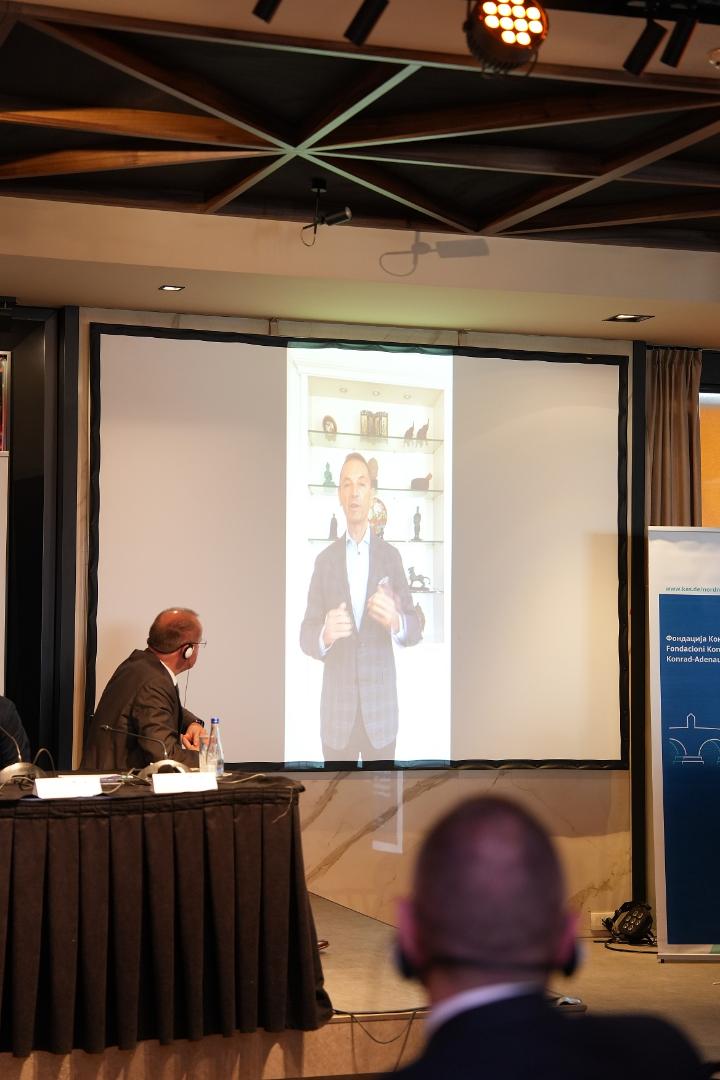
Within the framework of the event, the European Person of the Year 2025 award was presented to Sasko Kedev, interventional cardiologist, university professor and mountaineer. The award was granted in recognition of his exceptional contribution to medicine, education and the international promotion of the country through his professional and sporting achievements. The organisers emphasised that his professionalism, dedication and international reputation represent an example of European values and personal integrity.
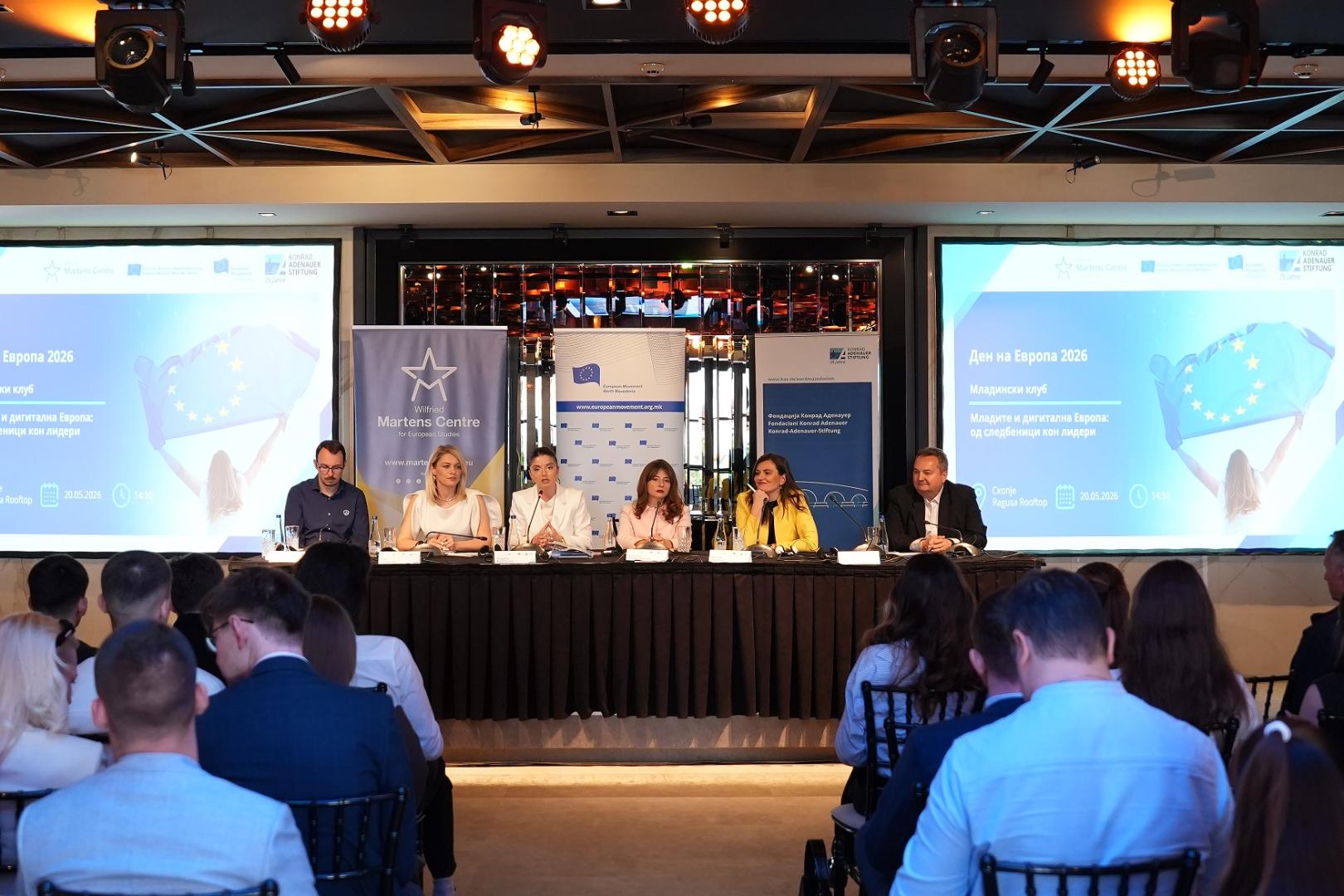
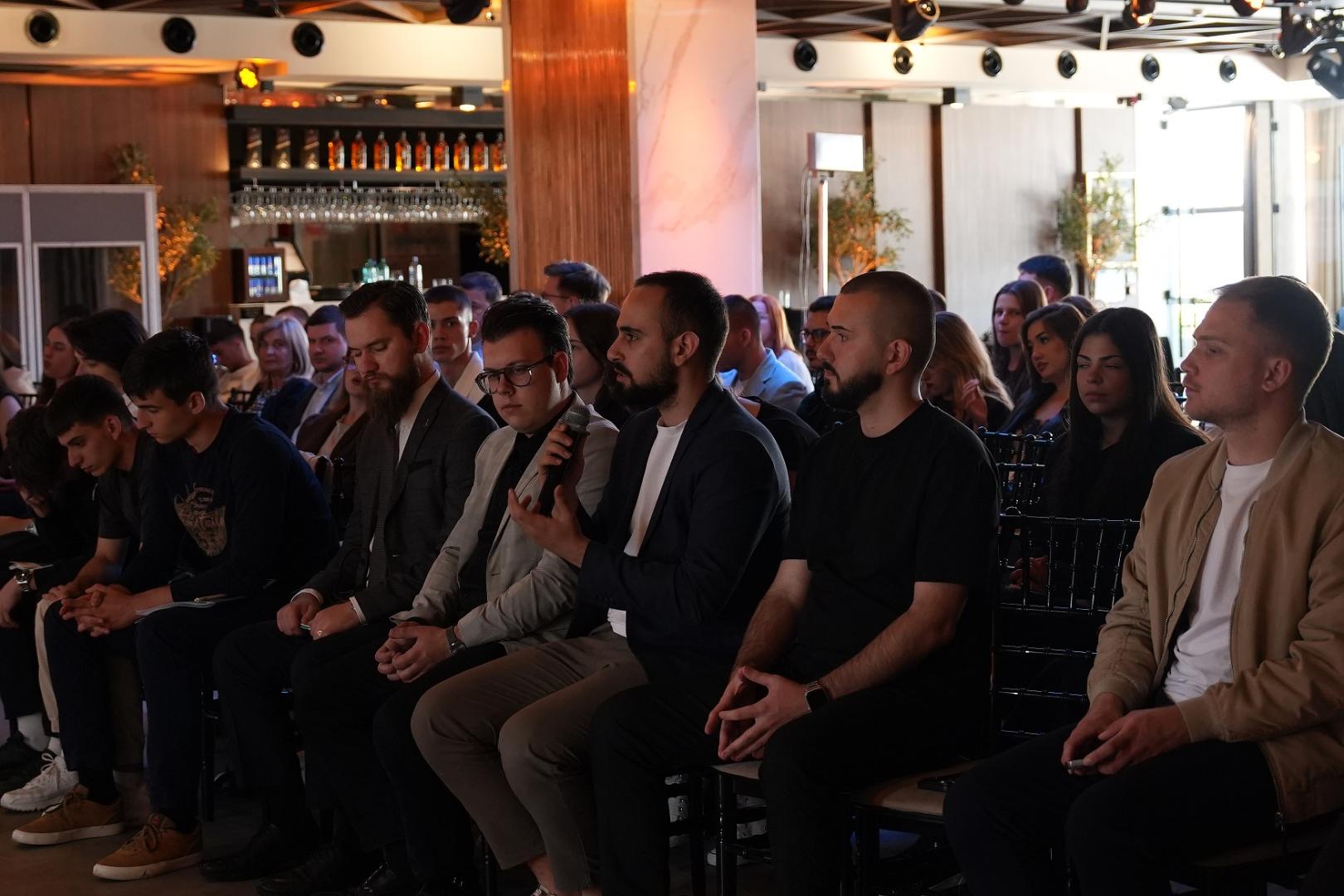
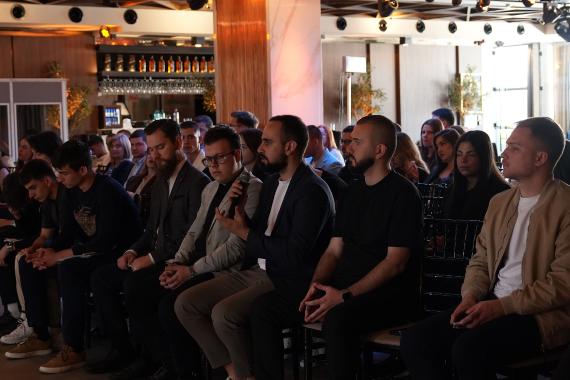
The conference dedicated particular attention to young people and their role in the country's European future. A youth debate was held on the topic "Young People and Digital Europe: From Followers to Leaders", bringing together representatives from state institutions, academia and organisations active in the fields of youth policy and education. Among the speakers in the debate were Dragana Bojkovska, Member of Parliament and Coordinator of the Parliamentary Club for Youth Issues and Policies; Monika Zajkova, Member of Parliament and President of the Liberal Democratic Party (LDP); Ana Mihajlov, Director of the National Agency for European Educational Programmes and Mobility; and Konstantin Minoski, Professor at the Faculty of Philosophy, Institute of Sociology, Ss. Cyril and Methodius University – Skopje. The speakers presented the current developments related to the rapid advancement of artificial intelligence worldwide and engaged in discussion with young people on the opportunities and challenges that society will face in the coming period. The debate focused on the impact of digitalisation, artificial intelligence and new technologies, as well as the need to develop critical thinking, media literacy and digital skills among young people.
The programme also featured a student oratory competition on the topic "Why Are We Leaving?", dedicated to youth migration, the challenges facing young people in the country, and the need to create better opportunities for education, professional development and civic participation.
First place went to Ivan Petreski from the University of St. Kliment Ohridski – Bitola, second place to Iskra Postolova from the University of Goce Delcev – Stip, while third place was shared between Enisa Sinani from the American College – Skopje and Marija Stojanovska from the University of St. Kliment Ohridski – Bitola.
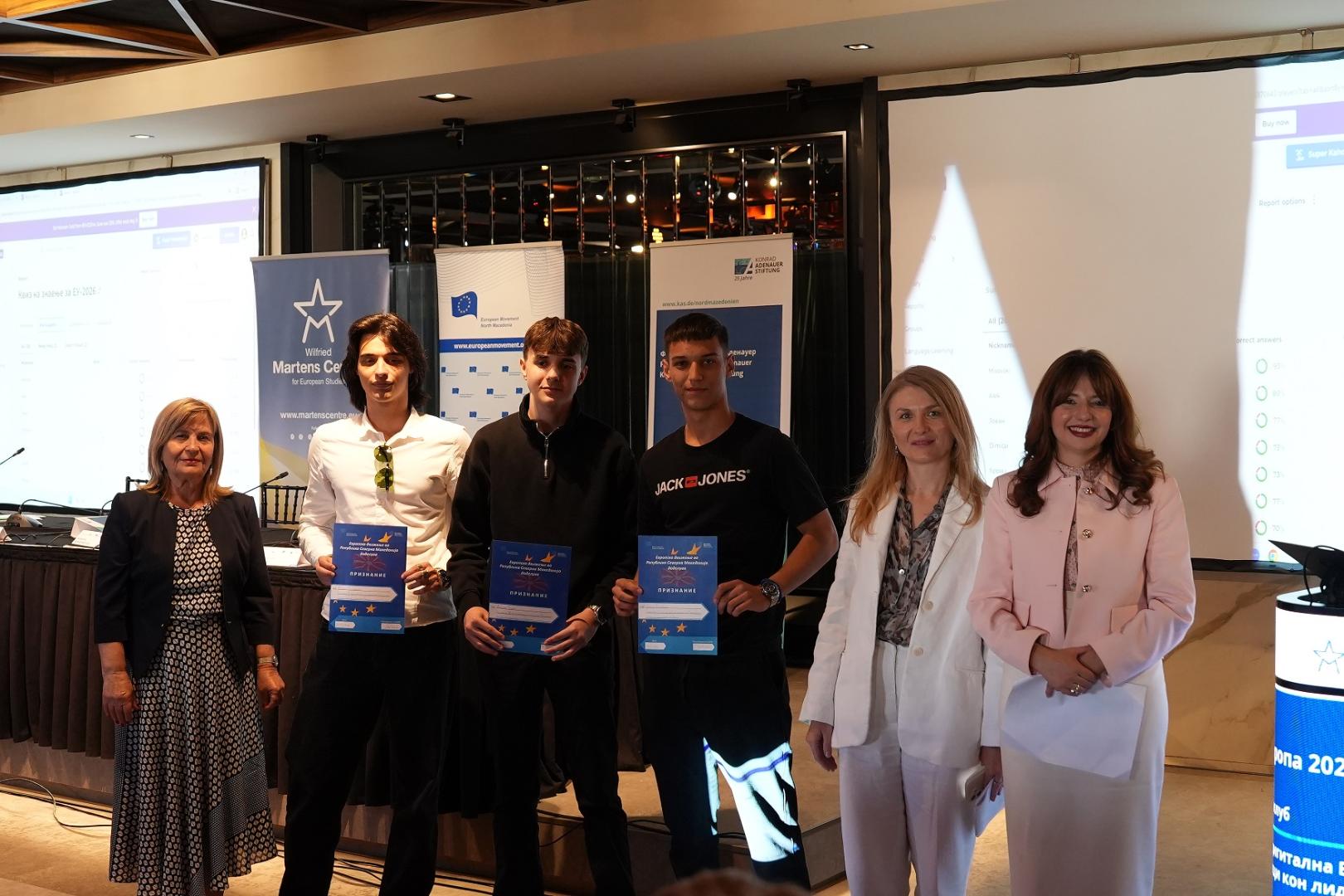
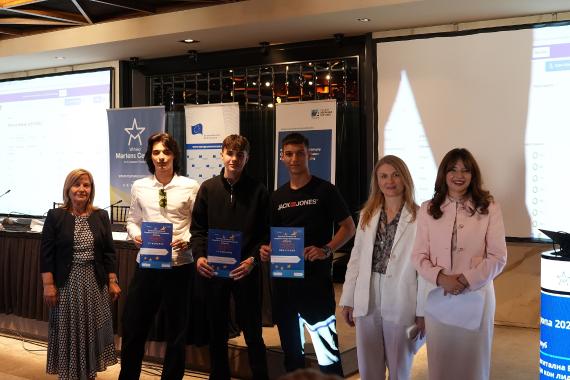
The event also included a EU knowledge quiz for secondary school students, aimed at fostering interest in European institutions, the history of European integration and European values. Over 25 students from Skopje took part, with first place going to David Misovski, second place to last year's winner Aleksej Stojanovic and third place to Dimitar Culev, all three students from the Rade Jovcevski – Korcagin High School.
The conference concluded with an award ceremony for the young participants and a shared affirmation that North Macedonia's European perspective remains a key strategic priority. Reforms, democratic values, regional cooperation and the active engagement of young people were identified as essential pillars on the path to successful integration into the European Union.
Topics
About this series
The Konrad-Adenauer-Stiftung, its educational institutions, centres and foreign offices, offer several thousand events on various subjects each year. We provide up to date and exclusive reports on selected conferences, events and symposia at www.kas.de. In addition to a summary of the contents, you can also find additional material such as pictures, speeches, videos or audio clips.