 RP SAARC
 RP SAARC
 RP SAARC
 RP SAARC
RP SAARC
RP SAARC
RP SAARC
RP SAARC
RP SAARC
RP SAARC
RP SAARC
RP SAARC
PRESSEÜBERBLICK
Der deutsche Außenminister Dr. Guido Westerwelle zu Besuch in Bangladesch
22. Juni 2012
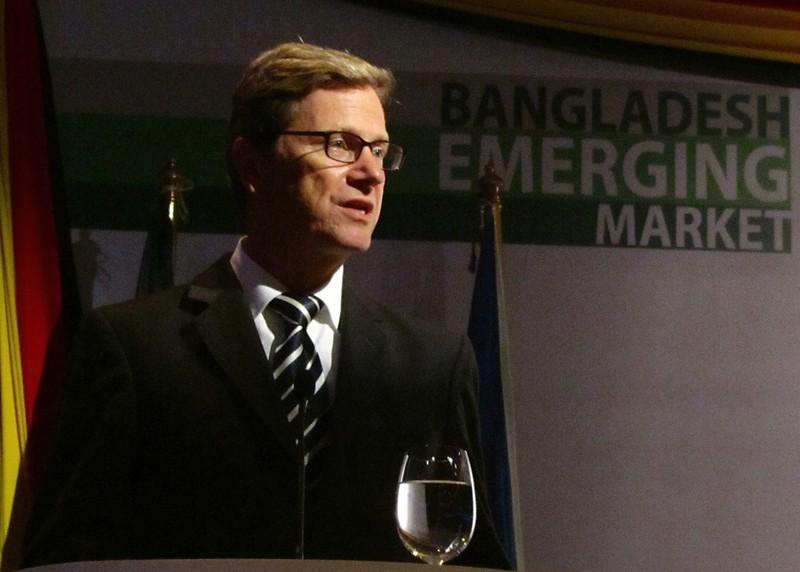
Bangladesh's goal of becoming a middle-income country will only be achieved with the contribution of a healthy and vibrant private sector; it also depends on a favourable business climate based on the rule of law, good infrastructure and reliable energy supply, German Federal Foreign Minister Guido Westerwelle, said in an interview with The Daily Star ahead of his arrival. (In a written interview German Federal Foreign Minister Dr. Guido Westerwelle gives his views to Rezaul Karim, Diplomatic Correspondent of The Daily Star, about bilateral development cooperation, German investment in Bangladesh, shipbuilding industry, development of private sector etc. He also talks about troops withdrawal from Afghanistan, economic recession in Europe and rising economy of China and India.
Please click the following link for the excerpts from the interview http://www.thedailystar.net/newDesign/news-details.php?nid=239331.
During his brief visit, the German foreign minister will hold discussion with high-level government officials and civil society representatives to strengthen bilateral ties. Dhaka considers this trip highly important as Germany is one of the most valued friends and development partners of Bangladesh. Westerwelle is coming to Dhaka at the invitation of Foreign Minister Dipu Moni. As par the programme schedule, the German foreign minister will arrive at Hazrat Shahjalal International Airport from India at 12:30pm on 23 June 2012 and will go straight to the state guesthouse Meghna. He will hold bilateral meeting with Dipu Moni at 1:00pm there. The meeting will be followed by a joint press briefing. Westerwelle will call on Prime Minister Sheikh Hasina and then meet the representatives of civil society. The visit wishes to further strengthen the excellent bilateral relations existing between the two countries commemorating the 40th anniversary of German-Bangladesh diplomatic relations this year, a press release of the German embassy said. Westerwelle will leave Dhaka for Germany on 24 June 2012 morning.
http://www.thedailystar.net/newDesign/news-details.php?nid=239416
23. Juni 2012
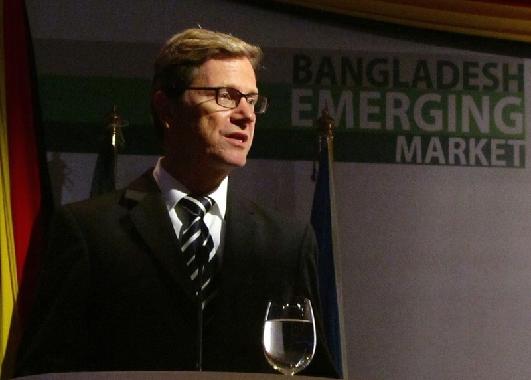
Expressing concern over killings and human rights situation in Bangladesh, visiting German foreign minister urged all political actors to work together to strengthen democracy, ensure human rights and uphold the rule of law in the country. "Like all others, we are concerned about the recent killings of activists political and garments. We hope the incidents would be investigated and the people responsible would be brought to justice," German Federal Foreign Minister Guido Westerwelle told a press conference after meeting Foreign Minister Dipu Moni at the state guest house Meghna. Expressing satisfaction with the role of the civil society in Bangladesh, he said the civil society is crucial to institutionalising democracy in any country. He emphasised the importance of holding free and fair polls, ensuring freedom of expression and free press to strengthen democracy.
The German minister added that his country has been a partner of Bangladesh for 40 years and has so far provided two billion euros in development assistance. Besides, it has granted a soft loan of 60 million euros for power transmission to the country's western zone. Germany is the biggest trade partner of Bangladesh in Europe, and Bangladesh's export to Germany stands at three billion euros a year, he mentioned. Both the foreign ministers expressed their satisfaction at the bilateral relations between the two countries.
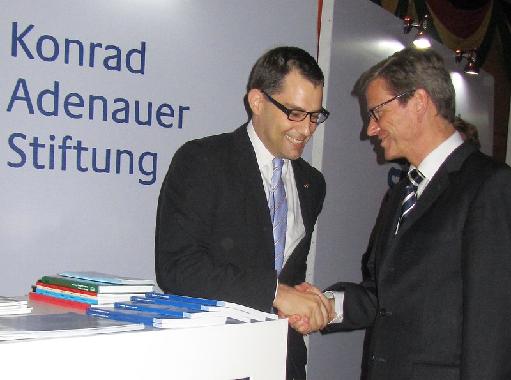
Westerwelle yesterday called on Prime Minister Sheikh Hasina, met representatives of civil society and joined a meeting of Bangladesh-German Chamber of Commerce and Industry. He also had meetings with Iftekharuzzaman, executive director of Transparency International Bangladesh, and NGO Federation Chairman M Ibrahim in the city's Westin hotel. Meeting sources said they discussed the present political situation in Bangladesh, governance and the role of civil society, NGO and media.
http://www.thedailystar.net/newDesign/news-details.php?nid=239519
Bangladesh proposed for a “broader collaborative framework” focused on skill development and knowledge-centric collaboration between Bangladesh and Germany. The initiative would include the current exchange of scholarships and broader academic and professional institutional collaboration towards skills development and access to German academic and professional universities and institutions. Foreign Minister Dipu Moni came up with the proposal while talking with visiting German Federal Foreign Minister Guido Westerwelle at the state guesthouse, Meghna, in the capital. Dipu Moni also highlighted the need for collaboration in “Vocational and Technical Education”, says a foreign ministry press release. Assuring to consider the proposal, Guido Westerwelle said, “Such collaboration can be gainfully tapped by the German industry and service sectors as our industries engage more in the coming years and cooperation deepens.” He also acknowledged the granting of licenses to four German container vessels owned by “M/s Omnikom Maritime” on “ChittagongPangaon” route under conditions specified by the Bangladesh authorities.
The German side also assured to examine Dipu Moni's request for Germany to recognise certificates of Bangladeshi merchant mariners. The two ministers agreed to consider supporting candidatures, among others, at the United Nations Security Council and United Nations Human Rights Council. Dipu Moni highlighted that the “Agreement on Bilateral Development Cooperation”, concluded four decades ago, needed to be revised and finalised at the earliest. This would shape it as a “framework agreement” so that it incorporates the developments over the past four decades and the potentials that have emerged and were emerging in Bangladesh, she said. Foreign Secretary Mijarul Quayes and Director General (Europe & EU) Riaz Hamidullah were present during the discussions.
http://www.thedailystar.net/newDesign/news-details.php?nid=239459
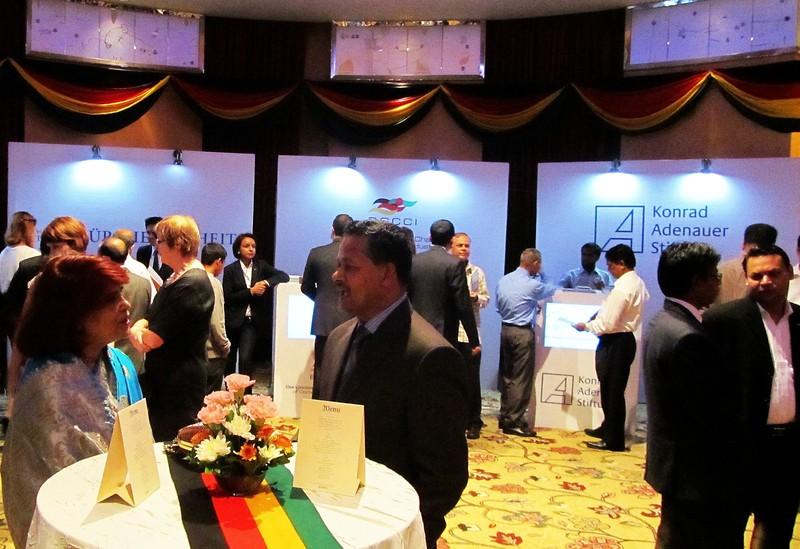
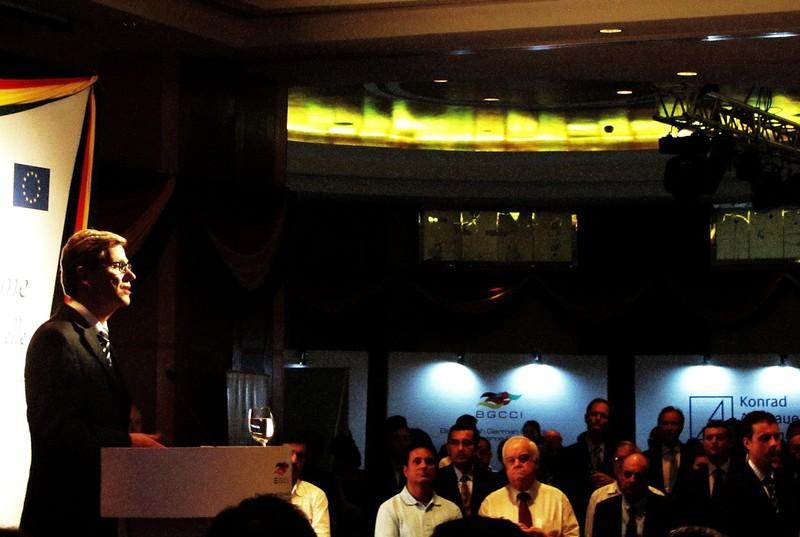
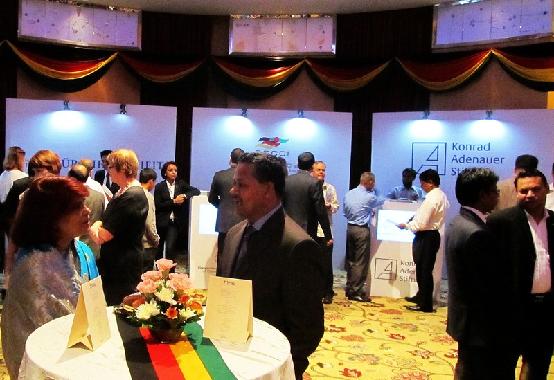
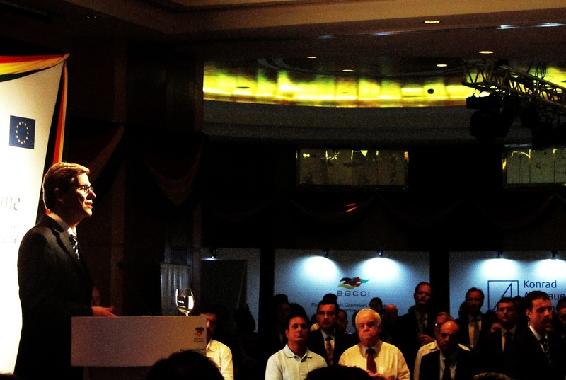
Guido Westerwelle, Germany's foreign minister, has suggested Bangladesh invest more in energy and education for future development of the country. Investing in energy and education must be the primary effort of Bangladesh as the country has the potential of development, Westerwelle said at a reception held in his honour by the Bangladesh-German Chamber of Commerce and Industry (BGCCI) at the Westin Hotel in Dhaka on Saturday. Westerwelle also described how Germany developed despite not having any fossil fuel. "Germany is rich in energy through adopting improved policies," the minister said. “We need intelligent and smart solutions of energy problem for future development of the world,” he said. Westerwelle also urged investment in education for proper utilisation of the vast number of young people in Bangladesh. “The best potential is that you have the young generation. Use the potential of the young people,” Westerwelle said, adding “During my short stay here I found people are out seeking opportunity and chances for changing their lots.” The minister also suggested Bangladesh work jointly with Germany on climate change issues. Climate change might be a global threat to security and peace in future, he feared. “We should have global responses to the climate change scenarios. Germany would like to have partners like Bangladesh to work together for management of climate change,” Westerwelle said.
Calling this visit a mere sojourn in developing bilateral relationship between Bangladesh and Germany, he commented that the potential of such relations is far from exhausted. “The bilateral relationship between Germany and Bangladesh is based on longstanding partnership, not quick profit,” he said. “Our idea is working on developing partnership between equals for better networking,” Westerwelle added. He said that with the rise of the South Asian economies, the global financial structure is also changing, particularly the rise of BRICS countries (Brazil, Russia, India, China and South Africa). He also mentioned the economic potentials of the next 11 emerging countries. The rise of new economic players does not mean that the old will be destroyed, he commented. Bangladesh has the potential to join the new ranks, he added.
At the reception, Promita Sengupta, programme coordinator of Gender, Governance and Rights of Dhaka based office of GIZ (German Development Cooperation) said the companies in Bangladesh are now maintaining social standard. “Companies are reducing pollution. All the associations in the apparel industries are working together to reduce pollution and increasing the social standard,” she said. Shakhawat Abu Khair, president of BGCCI, said the biggest bilateral trade body BGCCI now boasts 350 members. Between 2001 and 2011 exports to Germany grew 25 percent and German imports to Bangladesh grew 42 percent, he said.
http://www.thedailystar.net/newDesign/news-details.php?nid=239671
24. Juni 2012
The foreign ministry summoned the chargé d'affaires of the German embassy in Dhaka and conveyed its dismay, disappointment and concern over some remarks of German Foreign Minister Guido Westerwelle made at a joint press briefing.In a press release yesterday, it said the ministry “wishes to record its surprise at the content of a prepared written text and subsequent remarks by the German Foreign Minister immediately following the official meeting”. The visiting German minister referred to issues that include a free civil society, freedom of expression, human rights situation in Bangladesh, and concern over the recent killing of activists and bringing their perpetrators to justice. None of these issues were even raised at the discussion, it read. Guido Westerwelle, who arrived in the city on Saturday, in reply to a question at the joint press conference with Foreign Minister Dipu Moni, said, “Of course, we have discussed the human rights situation of Bangladesh. Like all we are concerned about the recent killing of activists and we expect proper investigation into the incidents and the perpetrators will be brought to justice.” The foreign ministry said since the German minister had read out from a prepared text, the ministry considered this as a serious failure on the part of the officials who did not reflect an accurate account of the discussions in the statement on human rights and recent killings. The ministry noted that Bangladesh was always ready to engage in discussions on all issues in full transparency and objectivity. Ralf Matthias Reusch, chargé d'affaires of the German embassy in Dhaka, was called immediately after Holger Michael, whose tenure as German ambassador here has ended, left yesterday morning. The German minister also departed early yesterday, ending his 2-day visit to the city.
http://www.thedailystar.net/newDesign/news-details.php?nid=239655
German foreign minister Guido Westerwelle's visit to Dhaka with a high level business delegation has provided fresh impetus to the already friendly and mutually beneficial relationship between our two countries. There is a plenty of substance to the bilateral partnership. Germany, the largest economy of the Euro zone, happens to be our largest trade partner in Europe. Bangladesh's export to Germany has touched three billion euros a year. In the last four decades we have received two billion euros in development assistance from Germany. Only recently we have been provided a soft loan of 60 million euros for power transmission.
Germany is the country which has propelled the growth of our ship building industry. It is an inspiring recognition from a top engineering country that Germany places orders for importing sea-worthy vessels from Bangladesh on a steady scale. According to the German foreign minister our ship building industry enjoys 'high reputation' in his country. Foreign Minister Guido Westerwelle's emphasis on a vibrant private sector, good infrastructure and reliable energy supply finds resonance with the economic experts' views in our country.
Given this backdrop of partnership with Germany, it is only natural that as a well-wisher for Bangladesh the German FM has expressed some concerns about the prevailing situation in the country. These centre around strengthening democracy through a process of reconciliation and understanding between all political actors and upholding human rights in Bangladesh.
Our foreign ministry in a late evening press statement "recorded its surprise" at the remarks by the German Foreign Minister that included comments on "free civil society, freedom of expression and …..latest human rights situation…….." The ministry warned that "Making public statement about issues never raised …… has the potential to affect bilateral trust and long-engaging mutually beneficial relationship." We find our foreign ministry's reaction far too overblown than the situation calls for, and suggesting that it may affect our bilateral "trust" and "beneficial relationship" not only hasty but seriously falling short of experienced handling. If the German minister raised issues that were not discussed, then summoning the CDA and conveying our "dismay" would be, in our view, quite sufficient. Issuing a press statement was not necessary, and hinting at a possible impact on our bilateral relationship was hardly diplomatic, and is not likely to serve the best interest of Bangladesh.
http://www.thedailystar.net/newDesign/news-details.php?nid=239692