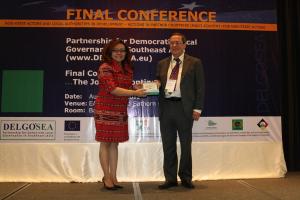





The final conference of the EU-cofinanced "Partnership for Democratic Local Governance in Southeast Asia" (DELGOSEA) project took place in Bangkok, Thailand, from 7 – 8 August 2012 in month 30 of the project.
The final conference itself was attended by more than 150 representatives of both the pilot and the best practice cities, members of local government associations (LGAs), ministries, the EU and ASEAN as well as CSOs, the media and academia from all five project countries. The conference was one important instrument to ensure dissemination of results and the commitment of all actors for future network activities. The conference’s objectives were:
- To illustrate the impact good local government can have on the living conditions of the people by highlighting the outcomes of the 16 pilot projects;
- To share lessons learnt, conclusions and evaluation of best practice replication;
- To strengthen the role of the LGAs and their function in supporting cities/municipalities in reform processes and best practice transfer;
- To evaluate possible options and scenarios for a further integration of local governments into ASEAN decision-making.
Two thematic areas were covered during the conference: one focus was on the pilot cities celebrating their success, looking at lessons learnt from their experiences and exploring how to continue the project activities without the funding through the DELGOSEA project. Institutional sustainability was the other aspect and the conference discussed with the local government associations (LGAs), as well as high-ranking political representatives from all project countries how this could be achieved.
The conference contained the following elements:
- Marketplace session where the pilot cities had prepared displays of their progress;
- Presentations from selected best practice and pilot cities;
- Two round tables:
- The role of the LGAs in supporting best practice exchanges;
- The Importance of local governance for the ASEAN region.
- Presentations of the findings of the DELGOSEA final evaluation;
- Presentations on ‘Mechanisms and Systems of Cooperation between Local Governments and Institutions who Safeguard the Interests of Local Governance on a Transnational Level’.
Several presentations by representatives of best practice and pilot cities, focusing on one successful replication per country, allowed the cities to share their experiences with the conference hall. This included all the four cities that had based their projects on the example of the Philippine city Marikina. Under the name of ‘Eco-savers’, the local government had developed an ingenious concept for dealing with the problem of household waste while at the same time encouraging environmental awareness in the younger generation. Through the cooperation with local schools to help collect recyclable waste, the city promoted a holistic approach to solid waste management that clearly appealed to many of the pilot cities and proved easy to adapt and to implement.
The cities that had chosen the Eco-savers as their model are all at different stages of implementing activities and have all adapted the original project to fit their own needs. All the cities felt that the project had gone very well in the pilot phase and are planning to roll it out to other schools in the respective districts. Numbers vary of course, but the Indonesian city of Tarakan is typical in its plans to extend the scheme to 104 schools, eventually involving nearly 200 000 pupils and teachers. Both Tarakan and Kupang, another Indonesian Eco-savers city, have started working with recycling entrepreneurs, taking the scheme further than its best practice and allowing a long-term approach to recycling. There are also plans to begin collaboration with banks to save the pupils’ money, which can then be taken out later once the students graduate from their school.
The extension of the Eco-saver project into other areas is also a feature in Kampot, Cambodia, where the programme is being integrated into a much wider and ambitious project on urban waste management, taking inspiration also from the waste management project in Muangklang, Thailand. Some of the necessary funding has been secured already, the continuation of activities is therefore ensured. The city’s mayor also presented plans to extend the project by engaging local women’s groups and other NGOs who will be producing goods such as bags, pens and souvenirs from the recyclable material that is being collected. Vinh City in Vietnam tells a similar story, adding proudly that the city is even becoming a best practice in its own rights, there being interest from neighbouring cities to start replicating the Eco-savers project from Vinh.
The presentation from Pakkret in Thailand, for example, showed how successful the rejuvenation of the old market area had progressed. The renovations are completed, trading is firmly established and the quality and variety of goods on offer has improved dramatically, making the market attractive not just for locals but also for tourists. The two municipal clusters of ManLuNa and BinKiSu in Misamis Oriental, Philippines, have based their projects on a similar mixture of conservation and revival of cultural tradition, hoping to attract tourists to Northern Mindanao. The focus here, though, is more on the preservation of the natural as well as the cultural heritage and the encouragement of eco-tourism. The clusters achieved much in terms of establishing a cooperation between neighbouring municipalities, the establishment of the legal framework and the integration of the concept into the local development plan – a crucial step for the continuation of the work since it means that funding has been secured for infrastructure development and capacity building over the coming years.
The common thread to all these success stories and their plans for the future was plain to see: a strong engagement by the city’s leadership, people participation and, perhaps most importantly, the integration of the project into the local development plan to secure future funding.
Roundtable: Role of LGAs and their Capacity to Support their Members in Reform Processes, Innovations and Transfer of Best Practice Examples
The Local Government Associations (LGAs), representing the local governments in the five project countries, have always played an important part in the DELGOSEA project. Over the last few months, however, their role in supporting pilot cities and ensuring the continuation of best practice exchanges has become even more crucial.
The LGAs have been well prepared for this task through their close cooperation with the DELGOSEA project teams in all five countries and they all have developed some ideas on how to ensure sustainability and continue the networking. A special session during DELGOSEA’s final conference was devoted to them sharing their plans and initiatives with the more than 150 participants. All of the LGAs have already begun to disseminate information on existing and potentially new pilot cities through their websites and newsletters and intend to keep this up in the future. Promoting knowledge sharing through training courses, seminars and exchange visits between member cities is also high on the list of LGAs' priorities. Encouragingly, all plan to maintain their support for the best practice model and to encourage more replication attempts.
Beyond these activities common to all, different LGAs are taking individual approaches, suited to their members' needs. ACVN, the Association of Vietnam Cities, for example, aims to create connections between the various international projects that ACVN is partner in and to formulate recommendations to the state authorities and provincial governments on the improvement of the legal framework. ADKASI, one of the four Indonesian LGAs, representing the regency councils in Indonesia is keen to continue the advocacy work for new laws that has started under the DELGOSEA banner and to strengthen the cooperation on the national and regional level between LGAs, national governments, CSO and universities. In Cambodia, the National League of Communes/Sangkats (NLC/S) is concentrating on improved cooperation with CSOs to encourage cooperation between LAs and CSOs, promoting the extension of best practices into other areas.
The Municipal League of Thailand (MLT), Thailand's influential LGA, outlined its concept of learning centers, five of which have already been established, to help cities and municipalities to learn from each other’s experiences. In this context, it was also encouraging to hear that MLT has secured funding from the EU for supporting cooperation between cities that have pledged to lower their environmental pollution, aiming to become low-carbon cities. In the Philippines, institutionalization is seen as the key to sustainability - the League of Cities of the Philippines (LCP) has integrated best practices exchanges into its offer of support to members and is in the process of developing a virtual knowledge platform of examples. The LCP is also keen to extend knowledge exchange on the ASEAN and APEC level.
Results of the Final Evaluation:
The presentation by the outside evaluator showed that the project has been very successful. DELGOSEA is driving local development in the pilot cities and has achieved sustainability through encouraging local ownership and establishing a network of local government actors who will continue the best practice exchanges.
Looking at seven results, it became clear that the project aims have all been achieved:
- BPs of democratic local governance identified, analysed and described: fully achieved in all thematic fields;
- 10 LGAs of the 5 countries motivated and capacitated to assist member municipalities in the adaptation and replication of BPs: fully achieved with 67 experts working as coaches on behalf of the LGAs in all countries and all thematic areas;
- Transfer mechanisms and adapted models, replication has taken place in 16 pilot municipalities in the 5 countries: Fully achieved. Most important: Transfer concept were integrated into local development plans;
- Partnerships on local and national levels between academic institutions, CSO-representatives and LAs on systematic cooperation on democratic local governance in the 5 countries: fully achieved with16 pilot cities and 16 best practice cities (10 best practice cities have been involved during the study visits), 11 LGAs, more than 1,300 representatives from civil society, academia, media, local leaders, civil servants and national governments involved in regular cooperation activities;
- National efforts on political framework improvement for democratic local governance: Achieved. National policy recommendations and advocacy plans with clear entry points. A paper on regional policy recommendations. Discussions at entry points for advocacy lead in all five countries;
- A sustainable regional network of LAs and NSAs: Achieved, there are partnership contracts of KAS with official project partners, MoUs with LGAs and application DELGOSEA II, exit strategy and continuous exploitation of network facilities;
- Promotion on UCLG-ASPAC website of Local Government-Academic Partnerships BP transfer in the region - continuation after the end of the action: DELGOSEA communication platform will continue to exist with the aim of sustaining the network.
In preparation for the roundtable discussion on a better representation of local government in ASEAN, there was a presentation on the role and function of the Committee of the Regions (CoR), the EU's forum for regional and local representatives. The CoR is the political assembly of holders of a regional or local electoral mandate serving the cause of European integration.
Denis Schrey, the Konrad Adenauer Foundation’s country representative in Cambodia, outlined the role of the CoR in the EU’s institutional structures, the reasons for its existence and the way the CoR is able to influence any decision-making processes connected to issues affecting the local level.
This was followed by a presentation on Ideas and suggestions for a better representation of local governments in ASEAN: Developing Regular Communication and Advocacy Mechanism on Democratic Local Governance at the ASEAN by Austere Panadero, Undersecretary, Dept of the Interior and Local Government.
In preparation for the following roundtable discussion, the speaker presented three options:
- Establishment of a specific working group on “Democratic Local Governance in ASEAN” through a decision of the representatives of the ASEAN Governments;
- Establishment of a liaison office on democratic local governance focusing on observation of developments of policies and guidelines in ASEAN as well as major concerns from the network stakeholders in the member states;
- Participation in existing ASEAN working groups related to Democratic Local Governance – a consolidation of Options 1 and 2, where participation of experts on democratic local governance from the DELGOSEA network in existing ASEAN working groups on Democratic Local Governance.
The necessity for stronger support of local government on the regional level was never in question: the looming further economic integration of ASEAN that will be accompanied by a liberation of the ASEAN labour market and free movement of people will present completely new challenges to local governments. According to Assoc. Prof Woothisarn Tanchai, the Deputy Secretary General of the Kind Prjadhipok’s Institute, cooperation between local governments across borders is vital to achieve some standardisation of services across the region; this was a statement that found general agreement in the conference hall.
Different options to ensure representation of local governments in ASEAN were put forward by Undersecretary Mr Austere Panadero of the Local Government Department for Interior and Local Government, Philippines. These were ranging from the rather ambitious plan for the establishment of a specific working group on local governance within ASEAN to the rather more modest proposal to establish a liaison office focusing on the observation of developments of policies and guidelines in ASEAN.
While there was a consensus from the speakers that a working group within ASEAN to fully concentrate on local governance would be a perfect solution in the long run and especially useful for supporting countries who have only recently started on the road of decentralisation – a sentiment well expressed by H.E. Sak Setha, Secretary of State of the Ministry of Interior and Chairperson of the Secretariat of the National Sub-Committee for Sub-Natinal Democratic Development (NCDDS) in Cambodia – some speakers also cast doubt on the short-term achievability of such an aim. Mr Un Sovannasam, Senior Officer of Legal Services and Agreements in the ASEAN Secretariat, explained more about the workings of ASEAN and warned that it would take a long time to establish such a new working group. He also emphasized that local governance is a cross-cutting issue that affects many already existing working groups, for example on urbanisation, environmental and labour issues. His suggestion would be to progress with a establishing a committee outside ASEAN for the joint purpose of following the issue of local governance in existing working groups and lobbying for the eventual establishment of an own working group.
Challenging the view that ASEAN should be at the centre of local governance on the regional level, Mr Basilio Araujo, Head of Division for International Financial Institutions and International Organization Cooperation in Indonesia’s Ministry of Home Affairs, made a passionate plea for south-south cooperation, including cooperation between financial institutions, supporting private-public partnerships and intra-regional cooperation for infrastructure projects. He was full of encouragement for city-to-city cooperation, calling on the conference participants to sign agreements before the end of DELGOSEA project to ensure that cooperation continues.
It became clear, however, that the majority of speakers and participants were keen to find a way forward that kept them in touch with developments in ASEAN and allowed for a structured cooperation. The discussion moved towards option three, i.e. a combination of working outside of as well as with ASEAN, focusing more on existing structures rather than creating alternative ones. Dr Rudolf Hauter, Secretary General of UCLG ASPAC, made a persuasive case for creating a liaison office within the existing office of UCLG ASPAC, since the thematic areas would very well fit with priorities of his organisation and synergies could be created through using existing facilities.
After an intensive discussion, the delegates endorsed this option of creating a liaison office within the existing UCLG ASPAC structure that would follow good governance as a crosscutting issue within ASEAN and would continue to support the efforts of the partner countries to continue cooperation on this issue and extend it to other ASEAN countries. A declaration to that effect was passed with the overwhelming support of the conference participants who were all keen to see DELGOSEA’s work continue.
For more information on the DELGSOEA network and its activities please visit www.DELGOSEA.eu