






Asset Publisher

Monitor

Publications

MAGO / snowfieldphotography

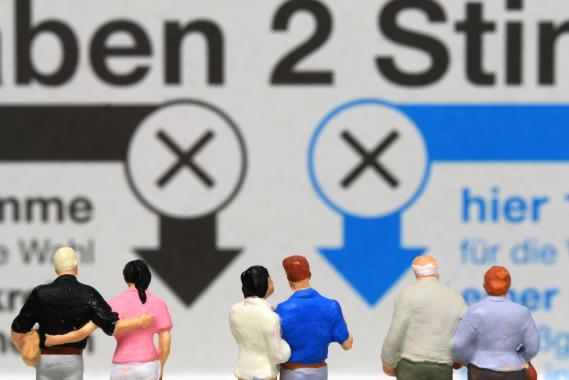
Poster, Online, Doorstep – Who was Reached by in the Bundestag Election Campaign 2025?

Representative survey on party advertisement in the general election campaign 2025: The perception of posters, flyers, social media ads, canvassing and other ways of campaigning

Parties put a lot of effort into presenting their issues and leaders during the election campaign. They use every means at their disposal: posters, flyers and information brochures, advertisements in newspapers and magazines, advertising on social media, street stands, and even personal contact at the doorstep. But what reaches the voters? Which form of election advertising do they remember? The Konrad-Adenauer-Stiftung conducted a representative survey on this question. The result in a nutshell: election advertising makes a difference.

smarterpix / fermate

Concepts of Integration in the Population

A Representative Survey on Perceptions of Coexistence Between Immigrants and Locals

How immigrants integrate in Germany and how they are integrated by locals is the subject of intense debate. Multiculturalism or assimilation, melting pot or salad bowl – the debates are controversial and often emotionally charged. But what are the attitudes of people in Germany? How do people who have immigrated, whose parents have immigrated, or who themselves do not have a migration background think about these issues?

smarterpix / AndreyPopov

Delivering Results: What Makes Governing Effective – and What Doesn’t

Impact over input – delivery units as key to better government outcomes

Governments must deliver – but passing laws and approving budgets aren’t enough. In Germany’s federal system, fragmented responsibilities and complex coordination often slow implementation. This Monitor calls for impact-driven governance: clear goals, indicators, and agile delivery units embedded in the Chancellery and State or Senate Chancelleries. These teams track priorities, remove obstacles, and ensure transparency across ministries – turning promises into measurable results.

KI-generiert mit ChatGPT, Konrad-Adenauer-Stiftung e. V.

Breaking Free from the Polarization Trap!

Clear on substance, fair in tone: Campaign strategies between democratic polarization and populist temptations

The author analyses the growing fragmentation and polarization in Germany’s party system and outlines ways for parties to build a strong profile without undermining the democratic consensus. He distinguishes between productive democratic polarization and destructive affective polarization. Recommended campaign strategies include clear core messages, a respectful engagement with competitors, distancing from extremist parties, and positive, authentic candidate profiling.

smarterpix / Curioso_Travel_Photography

COP30: Alliances, new climate finance and Brazil's balancing act in the fossil phase-out

First climate conference in the Amazon between new beginnings and disillusionment

COP30 brought progress on climate finance, adaptation and gender policy – but failed with regard to a clear phase-out of fossil fuels. Brazil acted as a bridge-builder, not only through the strong participation of indigenous communities, social movements and young actors, but also lost credibility through its own fossil fuel plans. The EU must stabilise its internal climate target architecture and strengthen credible international partnerships even without US support. Although multilateralism remains capable of acting, it does not reach the pace demanded by science.

alphaspirit / smarterpix

Voting motives in the 2025 federal election

Results from representative surveys on reasons for voting and important influencing factors among voters

The results of the federal election merely reflect the actual voting decisions. What remains invisible, however, is the motivation behind voters' decisions to support certain parties. What were the decisive factors?  Was it an easy decision for voters, or were there alternative parties? In which political camps did voters switch allegiances, and what factors played a decisive role in the election campaign? The answers are provided by the evaluation of representative data collected before the federal election campaign and after the federal election.

smarterpix / digitalgenetics

Better performance – Less static: Why Germany’s federal administration needs reform

More pooling of resources – fewer federal agencies – and a “Whole-of-Government” ap-proach

Germany’s federal administration employs over 500,000 people in 946 agencies – yet efficiency declines, costs soar, and trust erodes. Root cause: outdated ministerial structures and duplication of tasks. This paper advocates a paradigm shift: pooling HR, IT, and procurement in specialized agencies, consolidating oversight, and reducing redundant authorities. Guided by the coalition agreement and modernization agenda, the proposal champions a “Whole-of-Government” approach to break silos, accelerate decisions, and enable digital transformation – for more efficiency and effectiveness.

IMAGO / Depositphotos

Global Health as a Strategic Imperative – Health in the context of security and peace

Speeches by Hermann Gröhe and General Major Dr. Jürgen Meyer at the World Health Summit 2025

Global health is now a strategic imperative: pandemics, antimicrobial resistance, biotechnology, and climate change threaten not only public health but also security and stability worldwide. The speeches delivered at the World Health Summit 2025 analyze how health policy, resilience, and international cooperation can strengthen peace and security – and why investments in health are a central task for the future.

smarterpix / wasja

Government support for civil society

Time for a fresh start

Since spring 2025, controversy has continued to rage over the political neutrality of civil society organisations and their funding by the public sector. How did the accusation of party political appropriation arise? And how can the state, politicians and civil society return to working together for the common good?

SmarterPix / shtefanyelizaveta

Voting behaviour of people with a migration background

A representative analysis of the voting behaviour in particular of people of Polish, Russian and Turkish origin as well as ethnic German repatriates

Representative results on the voting behaviour of people with a migrant background show significant changes, particularly in the last five years. In this context, the voting behaviour of specific groups, such as those of Turkish, Russian or Polish origin or late repatriates, is always of interest to politicians. Which parties are favoured by Germans with and without a migrant background, as well as by foreigners? Where are the differences and similarities? What political attitudes can explain these voting intentions?

Asset Publisher

About this series

The Monitor series deals with one main topic at a time from the perspective of KAS experts and places it in the political and social context on the basis of a few key points.

Order details

The contributions appear exclusively online and can therefore not be ordered.


The current main topics are “Development policy”, “Sustainability” and “Election and social research”. The contributions of these sub-series are presented for you on separate overview pages in addition to the overall series.