







 kas
kas
kas
kas
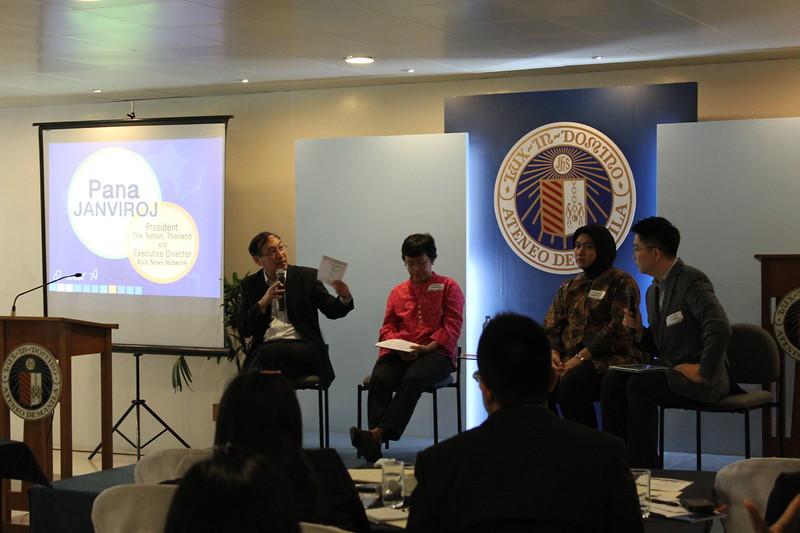
Asia News Network (ANN) is an alliance of 23 Asian newspapers. This year's coordinators' meeting took place in Manila, Philippines and was hosted by the KAS Media Programme Asia in cooperation with the Konrad Adenauer Asian Center for Journalism (ACFJ) and the European Journalism Center (EJC). ANN-Representatives met at Ateneo de Manila University to discuss crowdsourcing in Asian journalism.
Crowdsourcing is a process where media companies solicit content from the audience. Mostly it involves digital tools and invokes social networking platforms to collect that content - a grassroots initiative that could potentially produce better journalism. At the end of August, around eighty journalists from 17 countries came together in Manila to discuss the benefits and shortcomings of crowdsourcing, but also to share their own experiences.
One who knows about the very importance of “the crowd” is Maria Ressa, CEO of rappler.com and former CNN anchor from the Philippines. She pointed out the fact, that crowdsourcing has been in existence for a while, but through social media it became much more far-reaching and efficient – an attribute that she is now harnessing with rappler.com. Driven by the idea that journalism is going through a change, rappler.com embodies the concept of crowdsourcing: It is an online platform that tries to connect journalism, technology and the so-called “wisdom of the crowds”.
Apart from general information on crowdsourcing, journalists from Thailand, China and Indonesia illustrated how crowdsourcing works in practice back in their countries.
Primastuti Handayani, managing editor from The Jakarta Post, on Indonesia, the world's third most active country on Twitter:
“Twitter has much power in Indonesia. It helped getting rid of scandalous politicians, financing victims of medical malpractice or showing commitment to the events in Syria or Egypt.”
As China is blocking Facebook and Twitter, Kurt Lin Hanqing, Associate Producer and Anchor of the Multimedia Department at China Daily, introduced the possibilities his employer, chinadaily.com.ch, offers their users:
“China Daily mainly works with multimedia elements, although we recently got into crowdsourcing as well. Nevertheless, crowdsourcing is still not very popular in China. People do not understand why they should work on something without getting paid.”
Marisa Chimpprabhna, Website editor at The Nation, Thailand:
“Crowdsourcing in politics is very dangerous in Thailand, so we do not prompt protests or demonstrations but instead reactions on social issues and we get answers from both sides. Unfortunately politicians also try to manipulate, especially on Facebook.”
One example that crowdsourcing is more than just copying Tweets, is the Philippine homepage verafiles.org. The news page, represented by co-founder Luz Rimban, is committed to the slogan “truth is our business” and acquires its whole financial backing from its users. Javier Vincente Rufino, Director at Mobile Inquirer Group, Philippines, presented The Inquirer's concept of profiting from its readers via an App for smartphones.
As the example of Vera Files and others demonstrate, crowdsourcing does offer a huge range of possibilities. Above all, it shortens the distance between journalists and the persons concerned and helps to spread information. Nevertheless this also bears risks, as Rina Tsubaki, Project Manager at the European Journalism Centre (EJC), indicated during the conference. Especially when it comes to emergency cases - she provided examples of how users manipulated information just to be part of it. Further, she urged journalists to rely on their basic principles to check and recheck as time-lag, digital divide and information gap, as well as simple technology can alter information fundamentally. The European Journalism Centre has started an initiative for Emergency Journalism that brings together relevant news and resources for media professionals reporting in volatile situations. More information can be found here.
Crowdsourcing as a concept of getting in touch with clients, is also a strategy big brands and companies like Starbucks or WalMart increasingly discover and embrace, as Philip Behnke, PR and Communications Consultant, pointed out. The advantage: by asking their clients and users, the development of new products and their success is safer. But whereas crowdsourcing in journalism is a non-profit business, companies link social media participation with rewards like discounts or small gifts.