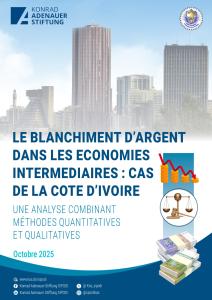





A study by the SIPODI Programme of the Konrad-Adenauer-Stiftung (KAS) in collaboration with the West African Scientific Research Centre (CRSOA)
The Security Policy Dialogue West Africa (SIPODI) Programme of the KAS supported a study entitled “Money Laundering in Intermediate Economies: The Case of Côte d’Ivoire.” The research was carried out in partnership with the Centre de Recherche Scientifique Ouest-Africain (CRSOA), headed by Mr. ODK, and benefited from the input of academics and finance professionals.
Summary
This study assesses the state, mechanisms, and challenges of combating money laundering in Côte d’Ivoire within the framework of an emerging economy.
Key findings:
- Context: Côte d’Ivoire, a country on the path to emergence, faces illicit financial flows notably through real estate, large-scale retail, international transfers, and informal economic activities.
- Mechanisms: money transfers, shell companies, intermediaries, and the integration of illicit funds into legal financial circuits.
- Challenges: limited awareness among stakeholders, insufficient institutional capacity, and gaps in the reporting and monitoring of suspicious transactions.
- Governance implications: money laundering weakens state revenues, undermines transparency, and poses risks to economic and financial stability.
- Recommendations: enhance awareness among professionals (bankers, notaries, real estate agents, etc.), improve reporting tools and coordination between public and private actors.
The study concludes that without stronger and coordinated commitment, Côte d’Ivoire’s progress toward economic emergence could be undermined by the persistent threat of money laundering.