






📍 The 10 principles that lay the foundation for the framework of the Social Market Economy and lead Germany to the so-called “Wirtschaftswunder” (Economic Miracle)
World War II left the world facing severe economic damage, especially Germany as a defeated nation. At that time, policymakers tried to avoid the two economic systems:
🔹 A centrally planned socialist economy, where the state controls all production and prices in the market. This system often undermines innovation, creativity, and individual freedom.
🔹 A free-market capitalist system where the state does not intervene in the market, emphasising social stability and competition. However, the lack of strict market regulation often leads to monopolies by powerful capitalists.
Therefore, scholars like Walter Eucken and political figures like Ludwig Erhard under Konrad Adenauer, Chancellor, advocated for what they saw as a "third way": the Social Market Economy.
This model is rooted in Ordoliberalism, a philosophy that argues that a free market cannot exist on its own but requires a strong legal and institutional framework for its operation and regulation. In this economic system, the state does not act as a market player, but a referee. The role of the state is to set and enforce the rules to ensure that competition remains fair and that no single entity or private entity has enough power to distort the market.
The term "Social Market Economy" was coined by the German economist and politician Alfred Müller-Armack.
In the context of the Social Market Economy, the word "social" does not refer to a state-managed or socialist economy, but rather to a system where the state uses the wealth and efficiency generated by the market to fund social security, education, and equity.
Looking back, the beginnings of Germany’s so-called Wirtschaftswunder (Economic Miracle) were not the result of luck, but of political courage. In 1948, Ludwig Erhard implemented a monetary reform and abolished nearly all price controls on consumer goods overnight, despite strong opposition and widespread fears that prices would rise sharply and burden the population. He acted out of a firm belief in the power of markets and competition. At the same time, he also famously stated that prosperity must not be the privilege of a few, but “prosperity for all” (Wohlstand für Alle).
With this idea in mind, he implemented a system that allowed market mechanisms to function freely under a regulatory framework set by the state, ultimately transforming society into an era of rapid and unexpectedly strong growth in production and consumption.

1️⃣ Private ownership of means of production: This principle ensures that the means of production remain in private hands to foster innovation and personal initiative. However, this must be accompanied by liability: private decision-makers must bear the social responsibility and the economic consequences, whether profit or loss.

2️⃣ Rule-based competition: Competition is the foundational mechanism of a free society. The state’s primary role is to prevent the formation of cartels and monopolies. Having more entrepreneurs in the market promotes fair competition, allows prices to be determined by market mechanisms, and decentralizes market power.

3️⃣ A competitive market can be inefficient, long-term investments risky, and the social fabric vulnerable to inflation if financial stability and price levels cannot be guaranteed and maintained to a certain extent. Therefore, an independent, stable monetary system focused on price stability is crucial in a functioning market.

4️⃣ High employment level is viewed as a prerequisite for social participation and human dignity. Preparing the workforce to be resilient for the labour market by developing skills through high-quality education, vocational training, and lifelong learning programs, coupled with proactive policies known as "Matching Process," will help bridge the gap between supply and demand, ensuring the labour always has the necessary skills and opportunities for new industries.
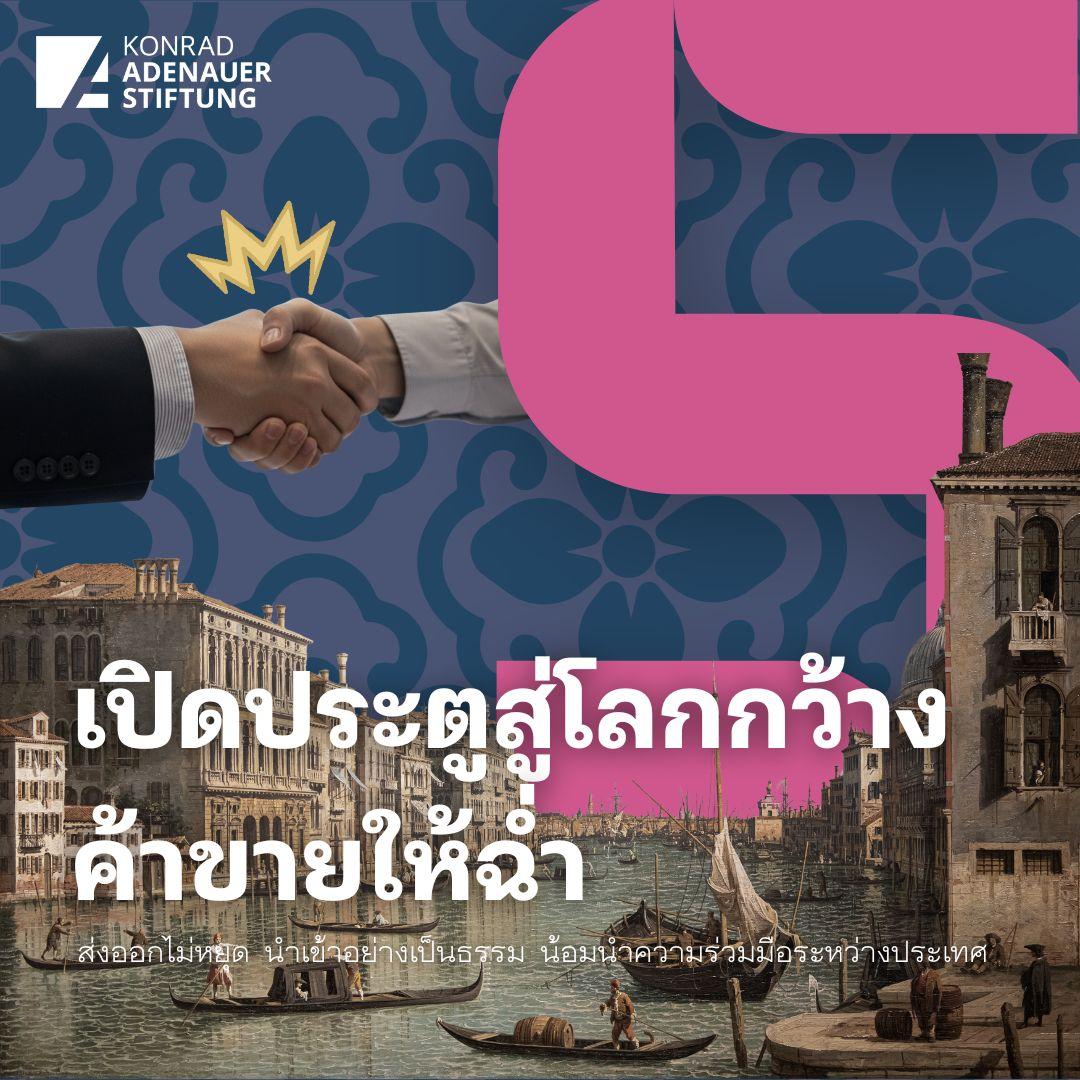
5️⃣ The foreign trade balance refers to maintaining an appropriate equilibrium between imports and exports. In the case of Germany, its export-oriented policy, championed by technology to offset its reliance on imported natural resources, illustrates how this principle can be put into practice. Other countries should leverage their comparative advantages and tailor their international trade policies to domestic conditions in order to promote free trade and international cooperation. Such an approach can foster a sustainable international division of labour that responds the specific needs of each country.

6️⃣ The Social Market Economy focuses on promoting qualitative economic growth, rather than merely increasing the quantity. At its core is the maintenance of stability to avoid extreme economic fluctuations that often lead to economic crises and unemployment, while also providing a solid fiscal foundation for allocating resources to the development of essential public services.

7️⃣ From the perspective of the Social Market Economy, fair income distribution can be achieved through two stages: primary income distribution, which refers to the rewards individuals receive directly through market mechanisms to create incentives, and secondary income distribution through a progressive tax system and social welfare to reduce inequality and support vulnerable groups. The aim of this principle is to ensure that everyone should have equal and dignified access to a competitive market, alongside economic prosperity.

8️⃣ The principle of fair wealth distribution aims to ensure that everyone has ownership of assets of their own by promoting the participation of all citizens, especially non-entrepreneurial households, in the national capital stock. This can take the form of residential real estate or investment in income-generating assets. The objective is to foster financial independence among citizens and to reduce reliance solely on state welfare in cases of loss of working capacity or retirement.

9️⃣ A key social mission is to protect nature and the environment, which is fundamental to maintaining a quality of life for present and future generations. Based on the Polluter Pays Principle, the state focuses on using market mechanisms to reflect true costs, ensuring that the hidden costs of environmental damage are borne directly by those who cause it. This approach encourages green innovation and the efficient use of resources, demonstrating that freedom of business and ecological responsibility can go hand-in-hand sustainably.

🔟 The final principle is regional integration. In the case of Germany, this principle laid the foundation for the Social Market Economy to serve as a key blueprint for the European Integration, emphasising the creation of prosperity through peaceful interdependence and freedom of cross-border competition. This principle also highlights “Subsidiarity,” allowing local authorities to address challenges independently before central state or supranational intervention, thereby building a strong international community based on mutual respect.
Siegfried Franke, David Gregosz, Soziale Marktwirtschaft – Was heißt das konkret?, Konrad-Adenauer-Stiftung e.V., 2013

Topics
The Encyclical Magnifica Humanitas and the Renewal of the Social Market Economy in the Digital Age
World trade continues even without WTO reform
The 14th National Congress of the Communist Party of Vietnam
Pragmatically reducing bureaucracy – lowering construction costs
"Wir brauchen für den Wohnungsmarkt einen Befreiungsschlag"