 Konrad-Adenauer-Stiftung
The rule of law is one of the core principles to which the Konrad-Adenauer-Stiftung is committed. Since 1990, the Foundation has therefore supplemented its international projects for the promotion of democracy and political dialogue with the transnational worldwide Rule of Law Programme.
Goals of the Rule of Law Programme
We are convinced that sustainable development and security are inconceivable without stable democracies - and that stable democracies are not possible without the rule of law. With its worldwide work on the rule of law, the Konrad-Adenauer-Stiftung therefore promotes
- structures based on the rule of law and main institutional elements of the rule of law (e.g. a functioning constitutional jurisdiction)
- separation of powers, in particular a strong, recognised and independent judiciary and a law-abiding administration
- the guarantee of fundamental and human rights
The offices of our Rule of Law Programme at a glance
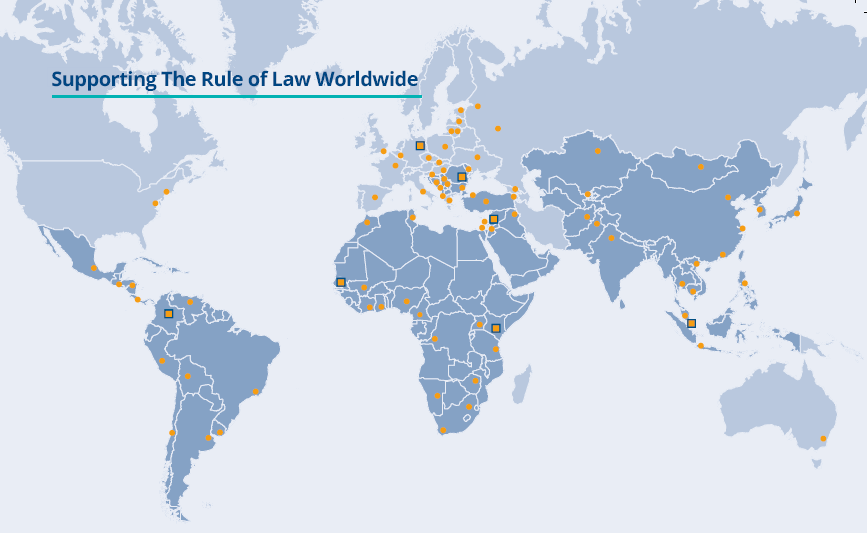
Through offices in Bogotá, Nairobi, Singapore, Bucharest and Beirut as well as the coordination in Berlin, the global Rule of Law Programme supports and promotes rule of law structures and processes in the respective regions.
 Konrad-Adenauer-Stiftung
Rule of Law Programme Asia

In 2005, the office of our Rule of Law Programme in Asia was opened to support the development of rule of law structures in Asian countries. Asia as a complex region between tradition and modernity, between regional contradictions and commonalities, places very special demands on the work of the Rule of Law Programme. Since its establishment, our Singapore-based office has been calling for and promoting the rule of law and democracy in many countries from South to Southeast to East Asia, with a focus on the ASEAN region.
Rule of Law Programme Latin America

As early as the 1980s, an intensive discussion on the rule of law and judicial reforms began in virtually all Latin American countries in the course of democratisation and the overcoming of authoritarian systems, which triggered numerous constitutional reforms. This is also where the rule of law work of the Konrad-Adenauer-Stiftung has its roots. For more than 30 years, we have been represented in Latin America with our own office of our Rule of Law Programme, since 2012 at the Bogotá location in Colombia.
Rule of Law Programme Middle East and North Africa

The Rule of Law Programme Middle East and North Africa is based in Beirut. With the establishment of this still very young programme, the Konrad-Adenauer-Stiftung is responding to the great and growing need for cooperation in rule of law work in the region. At the core of the work on the ground is the consolidation of rule of law structures, the promotion of a system of effective separation of powers and checks and balances, and the protection of fundamental rights and freedoms.
Learn more about the Rule of Law Programme Middle East and North Africa
Rule of Law Programme Sub-Saharan Africa

The rule of law in the Western sense is not anchored in sub-Saharan Africa and has therefore not yet become an integral part of the political culture. However, the Rule of Law Programme Sub-Saharan Africa (with headquarters in Nairobi, Kenya and a liaison office in Dakar, Senegal) tries to support and promote political, adiministrative, civil society and judicial actors who are concerned about the rule of law.
Learn more about the Rule of Law Programme Sub-Saharan Africa
Rule of Law Programme South Eastern Europe

The Konrad-Adenauer-Stiftung has been present in Southeast Europe since 2006 with the Rule of Law Programme. In addition to the three newest member states of the European Union, Bulgaria, Romania and Croatia, the Foundation carries out measures in the six states of the Western Balkans as well as in the Republic of Moldova. What all states have in common is that, three decades after the change of system, they are still in an ongoing process of transformation from an autocratic one-party state to a democratic constitutional state based on the rule of law, which continues to have a significant influence on the role and self-image of the judiciary.
Learn more about the Rule of Law Programme South Eastern Europe
The Rule of Law Programme shows impact
The clearly defined and concentrated thematic and target profile of the Rule of Law Programme, which also results from the character of the KAS as a political foundation, is the basis for its impact-oriented work. The long-term promotion of rule-of-law structures and the regional character of the work often prove to be well suited to openly addressing rule-of-law problems, especially in sensitive issues. Working in and with regional networks creates synergies and greater awareness. German legal culture is held in high regard in most regions, which leads to a great demand for German expertise in particular. The Rule of Law Programme also functions as an advisory body and competence centre.
It flanks and supports rule of law-relevant and political development processes and creates platforms that enable an exchange between rule of law actors, politics and society. Its success can be traced back to direct contacts with rule of law actors in all regions, which are often based on trust and have been built up over years, and is based on an approach that is not purely technical but explicitly political, dialogue-oriented and based on credibility.
Instruments of the Rule of Law Programme
The Rule of Law Programme supports educational measures and dialogue programmes whose focus is tailored to the needs on the ground, e.g. in the form of international and national conferences, seminars, workshops, discussion groups as well as teaching and study courses. Studies, analyses and other print and multimedia products are also published. In addition to awarding study scholarships to talented young professionals, visitor programmes to which the KAS invites to Germany and Europe also represent an important instrument.





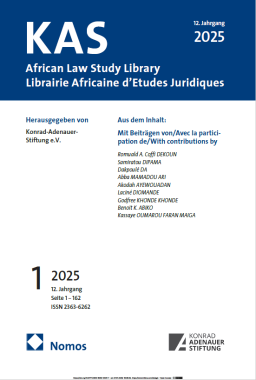
Publications on this topic
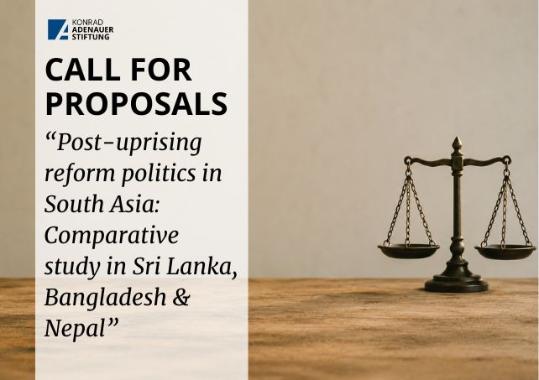
Post-uprising reform politics in South Asia: Comparative study in Sri Lanka, Bangladesh and Nepal
Call for Proposals
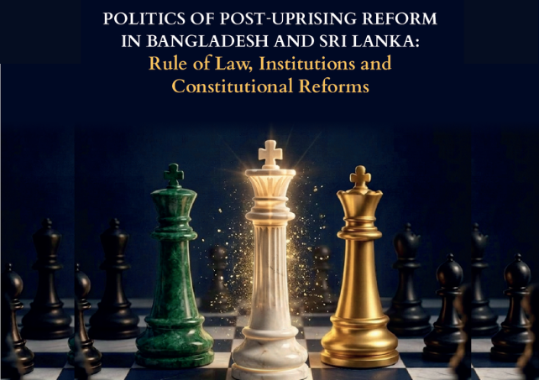
Politics of Post - Uprising in Bangladesh & Sri Lanka: Rule of Law, Institutions and Constitutional R...
ISAS-KAS Workshop Report



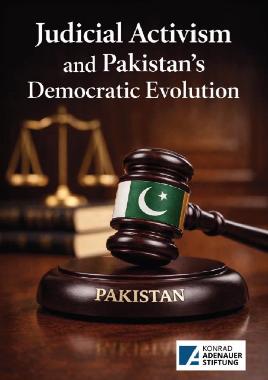
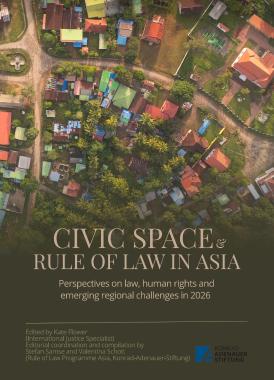
Civic Space and Rule of Law in Asia
Perspectives on law, human rights, and emerging regional challenges in 2026



 KI M365 CoPilot