At a glance
- More than just an anniversary: we are not only celebrating the historic figure of Adenauer, but also drawing on his legacy and the motto ‘We choose freedom!’ to provide impetus for the future.
- Our conviction: Adenauer's decisions in favour of democracy and the rule of law, his realistic view of the future and his belief in human freedom are more relevant today than ever before.
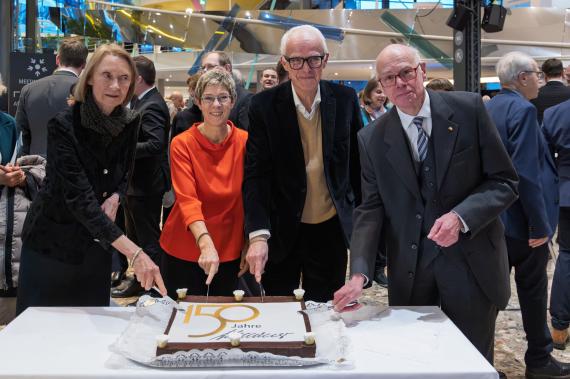
- Diverse programme: At authentic locations in Germany and abroad, we are offering 150 events and activities during the anniversary year that showcase Konrad Adenauer in all his facets.
- Our messages emphasise democracy as a guarantor of stable institutions and the rule of law, the shaping of Europe as a driving force for understanding, peace and freedom, and the social market economy as the basis for prosperity in responsibility.
- Our goal: We want to bring Adenauer closer to you and bring history to life. Let us celebrate democracy and freedom together and delve deeply into the fascination of the first German Chancellor through dialogue.
Content
1. Our clear commitment: ‘We choose freedom!’
2. 150 events and three key messages
3. Looking to the future with living history
4. The Adenauer era: Konrad Adenauer's relevance today
4.4 Prosperity through the social market economy
5. The five most important stages in Adenauer's life
6. Publications, events and media coverage on the topic
150 years of Adenauer – a name that stands for freedom, democracy and European unity. His ideas are more relevant today than ever before. Years ago, the ZDF television series ‘Unsere Besten’ (‘Our Best’) confirmed that Konrad Adenauer is considered by many to be the most important German of all time – even ahead of legends such as the poet Goethe and the reformer Martin Luther.
This survey may not have been representative, but reputable surveys also show that the importance attributed to the first Chancellor of the Federal Republic of Germany is still outstanding. Even 150 years after his birth and 58 years after his death, Konrad Adenauer is not a relic of old times.
We are convinced that he is and remains relevant because his fundamental decisions, his concerns, his sceptical optimism about the future, and above all his trust in the power of human freedom remain relevant, indeed painfully relevant.
Our clear commitment: ‘We choose freedom!’
Konrad Adenauer lived through many eras of German history – from the German Empire to the Weimar Republic to the Federal Republic. Throughout all these periods and at all levels – from the local and national to the international – he consistently championed the rule of law and the safeguarding of freedom under challenging conditions, with a lasting impact that continues to this day.
The Konrad Adenauer Foundation has therefore decided to adopt his iconic exclamation ‘We choose freedom’ as the motto for this anniversary year.
150 events and three key messages
Precisely because Adenauer had such a wide-ranging impact over such a long period of time, it is important to us to showcase the whole of Adenauer:
- the Man
- the Catholic
- the local Politician
- the Hope of the Centre Party
- the President of the Prussian State Council
- the Opponent of the Nazi regime
- the influential Head of the CDU
- the President of the Parliamentary Council
- the founding Chancellor
- the German Politician
- the Reconciler
- the European Politician
- the economic and social Politician
Our idea of commemorating the 150th anniversary of Konrad Adenauer's birth with 150 events in Germany and abroad should not, however, lead to arbitrariness, which is why we are placing three central messages under the main theme of ‘freedom’.
Our messages:
- Democracy guarantees stable institutions and a political order based on the rule of law.
- The shaping of Europe is a driving force for understanding and partnership in peace and freedom.
- The social market economy is the basis for securing prosperity in a responsible manner.
Looking to the future with living history
2026 will be a year full of encounters and inspiration. We cordially invite you to experience Adenauer where his history comes to life – at authentic locations throughout Germany and beyond. Together with strong partners, we are putting together a diverse programme: exhibitions, theatre, podcasts, research symposia, city runs, major events and much more.
Our goal: to bring history to life, especially for those of you who know little about Adenauer or who belong to the younger generation and want to learn more. We focus on dialogue rather than lecturing – open, inviting, nuanced and inspiring.
And yet we don't want to just look back; we also want to look ahead. Because:
‘A certain knowledge of history is, after all, the basis of all political thinking.’
– Konrad Adenauer in 1958 to the AP news agency
Looking back at the past is therefore not merely a matter of self-reflection, but rather the foundation for all future development. In this anniversary year, we will therefore be tracing Adenauer's forward-looking ideas and highlighting his political relevance and topicality. We hope that you will find this interesting.
The Adenauer era: Konrad Adenauer's relevance today
Konrad Adenauer shaped the fundamental decisions that continue to shape Germany today: democracy, freedom, European integration and social responsibility. In a time of new challenges, it is worth taking a look at his ideas – as inspiration for the future.
Konrad Adenauer: History and Legacy
Retro charm meets the future – our video proves that Adenauer remains as timeless as vinyl.
YouTube, onlinekas
Courage for democracy: a new beginning after National Socialism
"Democracy is more than a parliamentary form of government; it is a world view rooted in the concept of the dignity, value and inalienable rights of every single human being."
– in: Konrad Adenauer, "Erinnerungen 1945-1953", Stuttgart 1965
Adenauer has recently been unfairly accused of not having been a good democrat. His impeccable conduct as Mayor of Cologne during the Weimar Republic and his uncompromising rejection of National Socialism clearly contradict this accusation. Shortly after the end of the Nazi dictatorship, he became involved in the newly founded CDU and served as a member of the state parliament of North Rhine-Westphalia.
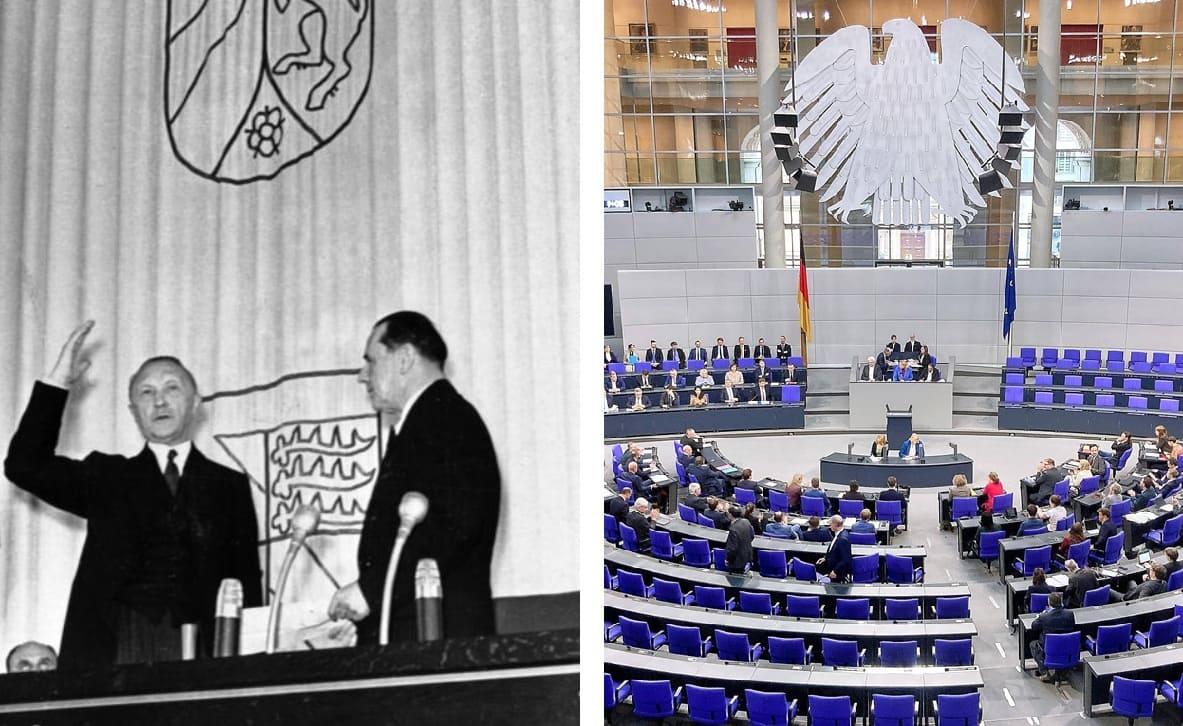 Bundesarchiv, B145 Bild-P047643 / Fotograf(in): Munker, Georg | Imago / dts Nachrichtenagentur
As Chairman of the Parliamentary Council, he played a key role in the creation of a democratic constitution, the Basic Law. The fact that the German people had confidence in the new state, unlike after 1918, was also due to the personality of the first Federal Chancellor and the stability he embodied. ‘Bonn is not Weimar’ was the title of a well-known book from the 1950s. Today, all democrats are called upon to help ensure that this statement remains valid with regard to Berlin.
Our mission statement: We are committed to the legacy of Konrad Adenauer. His ‘courage for democracy’ shapes our work: we stand for personal responsibility, justice and solidarity. We are committed to liberal, representative democracy, the rule of law, the social market economy and European integration. Our actions are based on the Christian view of humanity.
Paths to Europe: visions become reality
"The unity of Europe was a dream for a few. It became a hope for many. Today, it is a necessity for us all."
– Konrad Adenauer, Government statement, 15th December 1954
As a native of the Rhineland, Adenauer had a clear understanding of the European dimension of events in Germany and vice versa. As early as the 1920s, he had advocated cooperation rather than confrontation in relations with France and economic integration, albeit without success.
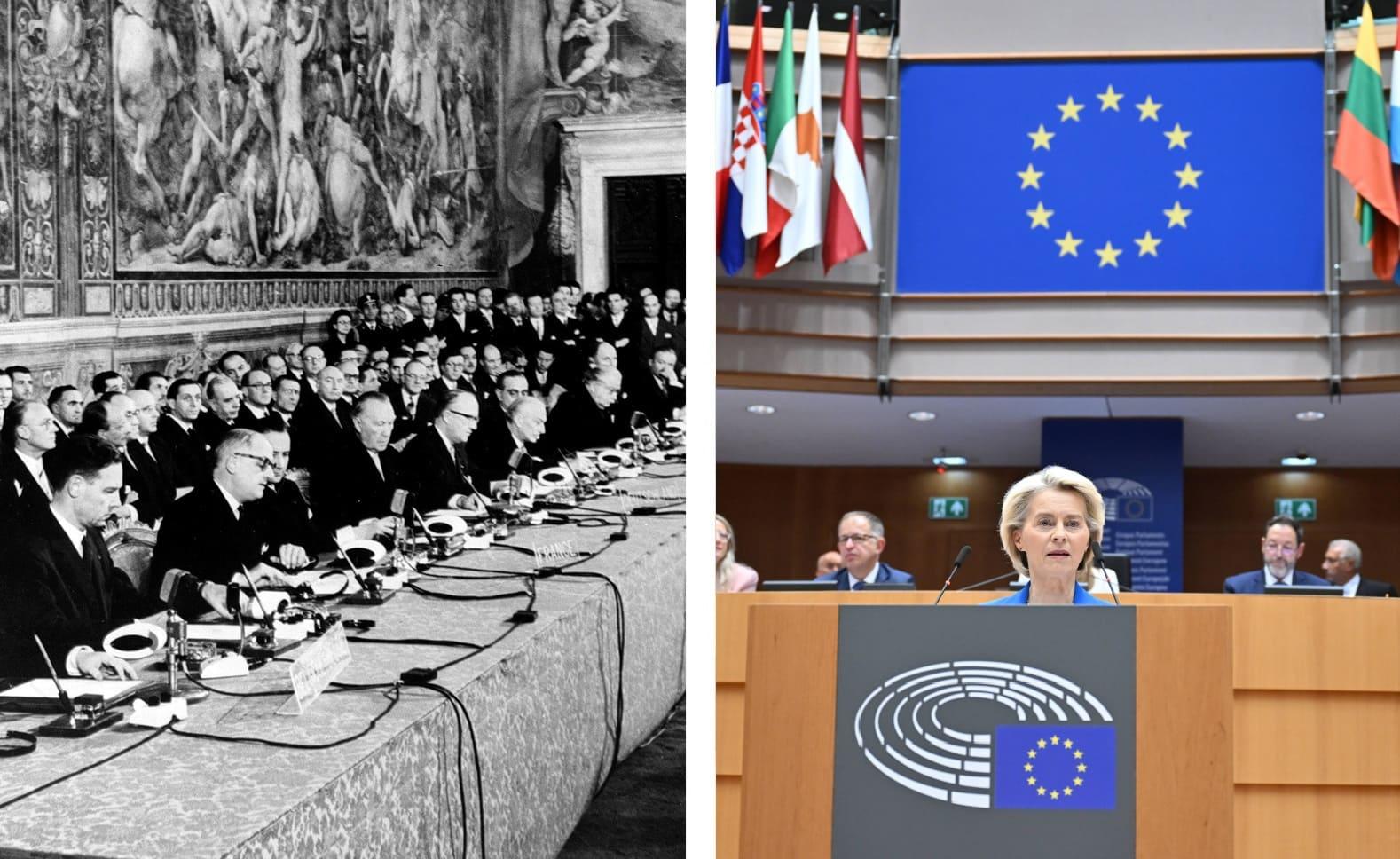 Bundesregierung, B 145 Bild-00014192 / Fotograf(in): o. Ang. | Imago / Anadolu Agency
As Federal Chancellor, he put his vision into practice. In 1952, the European Coal and Steel Community (ECSC) was founded, thereby communitising two commodities that had previously been central to warfare. Looking back, it is clear how visionary the failed project to create a European Defence Community (EDC) was. With the establishment of the European Economic Community in 1957, the path was paved for today's European Union (EU). In a world of new challenges and dangers, we are called upon today to preserve and continue Adenauer's European legacy.
State of Europe: Konrad Adenauer laid the foundation for a united Europe: from the European Coal and Steel Community to the European Economic Community. Today, in a world full of new challenges, our ‘State of Europe’ continues this legacy. Every year, the leaders of the EU institutions gather in Berlin to share their views on the state and future of Europe. It is a tradition that transcends day-to-day politics and keeps Adenauer's spirit alive.
Securing freedom: foreign policy through cooperation
"It is a question of Germany's destiny. We are faced with a choice between slavery and freedom. We choose freedom!"
– Konrad Adenauer, Bundestag debate, 3rd December 1952
For Germany, Adenauer's foreign policy represented nothing short of a revolution: no longer would the country pursue an ambiguous policy of oscillating between East and West, but would instead make a clear choice in favour of the free West with the aim of achieving the greatest possible security for the Federal Republic as a frontline state in the Cold War. This also enabled West Germany to gain extensive sovereignty. With rearmament and the establishment of the Bundeswehr, the Federal Republic made its own contribution to the security of the Western alliance as a member of NATO.
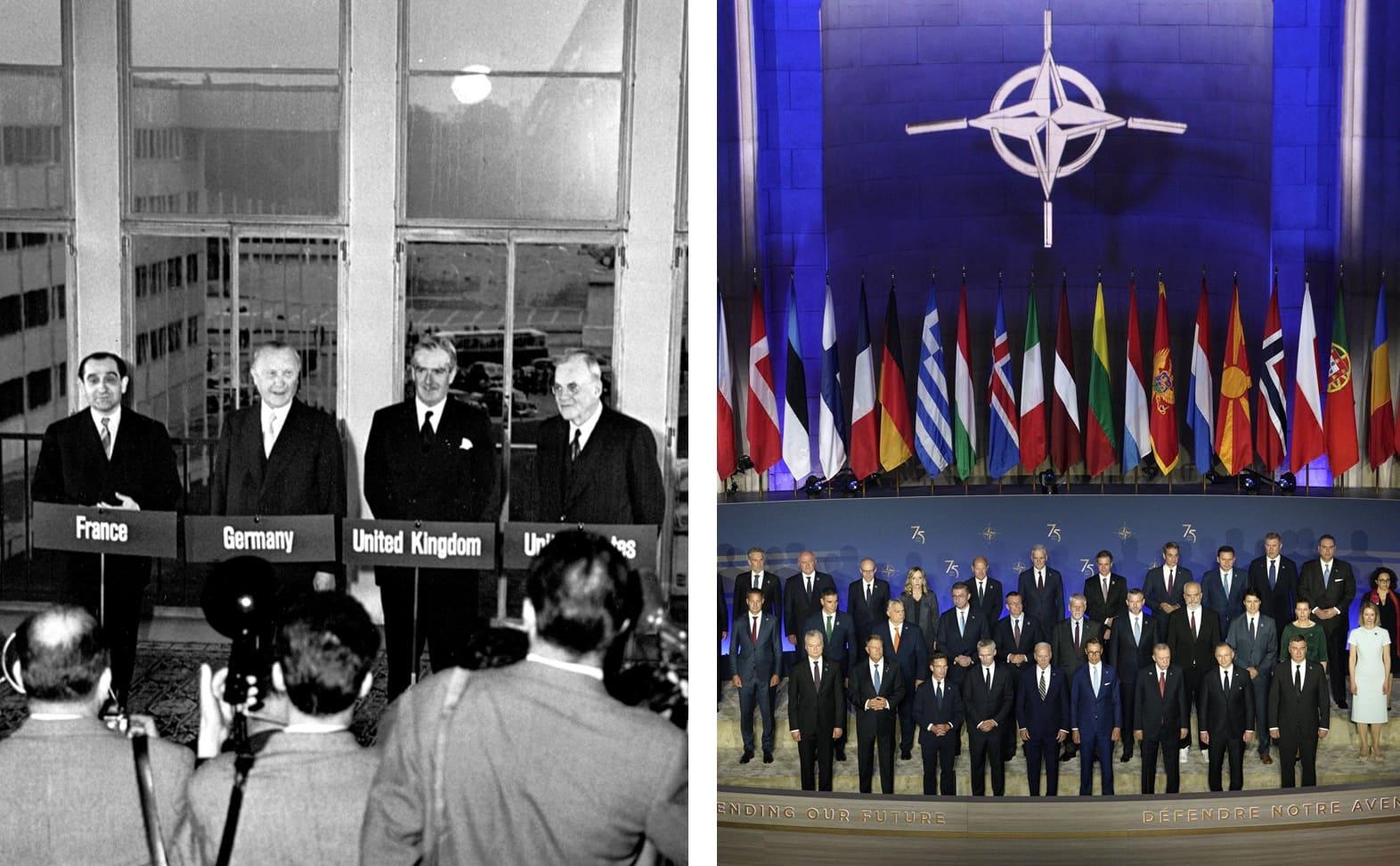 Bundesregierung, B 145 Bild 00048344 / Fotograf(in): o. Ang. | Imago / Cover-Images
Within the framework of the European Coal and Steel Community (ECSC), the Council of Europe and the European Economic Community (EEC), Germany also became a pioneer in the process of European integration. In light of a difficult international environment and new foreign policy challenges, the task today is to adhere as far as possible to Adenauer's legacy of a cooperative foreign policy based on Western ideals – in the spirit of his famous statement: ‘We choose freedom.’
Exhibition ‘Unity Only in Freedom’: After the war, Adenauer clearly voted for freedom instead of dictatorship, for ties with the West instead of isolation. With courageous steps, he created security, trust and stability. In his eyes, this foundation was the only realistic way to regain national unity in freedom. The exhibition shows how this courageous policy shaped Germany – and demonstrates to visitors why Adenauer's values are more relevant than ever today in the face of new threats.
Prosperity through the social market economy: a new beginning, freedom and responsibility
"We organised our economy on the basis of competition and social justice. We call this economic system the ‘social market economy’, which combines free enterprise with social responsibility."
– Konrad Adenauer, Speech before the US House of Representatives, 28th May 1957
The question of the future economic and social order of war-torn Germany played a central role in political discussions after 1945. There was also heated debate within the newly founded CDU. Here, convictions based on ‘Christian socialism’ clashed with economically liberal ideas. Personified by Federal Minister of Economics Ludwig Erhard, the concept of the social market economy, conceived by the ‘Freiburg School’, proved to be the solution for both the CDU and the country as a whole.
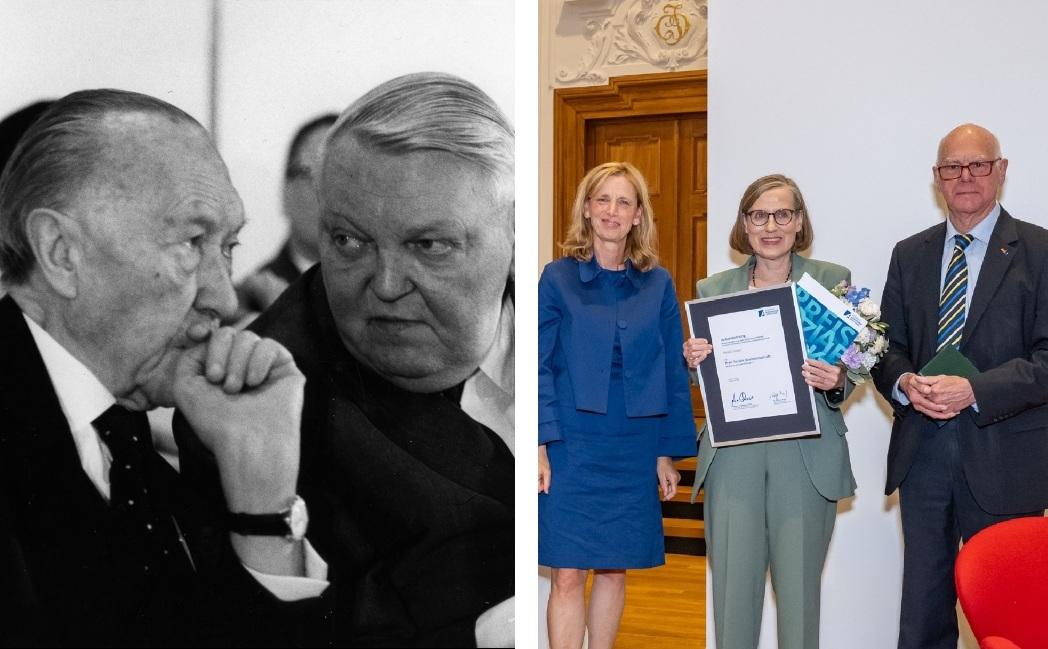 KAS / Peter Bouserath | KAS / Julia Reisinger
A market economy orientation, combined with assistance measures for those in need and social partnership between employers and trade unions, paved the way for the hard-won ‘economic miracle’ in line with Erhard's motto of ‘prosperity for all’. Achieving this goal in today's globalised world requires courage, a willingness to change and optimism – just as was the case in the ‘Adenauer era’.
Social Market Economy Award: The introduction of the social market economy shaped the young Federal Republic of Germany and contributed significantly to the economic miracle. To ensure that the concept remains successful in the future, it must continue to evolve innovatively and adapt to today's challenges. To foster courage and willingness to change, we have been recognising outstanding achievements by individuals in line with this idea since 2002.
The five most important stages in Adenauer's life
Konrad Adenauer shaped German history like hardly any other politician of the 20th century. His career took him from local politics to the Weimar Republic and finally to the top of the young Federal Republic.
The following five stages show how Adenauer took on responsibility and left a lasting mark.
Adenauer as Mayor
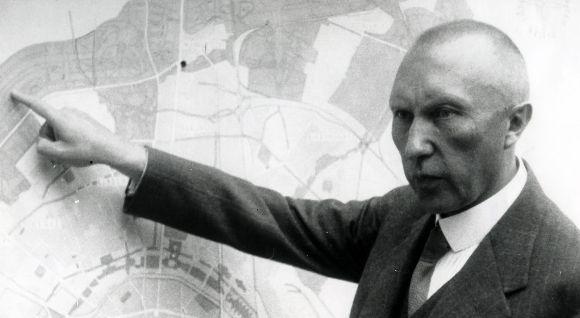
As mayor of Cologne (1917-1933), Konrad Adenauer – under the difficult conditions of British occupation until early 1926 – oversaw comprehensive innovations and modernisations, some of which continue to have an impact today: The reopening of the university, the creation of the exhibition grounds in Deutz, the creation of the ‘green belt’ as a local recreation area around the city centre and the establishment of the American Ford Motor Works can all be traced back to him.
Under Adenauer, the Rhine metropolis became a modern city. He also emerged as a staunch opponent of National Socialism, refusing to receive Adolf Hitler in Cologne after his appointment as Reich Chancellor and to fly the swastika flag in public spaces. As a result, he was dismissed as mayor and threatened with death (‘Adenauer to the wall’).
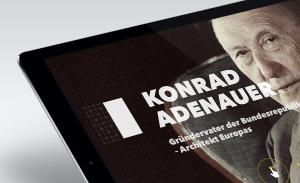
Further information on Adenauer's time as mayor can be found on the online portal ‘Konrad Adenauer’.
Adenauer as President of the Prussian State Council

In retrospect, Konrad Adenauer's image of Prussia was clearly negative. However, he could certainly identify with the democratic Free State of Prussia that had existed during the Weimar Republic. In 1921, he was elected President of the Prussian State Council, which was housed in Berlin in what is now the Bundesrat building. This body consisted of representatives of the individual Prussian provinces, who were delegated by the provincial parliaments. Their role was to protect the interests of their home regions and participate in the Free State's legislative process.
Adenauer spent several days in Berlin almost every month chairing the meetings, which enabled him to cultivate political contacts in the Reich capital. Long before his election as Federal Chancellor, he had thus already emerged as a supra-regional politician in Germany's first democracy.
Details of Adenauer's work in the Prussian State Council can be found on the online portal ‘Konrad Adenauer’.
Adenauer as Chairman of the Parliamentary Council

As Chairman of the Parliamentary Council, Konrad Adenauer played a prominent role in the creation of the Basic Law, which initially served as the provisional constitution of West Germany and has been the constitution of the whole of Germany since 1990. Between autumn 1948 and spring 1949, the Council met in Bonn in the Alexander König Museum, a natural history museum.
In his role as chairman, Adenauer not only presided over the Council of Elders and mediated between the parties, but also acted as the central point of contact with the Western Allies and the federal states. Reconciling the different interests of these groups required considerable negotiating skill. On 23rd May 1949, the Basic Law was promulgated and the Federal Republic of Germany was founded. Chairman Adenauer's signature appears at the top of the constitutional document signed by the members of the Parliamentary Council.
You can gain an insight into the work of the Parliamentary Council via the online portal ‘Konrad-Adenauer’.
Adenauer as party leader of the CDU

After the end of the Nazi dictatorship, Konrad Adenauer was convinced that the existing parties, including his own, the Catholic Centre Party, had failed in the fight against National Socialism. For him, therefore, the only option was a new party based on Christian values, in which Protestants and Catholics would work together from then on. Adenauer's rise in the Christian Democratic Union (CDU) began in early 1946 with his election as chairman in the British zone.
When the federal party was finally founded in autumn 1950 and Adenauer was elected CDU chairman, he had already been Federal Chancellor for a year. The successful federal elections in 1953 and 1957 saw the CDU develop into a people's party, absorbing smaller bourgeois parties such as the Union of Expellees and Disenfranchised Persons (BHE) and the German Party (DP). Adenauer led the party with a strict top-down approach, but its success proved him right until he stepped down as chairman in 1966.
A detailed overview of how Adenauer shaped the party as its chairman can be found on the online portal ‘Konrad Adenauer’.
Adenauer as Federal Chancellor
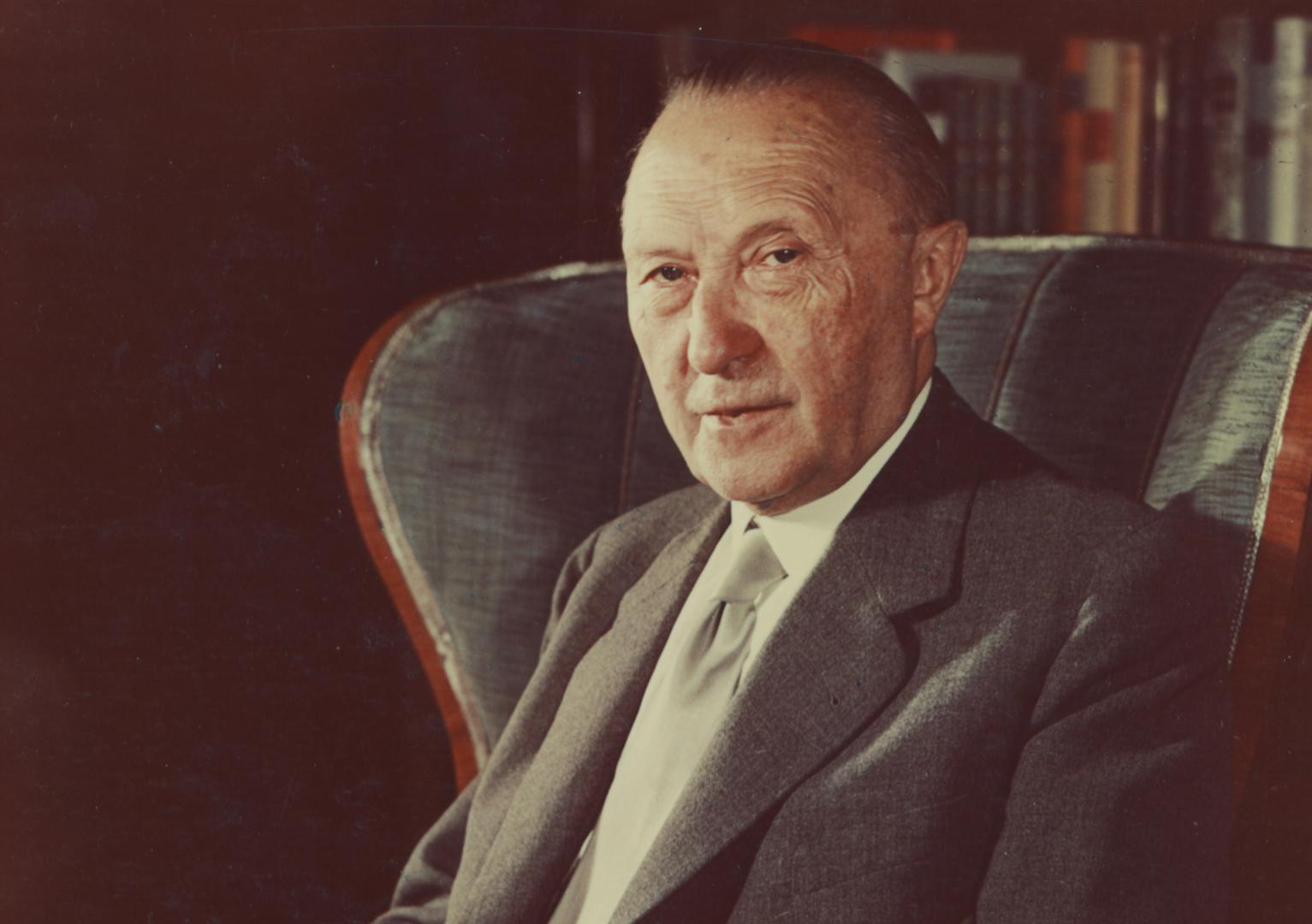
As the founding Chancellor of the Federal Republic of Germany, Konrad Adenauer shaped an era. During his term in office (1949-1963), important fundamental decisions were made, some of which continue to have an impact today. These include, for example
- the initially controversial policy of alignment with the West and European integration,
- friendship with France,
- the security partnership with the USA within the framework of NATO,
- the establishment of the ‘social market economy’ as the basis for economic growth and social peace, and
- reparations and reconciliation with Israel and Judaism.
Certainly, he made mistakes during his 14 years as head of government, but as Federal Chancellor, Adenauer played a key role in developing democracy, prosperity and security and in helping Germany regain its reputation abroad after the crimes of National Socialism.
If you would like to learn more about the term of office of the first Federal Chancellor, take a look at the online portal ‘Konrad Adenauer’.
Publications on this topic

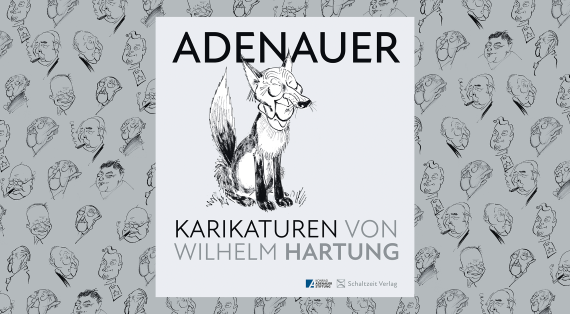
Adenauer auf der Wolke. Himmlische Karikaturen zum 150. Geburtstag
hrsg. von der Konrad-Adenauer-Stiftung e. V., kuratiert und bearb. von Matthias Krüger
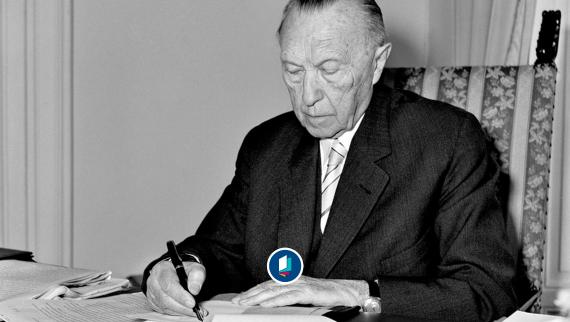 KAS / Giuseppe Moro
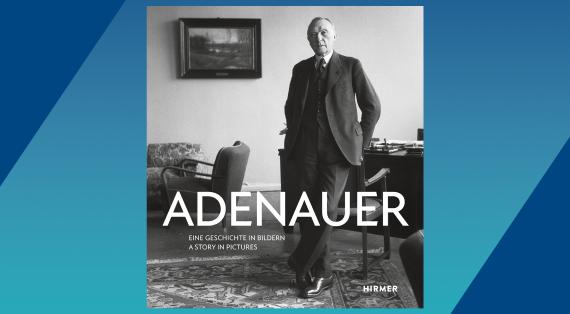
Wenig Neues vom „Alten“
Drei Neuerscheinungen zum 150. Geburtstag Konrad Adenauers
Event reports on the topic
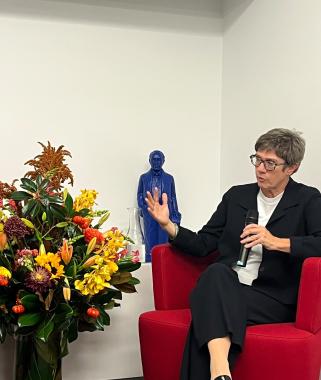
Germany’s Foreign and Security Policy Today: Navigating the Polycrisis and a Fractured Transatlantic ...
Discussion and Reception with Annegret Kramp-Karrenbauer, Chairwoman of the Konrad-Adenauer-Stiftung (KAS)
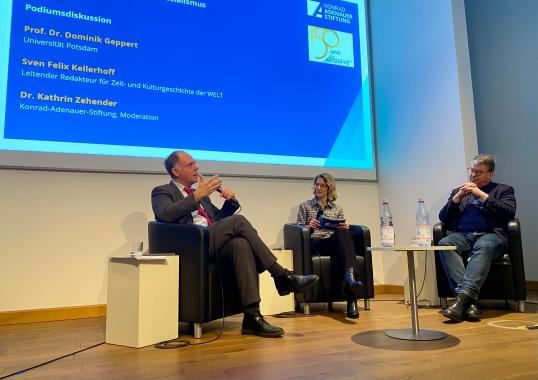
Event Report: Konrad Adenauer at 150 – Still Leaning Westward?'
Germany’s role in transatlantic (security) relations, the past, present and future.
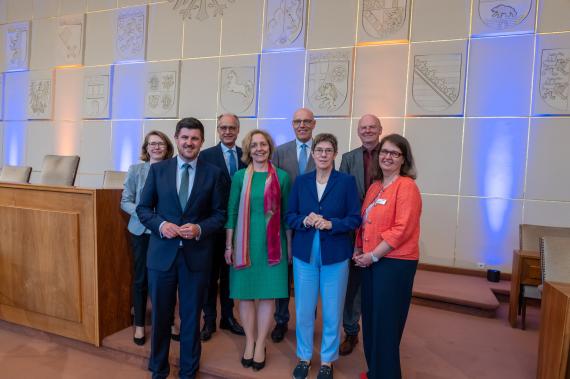
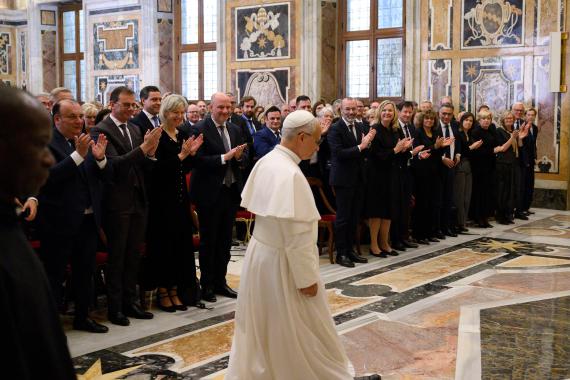
„Ach, Gussie!“ – Eine Frau zwischen Politik, Familie und Widerstand
Sonderaufführung des Theaterstücks „Ach, Gussie!“ zum 150. Geburtstag Konrad Adenauers im Pfefferberg-Theater Berlin
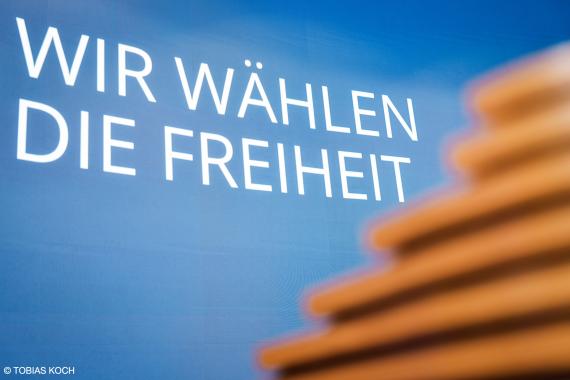
Wir wählen die Freiheit
Von der wertebasierten Sicherheitspolitik Adenauers zur nationalen Sicherheitsstrategie
 KAS-Bremen