






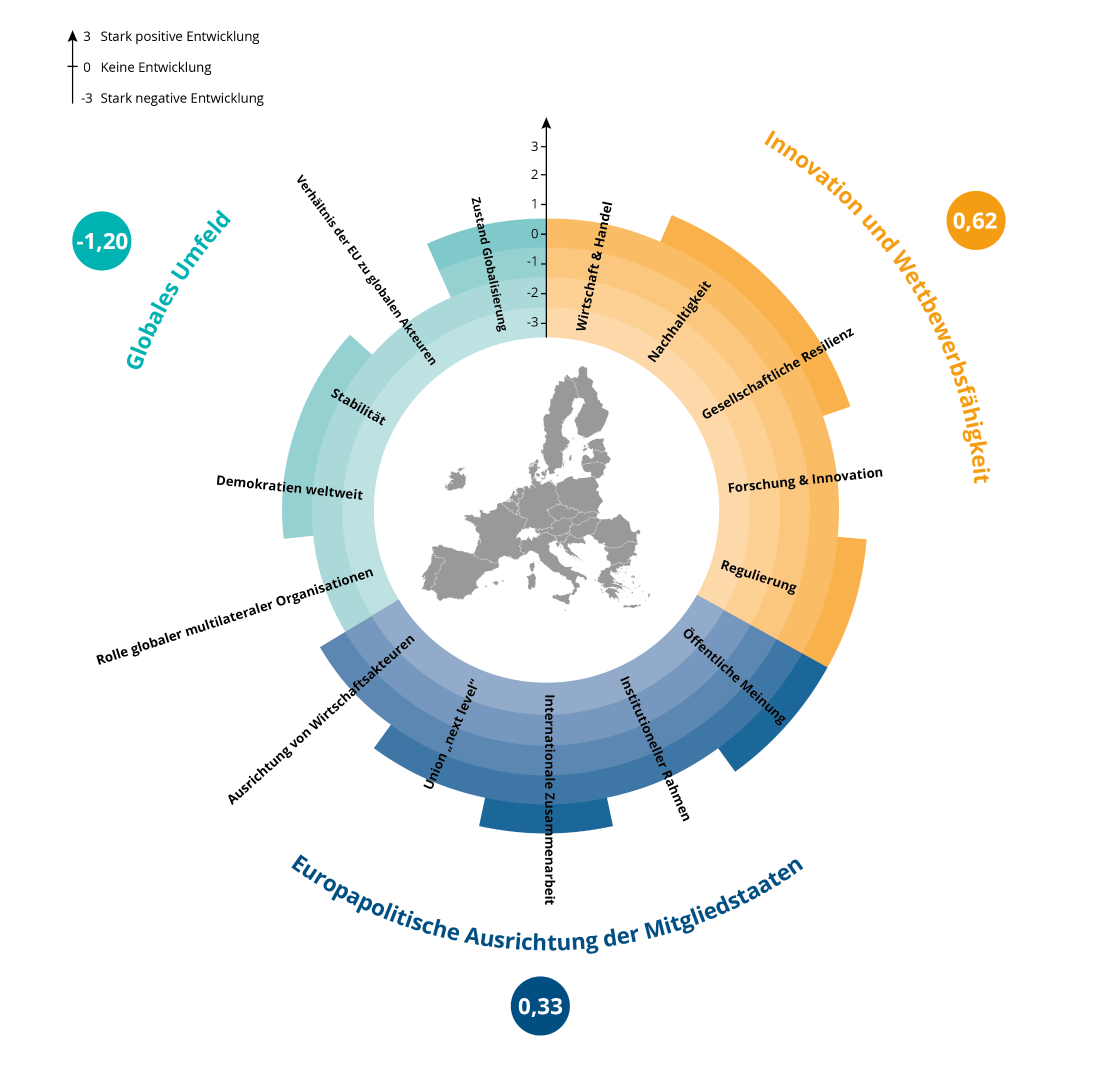
The results of this year’s Panorama Analysis, which monitors developments in 2025 compared to 2024, show that the European Union is increasingly becoming a bastion of stability in a geopolitically tense environment.
Implementing a clear competitiveness agenda
In the Innovation and Competitiveness dimension, two opposing trends of the past two years are continuing: on the one hand, the EU is stagnating in the fields of economy and innovation. On the other hand, the transition to a sustainable economy is steadily progressing, and the EU is once again proving to be socially resilient. The EU and its member states must therefore implement a clear competitiveness agenda. After the simplification of the omnibus packages, a systematic further dismantling of bureaucracy must follow and bold steps towards integration within the European single market are required. If necessary, these should be pursued within a coalition of the willing in order to overcome long-standing deadlocks. Furthermore, the EU and its member states must consistently redirect economic resources towards their capacity for innovation in order to remain competitive internationally. This begins with prioritising public spending on research and innovation and ends with the need to allow for structural change of the economy.
Using the temporary window of opportunity for reform
Compared with the previous year, the attitudes of member states towards the EU appear to be broadly stable, yet more fragmented. Whilst support for the EU and legal and institutional cohesion remain largely stable, political polarisation, informal decision-making processes and selective patterns of integration are on the rise. The discrepancy between the public’s positive perception of the EU and contentious national political dynamics persists. The continuing positive attitude towards the European Union is becoming a strategic asset and is gaining further significance against the backdrop of a weakened multilateral order. This is also reflected in the growing interest shown by countries such as Iceland and Norway in closer ties with the EU. The change of government in Hungary opens a temporary window of opportunity for reform to extend majority voting in the Council.
Building a backup for the rules-based world order
The Global Environment dimension shows that the EU is operating within an increasingly dysfunctional multilateral order in which the reliable foundations for international cooperation are eroding. Whilst the EU continues to champion rules-based cooperation and actively supports individual organisations, deadlocks, power politics and institutional erosion are exacerbating the structural tensions between European aspirations and global reality. The ongoing erosion of the multilateral order requires the EU to assume its geopolitical role with greater determination and to fulfil it strategically in the interests of its member states. In the face of waning global reliability, the EU and its member states are increasingly taking on a stabilising and backup role. This is particularly evident in the successful trade agenda, through which the EU and other middle powers are building a safety net for rules-based trade. At the same time, significant capability gaps remain – for example in the areas of defence, intelligence gathering and critical technologies, which should be addressed in a targeted manner. If the EU pursues this path consistently, it can become a global anchor of stability.


Topics
About this series
The series informs in a concentrated form about important positions of the Konrad-Adenauer-Stiftung on current topics. The individual issues present key findings and recommendations, offer brief analyses, explain the Foundation's further plans and name KAS contact persons.