[…] the digital economy and the age of digitalization [should] also serve people […] and not the other way around. None of this is an end in itself.




At a glance
- Artificial intelligence (AI) has long been part of our everyday lives and is already being used in fields such as medicine, public administration, education, security, defence, business and transport.
- All AI systems in existence today fall under the category of so-called “weak AI”. “Strong AI” – which could solve virtually any task that humans can solve – does not yet exist.
- AI is far more than just chatbots and image generators. It encompasses a wide range of technical approaches – from robotics to generative AI.
- AI opens up great opportunities for innovation and prosperity, but also presents challenges for democracy, the world of work and data protection.
- The Konrad-Adenauer-Stiftung advocates a level-headed and responsible approach to AI. Opportunities should be seized, risks mitigated and democratic principles upheld.
Content
1. What is Artificial Intelligence?
2. How does Artificial Intelligence work?
2.1 Classification by technical approach
2.2 Methodological approaches to data-driven AI
3. Opportunities, challenges and applications of Artificial Intelligence
3.1 AI in public administration and government
3.2 AI in the economy and the world of work
3.3 AI in education, public life and democracy
3.4 AI in the medical and healthcare sector
3.5 AI in security, the military and defence
4. Regulation and design: what sort of AI should shape our society?
4.1 Efficiency vs. transparency
4.4 What sort of regulation do we need?
5. Our stance on AI: The work of the Konrad-Adenauer-Stiftung in this area
6. Our offers and projects on the topic
7. Publications, events and media contributions on the topic
Artificial intelligence (AI) is already transforming our everyday lives: it writes texts, recognises images, assists doctors with diagnoses, optimises traffic flows and is used in business and public administration. Much of this takes place behind the scenes of digital systems and often remains invisible in our daily lives. At the same time, hardly any other technology is currently the subject of such heated debate: is AI a driver of innovation and prosperity, or a threat to jobs, democratic processes and social cohesion?
The real challenge lies between euphoria and concern: AI is neither a saviour nor a doomsday scenario, but a technology that is transforming existing decision-making and power structures. This raises key questions: what tasks is AI already taking on today? Where are decisions being automated, and where must humans retain control? And what rules are needed to ensure transparency, accountability and traceability?
This topic page offers guidance: it explains basic principles, highlights specific areas of application and assesses the opportunities and risks. The focus is on the question of how artificial intelligence can be designed in such a way that it delivers societal benefits whilst remaining subject to democratic control.
What is Artificial Intelligence?
Artificial intelligence refers to technologies capable of performing tasks that would otherwise require human thought processes: such as learning from examples, recognising patterns or making simple decisions.
There are essentially two forms of AI:
- Weak AI: These systems are specialised in clearly defined tasks. Examples include voice assistants, recommendation algorithms, spam filters and navigation systems. They work reliably, but only within their defined scope of tasks. All AI systems in existence today fall into this category.
- Strong AI: This form of AI would be capable of comprehensive understanding, flexible learning and solving almost any mental task that a human can also perform. Such strong AI does not currently exist; it is a long-term research goal.
2. How does Artificial Intelligence work?
AI is not a single process, but rather an interplay of different technical approaches.
2.1 Classification by technical approach
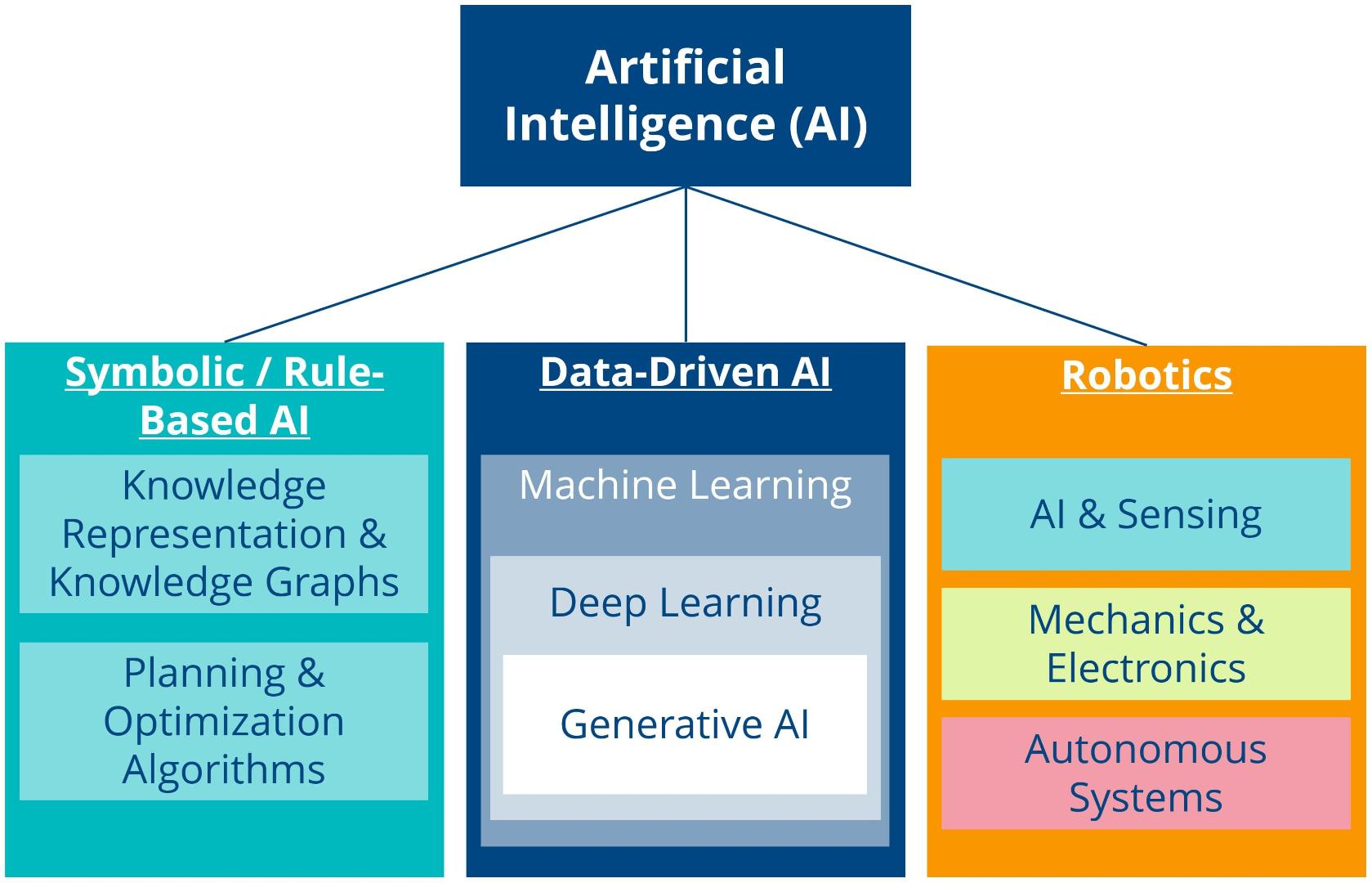
AI can broadly be viewed from different perspectives: in terms of its methodological foundations (e.g. symbolic or data-driven) and in terms of specific systems such as robotics. These three areas can in turn be broken down into more detailed sub-categories. In practice, they are often combined, which is why the term “hybrid AI” is also used.
 Konrad-Adenauer-Stiftung e. V.
- Robotics: AI-controlled systems in physical form, e.g. in manufacturing robots, service robots or autonomous systems. Robotics combines AI-supported perception (sensor technology), decision-making logic and physical implementation through mechanics and electronics.
- Sensor technology: Enables perception of the environment through the processing of sensor data such as camera images, lidar information or audio signals. AI is used here, for example, for object, situation or environmental recognition.
- Mechanics and electronics: Comprises the physical and electronic components of robots, e.g. actuators, drives, control systems and power supplies. These ensure that AI-based decisions can be translated into real movements and actions.
- Autonomous systems: Systems that can act independently on the basis of sensor data and decision-making logic, without requiring constant human control. These include, for example, autonomous vehicles, drones or mobile service robots, which navigate independently and react to their environment.
- Symbolic and rule-based AI: AI that operates using logic, rules or knowledge databases. These are used, for example, in expert systems, planning software or decision support systems.
- Knowledge representation and knowledge graphs: Applications that represent knowledge in a structured way so that machines can understand relationships, e.g. in search engines or question-and-answer systems.
- Planning and optimisation algorithms: AI that improves processes. Used, for example, in route planning, logistics operations, energy optimisation and traffic management.
Data-driven AI: AI systems based on statistical methods and machine learning that recognise patterns in large volumes of data. They are used, amongst other things, for speech and image recognition, text analysis, forecasting, recommendations and content generation, and learn their behaviour not through explicit rules but by training on example data. The more data there is and the better the training, the more accurate the results become.
2.2 Methodological approaches to data-driven AI
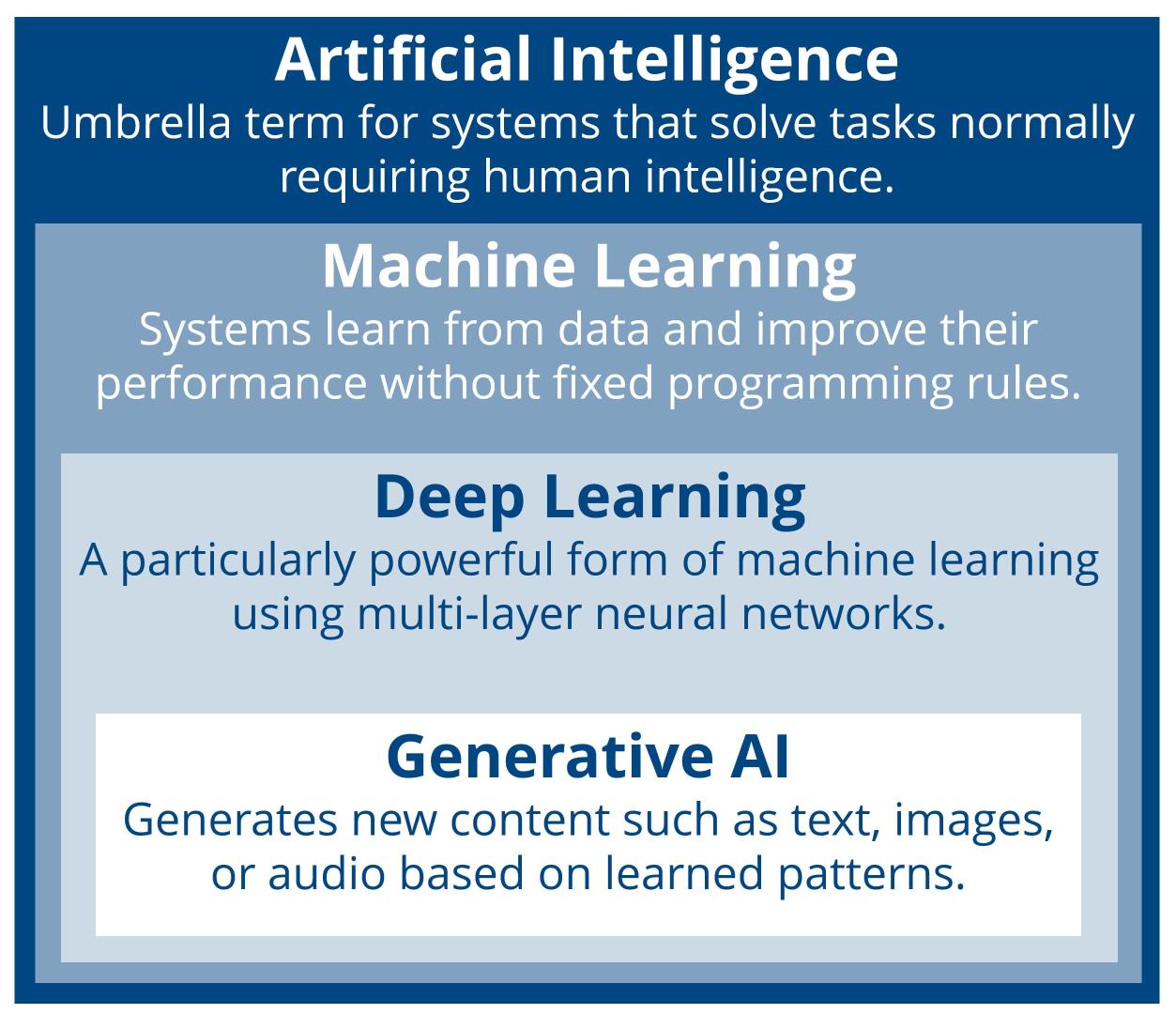
The AI widely used today is largely data-driven. This includes machine learning, deep learning and, in particular, generative AI. These terms refer to different levels and approaches within AI.
 Konrad-Adenauer-Stiftung e. V.
-
Machine learning (ML): A subfield of data-driven AI: systems learn autonomously from examples.
Typical characteristics:- recognises patterns rather than being explicitly programmed
- requires training data (e.g. images, text, measured values)
- can classify or make predictions
- Principle: The more data, the more accurate the results
-
Deep learning (DL): A specialised field of machine learning using artificial neural networks.
Typical characteristics:-
particularly effective with images, speech and text
-
uses many levels (“layers”) that recognise increasingly complex features step by step
-
forms the basis for modern breakthroughs such as autonomous driving, language models and medical image analysis
-
-
Generative AI: A subfield of deep learning that can generate new content.
Typical characteristics:-
creates text, images, music, videos or code
-
combines learnt patterns to form new content
-
is used in creative fields, education, research and business
-
In addition to its hierarchical structure, data-driven AI can also be categorised according to its characteristics into so-called “large” and “small” models:
-
Large models:
-
a very large number of parameters (configuration variables)
-
high computational and energy requirements
-
often operated centrally (cloud, large corporations)
-
e.g. large language or image models
-
-
Small models:
-
significantly fewer parameters (configuration variables)
-
more efficient, cheaper, more robust
-
can be used locally (edge, devices)
-
often specialised for specific tasks
-
3. Opportunities, challenges and applications of Artificial Intelligence
The impact of artificial intelligence on society as a whole is enormous and lies at the heart of every discussion on AI. Its significance is not limited to individual applications, but manifests itself wherever AI shapes key structures of the economy, the state and public communication. What is therefore crucial is not so much that AI is used, but how, to what extent and within what normative framework.
|
Potential |
Risks |
|
✅Increases in productivity and new business models |
❌Disinformation and deepfakes |
|
✅More efficient administrative processes |
❌Risks relating to data protection and surveillance |
|
✅Medical advances and improved diagnostics |
❌Discrimination caused by biased data |
|
✅Personalised learning opportunities and broader access to knowledge |
❌Changes to jobs and skills requirements |
|
✅Support for research and innovation |
❌Concentration of power amongst a few technology providers |
|
✅Strengthening resilience and security capabilities |
❌Ethical and legal issues surrounding autonomous systems |
3.1 AI in public administration and government: efficiency and the rule of law
In politics and public administration, AI is used primarily in areas where large volumes of data need to be processed, procedures standardised or decisions prepared. It is an important tool in the modernisation of the state and can play a significant role in reducing bureaucracy.
It promises:
-
more efficient procedures
-
faster analysis and
-
better use of scarce staff resources
Applications range from the automated processing of applications and digital assistance systems to forecasting and planning tools.
Typical areas of application include:
-
Citizen communication: Chatbots answer standard enquiries
-
Document processing: Automated capture and analysis of applications
-
Internal processes: Preliminary review of cases, minute-taking and report generation
-
Data analysis: Forecasts for transport, school or resource planning
-
Smart Cities: Traffic management, energy and environmental monitoring
-
Crime and internal security: Detection of fraud or cyber risks
However, particularly in a government context, the use of AI comes with high demands. Government action must remain traceable, verifiable and legally accountable. AI-supported systems pose new challenges to these principles, particularly when decision-making logic is not transparent or when responsibility shifts between humans and the system.
🟦 Analysis:
The publication “Greater capacity for action for public administration with artificial intelligence” (full text available in German only) analyses how AI can help make administrative procedures more efficient whilst upholding the rule of law, transparency and data protection. It examines specific applications, the legal framework and the prerequisites for the successful use of AI in the public sector.
3.2 AI in the economy and the world of work: productivity and change
Economically speaking, AI is one of the most effective drivers of innovation today.
It:
- increases productivity
- accelerates innovation processes and
- enables new business models.
AI-supported analysis and forecasting methods make it possible to better understand complex markets, make supply chains more resilient, and organise research and development more efficiently. Particularly in knowledge-intensive sectors, AI acts as a multiplier of human capabilities.
Examples of applications in business and industry include:
- Smart manufacturing
- Quality control: AI detects defects in components via image analysis
- Predictive maintenance: maintenance requirements are predicted
- Digital twins: production processes are simulated virtually
- Robotics in manufacturing
- Robots identify and assemble components autonomously
- Flexible welding, painting or assembly processes
- Collaborative robots (cobots)
- Support with assembly work
- Relief from heavy or monotonous tasks
- Highly relevant for small and medium-sized enterprises
- Autonomous logistics
- Self-driving transport systems in factories and warehouses
- AI-based route and material planning
- Humanoid robotics (pilot projects)
- Initial tests for logistics and support tasks
- Research and demonstrations, e.g. at trade fairs
These examples show that artificial intelligence is bringing about significant changes to the economy and is therefore having a direct impact on the world of work. Where AI automates, optimises or supports processes, job profiles, skill requirements and forms of collaboration between humans and machines are changing.
For many employees, these developments are accompanied by concerns and uncertainties. Frequently cited are fears of job losses, increased performance monitoring, the devaluation of existing skills, or growing pressure to adapt in day-to-day working life. Jobs that are highly standardised, data-driven or repetitive are particularly affected.
At the same time, most experts in labour and economic sciences emphasise that AI does not lead to widespread job losses, but rather to structural change. It is primarily individual tasks that are being automated, not entire professions. At the same time, there is a growing need in many sectors for analytical, creative, coordinating and social skills. AI is increasingly acting as a tool to support human work in these areas, for example in decision-making, knowledge processing or process control.
Education, continuous professional development and the targeted upskilling of employees are becoming key factors for socially responsible change. However, without appropriate political and organisational support, there is a risk of new forms of economic inequality or growing dependence on a small number of data- and capital-rich players.
Environmental considerations are also gaining in importance. Whilst AI enables efficiency gains and savings in human resources, high-performance models are associated with high energy and resource consumption.
3.3 AI in education, public life and democracy: information and influence
The significance and use of AI for democratic public life and political opinion-forming are highly complex.
Algorithmic systems:
- structure information spaces
- determine the visibility and reach of content, and
- influence which topics receive public attention
With the emergence of generative AI, this trend is intensifying: Texts, images or videos can be produced in large numbers, in a short space of time and in a way that is difficult to distinguish from human-generated content.
This development poses significant risks to democratic processes. AI-fuelled disinformation, deepfakes or emotionally charged, target-group-specific content can undermine trust in the media, institutions and political actors, even if they are later refuted. Added to this is targeted micro-targeting, in which political messages are finely tailored to specific groups or emotions with the help of AI. This makes public counter-narratives and transparency more difficult to achieve.
The line between legitimate political communication and targeted manipulation is becoming increasingly blurred. This puts not only the quality of public debates at stake, but also the legitimacy of democratic decision-making processes.
🟦 Analysis:
The publication “The influence of Deep Fakes on Elections” examines the potential effects of AI-generated content – and deep fakes in particular – on democratic elections. It analyses the risks to political opinion-forming and discusses possible countermeasures.
At the same time, however, AI can also promote social inclusion and specifically strengthen the education sector, for example through:
- barrier-free access to information
- translation services or
- personalised educational programmes
Particularly in the field of school and university education, there are high hopes pinned on the use of AI: It is fundamentally transforming teaching and learning by enabling personalised learning opportunities, relieving teachers of routine tasks and facilitating access to education. An in-depth engagement with AI and the appropriate teaching of media and AI literacy can also sharpen the ability to recognise deepfakes and disinformation, thereby strengthening the resilience of a democratic public sphere.
Nevertheless, its use in the education sector brings new challenges, for example when it comes to the responsible use of AI tools and the risk of growing educational inequalities. Experts therefore emphasise that AI can provide valuable support in the classroom but cannot replace the human factor. This applies both to the creativity and design of lessons by teachers and to the achievements of children and young people.
🟦 Analysis:
The publication “AI methods for specific challenges in education” (full text available in German only) highlights which specific AI methods can already be used in the education sector today and what potential they offer for personalised learning processes, individual support and the organisation of education.
3.4 AI in the medical and healthcare sector: precision and responsibility
The healthcare sector is an ideal testing ground for AI applications, offering enormous and diverse potential.
AI-supported systems are already assisting in the following areas:
- Imaging and diagnostics: support with CT, MRI or skin cancer analyses
- Clinical decision-making: risk assessments in complex cases
- Drug development: Faster search for active ingredients through data analysis
- Public health: Prediction of disease outbreaks
- Hospital organisation: Planning of capacity and resources
- Digital health applications: Apps for symptom or treatment monitoring
AI can significantly accelerate medical research, make diagnostics more precise and processes more efficient.
However, the medical and healthcare sector is considered particularly sensitive. Decisions affect individual health, personal data and high ethical standards. Faulty models, biased data sets or a lack of transparency can therefore have serious consequences.
🟦 Analysis:
The publication “Bits and Bytes for Global Health” (full text available in German only) explores how artificial intelligence and digital health applications can transform diagnostics, care and health management. It examines both the potential and the ethical, regulatory and societal challenges involved.
3.5 AI in security, the military and defence: resilience and sovereignty
Artificial intelligence has also become a key strategic factor in the security and defence sectors. Russia’s war of aggression against Ukraine has clearly demonstrated the importance of drones, digital reconnaissance and AI-enabled systems in modern conflicts. Many countries are therefore stepping up investment in their own AI capabilities in order to strengthen their security and defence capabilities and reduce technological dependencies.
Auslandsinfo Spotlight: drones, AI and a turning point
Ulrike Franke on the future of warfare (available in German only)
YouTube, onlinekas
The benefits of AI in security policy extend far beyond autonomous weapons and drone systems. It supports the analysis of large volumes of information, the early detection of risks, and the management of complex crises and threat scenarios. In this way, AI can contribute to the resilience of the state and society, as well as to the capacity to act in security crises.
Typical areas of application include:
- Internal security
- Preparation of threat analyses and situational assessments
- Protection of critical infrastructure
- Support for civil protection and crisis management
- Detection of fraud, extremism and security risks
- Cyber security
- Identification and analysis of cyber attacks
- Protection of state and private IT systems
- Real-time analysis of large volumes of data
- Strengthening digital resilience and technological sovereignty
- External security and defence
- Reconnaissance and analysis of satellite and sensor data
- Support for military planning and decision-making processes
- Deployment of autonomous and semi-autonomous systems
- Integration and analysis of complex military situational pictures
🟦 Analysis:
The publication “More AI for Defence and Resilience” (full text available in German only) examines the significance of artificial intelligence for defence capabilities, resilience, cyber security and technological sovereignty. It highlights the strategic implications for Germany and Europe arising from the growing importance of AI in security policy.
At the same time, their use raises specific ethical, legal and security policy issues. The way in which autonomous systems are managed serves as a prime example of how important human oversight, clear lines of responsibility and adherence to the rule of law and ethical principles remain.
4. Regulation and design: what sort of AI should shape our society?
The wide-ranging effects of artificial intelligence make it clear that its use is not merely a technical issue. AI touches on fundamental social values and political principles of organisation. Regulation thus becomes a key task in shaping the future: it should limit risks without stifling innovation, and build trust without prematurely restricting technological development.
In this context, the regulation of AI is not a static state but an ongoing process of negotiation. It operates within areas of tension where key social norms compete with one another. Openly acknowledging these conflicts of norms is a prerequisite for a realistic and responsible AI policy.
4.1 Efficiency vs. transparency
A key conflict lies between efficiency and transparency. AI-powered systems often derive their effectiveness precisely from their complexity. The faster and more powerful they become, the more difficult it is to fully understand their decision-making processes. At the same time, transparency and explainability are key prerequisites for democratic oversight, particularly where AI prepares or makes decisions that have significant implications for people. Regulation must strike a balance here: not every application requires maximum explainability, but wherever responsibility, rights or government decisions are at stake, efficiency must not come at the expense of traceability.
4.2 Security vs. freedom
Another fundamental conflict of objectives arises between security and freedom. AI can help to detect threats earlier, uncover fraud or protect critical infrastructure. At the same time, it carries the risk of far-reaching surveillance, in-depth profiling and a creeping loss of informational self-determination. Particularly in the field of security, this raises the question of where the protection of legitimate interests ends and where disproportionate infringements of civil liberties begin. A democratic approach to shaping AI must consciously draw this line and continually review it.
4.3 AI and ethics: responsibility in the digital age
A key ethical risk lies in discrimination resulting from biased data or algorithmic assumptions. If AI reproduces or exacerbates existing inequalities, this can lead to certain groups being disadvantaged. Equally problematic is the use of AI in areas involving surveillance, profiling or biometric data collection, where fundamental rights such as privacy or freedom may be restricted.
4.4 What sort of regulation do we need?
Taking into account the areas of tension mentioned above, current regulatory approaches aim to assess risks on a case-by-case basis. Not every AI application poses the same level of concern. The decisive factors are the area of application, the extent of its impact and the potential consequences for fundamental and human rights. Regulation is thus understood less as a blanket ban and more as a framework that sets clear minimum standards, defines responsibilities and subjects particularly sensitive applications to strict requirements.
This makes it clear that the crucial question is not how much regulation is needed, but what kind of regulation is necessary. AI that is intended to deliver societal benefits requires rules that enable innovation whilst effectively limiting misuse, discrimination and manipulation. Regulation is therefore not a hindrance to technological development, but a prerequisite for its democratic legitimacy and sustainable acceptance.
In the context of regulation, AI is increasingly being discussed as a matter of technological competitiveness and digital sovereignty. The development of high-performance AI systems is currently concentrated amongst a small number of global players, particularly in the US and China. Europe therefore faces the challenge of strengthening its own innovation and technological capabilities whilst upholding its values and regulatory standards.
Against this backdrop, the European Union is pursuing a risk-based regulatory approach with the EU AI Act. The aim is to promote innovation whilst ensuring the protection of fundamental and human rights. AI applications are treated differently depending on their potential risk: whilst low-risk systems are subject to minimal regulation, high-risk applications are subject to strict transparency, documentation and oversight requirements; particularly problematic practices are prohibited.
EU AI Act: A risk-based approach
Basic principle: The higher the risk associated with an AI application, the stricter the regulatory requirements.
🟩 Minimal risk: No or only minimal requirements
🟨 Limited risk: Transparency obligations
🟧 High risk: Strict standards and controls
🟥 Unacceptable risk: Prohibition
Internationally, the approaches differ significantly. Whilst the EU relies on binding rules, the US primarily pursues a market-oriented approach at federal level, with voluntary guidelines; however, in conjunction with the federal system, this leads to a regulatory framework that is, in some respects, inconsistent across the individual states. China, on the other hand, as a non-democratic actor, is establishing a system that combines state control with targeted support. The European approach is therefore also a conscious decision based on values: it aims to strengthen trust in AI, ensure democratic control and enable responsible innovation within the single market.
5. Our stance on AI: The work of the Konrad-Adenauer-Stiftung in this area
For the Konrad-Adenauer-Stiftung, AI is far more than just a technological issue. It is part of our future, which we are shaping together. We are following its development with an open mind and keen interest, whilst at the same time maintaining a level-headed perspective: neither hype nor blanket uncertainty will help us make meaningful progress on this issue. What matters is how it is actually implemented, as well as an objective examination of its opportunities, risks and potential applications.
Our work therefore centres on the question: how can we harness the potential of AI for innovation, prosperity and social progress without jeopardising freedom, democratic control and social cohesion?
We are guided by the following fundamental principles:
-
AI must serve humanity: technological progress is not an end in itself. Artificial intelligence should support people, expand their scope for action and contribute to solving societal challenges.
-
Freedom, democracy and the rule of law remain the benchmark: even in the age of AI, decisions must remain transparent, fundamental rights must be protected and government action must remain subject to democratic scrutiny.
-
Innovation and responsibility go hand in hand: the opportunities offered by AI can only be realised if innovation is facilitated, risks are openly identified and responsibilities are clearly defined.
-
Regulation requires a sense of proportion: AI needs clear rules. These should effectively limit risks without unnecessarily restricting innovation and competitiveness.
-
Europe must remain technologically capable: AI is also a matter of competitiveness and digital sovereignty. Europe should strengthen its own technological capabilities and develop joint European responses to the challenges of the AI era.
For us, the guiding principles outlined above are not abstract concepts. They take concrete form where AI is transforming society, the economy and politics, and where policy-making is required. That is why our work focuses on those areas where the opportunities and risks of artificial intelligence are particularly evident. Our main areas of focus are:
-
Democracy, media and political communication: We analyse the impact of AI on public debates, political opinion-forming and democratic processes. Among other things, we examine disinformation, polarisation, changes in journalism, and the opportunities and challenges that AI presents for parliamentary practice.
-
Law, ethics and governance: The legal, ethical and political framework surrounding AI represents a very broad but important area of focus. This includes issues of regulation, European AI governance, and accountability and transparency in the use of intelligent systems, which we examine from various perspectives.
-
Public Administration and the state: AI has the potential to make a significant contribution to the modernisation of the state. More efficient procedures, faster processing times and more user-friendly administrative services can help to strengthen citizens’ trust in government action. We therefore examine its use in public administration and the public sector, as well as how efficiency gains, the rule of law and citizen-centred approaches can be reconciled.
-
Education, health, infrastructure, security and defence: In addition, we examine the impact of AI on education systems, the healthcare sector, energy and digital infrastructure, as well as security and defence policy issues. We are interested in both the potential of these technologies and the social, ethical and political requirements for their responsible use.
Through workshops, seminars, lecture series, publications and national and international dialogue forums, we create spaces for guidance, knowledge transfer and social exchange. Our aim is to contribute to a fact-based debate on the opportunities and challenges of artificial intelligence and to provide impetus for its responsible development in society, business and politics.
3 years of ChatGPT – an interim assessment

Three years ago, OpenAI made the ChatGPT application available to the general public. To mark this anniversary, we spoke to various experts and employees about their perspectives on ChatGPT. They report on the advantages and disadvantages, opportunities and risks of the application.
Web3 and Blockchain

The Internet is constantly evolving: from Web1 to Web2 to Web3. Web1 was the static internet, Web2 brought social networks and interactivity, and Web3 could bring more security, privacy and user autonomy. The basis of Web3 is blockchain technology, which used decentralised structures to create innovations such as smart contracts, tokens, cryptocurrencies and digital currencies. For the development of artificial intelligence, it could also contribute to greater data protection and promote digital sovereignty. Below you will find basic studies and insights into specific fields of application.
Quantum computing and its importance for society

Whether economically or in a societal context, quantum computing has great potential. The technology of quantum computers represents a significant technical advance. Our publications on this groundbreaking future technology deal with the potentials of quantum computers, their fundamentals and possible applications.
Artificial intelligence and human rights

With a three-part publication series, we want to show that artificial intelligence (AI) not only drives the productivity of an economy, but also empowers individuals to claim and assert their own rights. Through two expert interviews and an interactive web publication, we look at the legal implications, the design aspect of human-machine interaction and provide examples of how AI is strengthening human rights at this stage of development.


Publications on this topic
 KALUZA+SCHMID Studio
The Encyclical Magnifica Humanitas and the Renewal of the Social Market Economy in the Digital Age
A Discussion Paper

 NongAsimo, stock.adobe.com
Three years of ChatGPT – an interim assessment
Where do we stand and what does the future hold for the European economy?
 Nicola Pitaro
ChatGPT technisch betrachtet
Was vor zwei Jahren nur die Großen machen konnten, wird bald auch für öffentliche Institutionen erschwinglich sein

ChatGPT in der Wissenschaft
Agenten können zu Resultaten kommen, aber es braucht immer noch die Einschätzung von Expertinnen und Experten, ob etwas Sinn ergibt und wirklich neu ist.


ChatGPT im Krankenhaus
Mit künstlicher Intelligenz können wir die Effizienz extrem steigern – und das müssen wir auch.

ChatGPT im Journalismus
KI schafft einen Innovationsschub im Journalismus. Es ist aber nicht damit getan, nur ChatGPT zu öffnen und sich Texte umformulieren zu lassen.

ChatGPT aus Sicht eines Dolmetschers
Immer da, wo menschliche Interaktion ins Spiel kommt, wo es um Interpretation und Sinn geht, kommt ChatGPT an seine Grenzen.

ChatGPT aus Sicht des EU-Parlamentes
Die Veröffentlichung von ChatGPT Ende 2022 war ein echter Wendepunkt


ChatGPT aus ökologischer Perspektive
Wir haben noch nicht gelernt, den Verbrauch zu erfassen und einzuschätzen
 TH Köln, 2025
ChatGPT aus juristischer Sicht
Die Möglichkeiten der KI sind enorm – die Gefahren aber auch.
 Britta Matthes
ChatGPT aus Arbeitsmarkt-Perspektive
Viele Unternehmen in Deutschland haben noch gar nicht die richtigen Voraussetzungen dafür, KI produktiv einzusetzen.

„Ein Mittel des Friedens und des Dialogs“
Zur Aktualität der Katholischen Soziallehre unter Papst Leo XIV.

Event Reports on the topic
 Leon Füllber
AI and Human Dignity
What implications does the encyclical Magnifica humanitas have for politics, the economy, and society?
 Beke-Bramkamp