The sole aim of German rearmament is to contribute towards the preservation of peace. We will have achieved this goal when the joint potential defensive capability of the allies poses too great a risk to any potential aggressor at any point in time. Nobody can see a threat in such military strength, which merely suffices for our defence.




At a glance
- A turn away from the constitutional mission of territorial and alliance defence in the aftermath of the Cold War has resulted in a continually deteriorating condition of the troops.
- The Russian war of aggression on Ukraine dramatically changed the security policy environment in Europe. A fundamental strategic reorientation is necessary so as to restore the operational capacity of the Bundeswehr.
- More efficient procurement strategies as well as the use of modern and, in some cases, AI-based technologies must become an important part of the Bundeswehr’s reorganisation and change processes.
- In democratic states, an army can only be strong if it has the support of the population. In order to improve this, strategic and transparent communication is needed.
- With its analyses and events, the Konrad-Adenauer-Stiftung aims at supporting the transformation to a modern and structurally well-positioned Bundeswehr.
Content
1. International crisis management as a core mission?
2. Turning away from national and alliance defence
3. The current threat situation requires fast reactions
4. Operational capability only with adequate funding
5. High demand for more efficient procurement structures
6. Be prepared today for the war of tomorrow
7. A high degree of legitimacy among the population
8. We support modernisation and structural realignment
9. Our offers and projects on the topic
10. Publications, events and media contributions on the topic
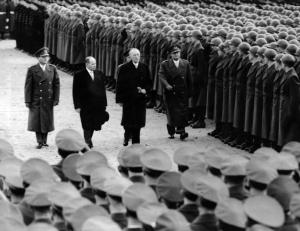
The Bundeswehr was founded in 1955 to deter against potential aggression by the Soviet Union and later the Warsaw Pact as an alliance army within the framework of NATO. The rearmament of the Federal Republic was thus also a milestone of Adenauer’s integration with the West and the Bonn Republic.
International crisis management as a core mission? New challenges awaited after the end of the Cold War
The disintegration of the Soviet Union and the end of the Cold War marked a turning point in global politics, and amounted to a seismic shift for the Bundeswehr. Virtually overnight, one of its essential core tasks – namely the military deterrence of the Warsaw Pact within the framework of NATO – had become obsolete. As a result, since 1991 the Bundeswehr has been downsized, the defence budget has been successively reduced and compulsory military service has been suspended. The Bundeswehr was no longer confronted with tasks of traditional national and alliance defence.
Instead, from the 1990s, the armed forces had to face new challenges: international crisis management and the fight against terror organisations were now the tasks under the remit of the army. This was reflected in the deployments in Bosnia-Herzegovina, in Kosovo and in Afghanistan, for instance.
Turning away from national and alliance defence: the assumption of being surrounded by “Friends” was wrong
Traditional national and alliance defence was perceived less and less as part of the Bundeswehr’s mission, as Germany saw itself surrounded exclusively by “friends” in the wake of the NATO and EU eastward enlargement and many believed that direct threats from other states were a long way off. That set developments in motion that favoured a departure from operational capability in a conventional deployment scenario. Specifically: The Bundeswehr progressively lost the ability to fulfil their own core task under the constitution: namely, national and alliance defence. Relevant key capabilities, such as air defence, were almost entirely abandoned in this context.
In times of international crisis management, however, the increasingly deteriorating state of the troops did not represent a major problem, at least from a mission perspective. International deployments were able to be carried out within the framework of “pooling” – the consolidation of personnel and material from the entire armed forces – and the mission was thus fulfilled.
The current threat situation requires fast reactions: Cold-start capability and full equipment are essential
If nothing else, the annexation of Crimea in 2014 in contravention of international law and its full-scale invasion of Ukraine with Russian troops from 24 February 2022 changed the security policy landscape for Germany and its allies. The current threat situation requires a NATO that is capable of operation and defence at all times, to which Germany, as the largest economy in Europe, must make a relevant contribution with a reliable and effective Bundeswehr. To ensure our armed forces are capable of doing so again in the future, not only do we need small personnel and financial corrections, but also a fundamental, strategic reorientation.
Operational capability only with adequate funding: orientation towards NATO's two per cent target is an important basis
NATO’s two per cent target is an important foundation for sustainably funding the Bundeswehr. This target – pledged by all partners at the 2014 NATO summit in Wales within a transitional period of ten years – is regarded as a minimum requirement for restoring the Bundeswehr’s operational capability. The announcement of the target in 2014 was no coincidence, as Russia’s annexation of Crimea in violation of international law bore testimony to the imperial expansionist policy of Russia and the threat to the international rules-based order.
Although a number of NATO partners have already boosted their defence budget accordingly or will still achieve the two per cent target by 2024, Germany continues to lag behind in achieving the target. Despite the special fund for the Bundeswehr amounting to 100 billion euros announced by Federal Chancellor Olaf Scholz on 27 February 2022 being a step in the right direction, massive improvements are still needed in various areas, and especially with the inefficient procurement structures and long-term contracts with the defence industry.
High demand for more efficient procurement structures: a prerequisite for adequate equipment and operational capability
A lack of ammunition, technical defects in large military equipment or a shortage of helmets, protective body armour, night-vision goggles and modern radios must no longer afflict our Armed Forces in the future. In order to meet material requirements, the defence industry not only needs strategic, long-term foresight, but also planning security. Clear political targets must give rise to short procurement times through simpler tender procedures, which should culminate in an agile development process in the defence industry. In partner countries, a shortened (national) tender procedure is already the rule: The tedious European tendering procedure is not used where possible in favour of national security.
Direct cooperation between industry and the Bundeswehr also needs to be improved: Particularly in the development and production phase, there needs to be better coordination in which devices are jointly optimised to meet the needs of the troops and the requirements on the field through ongoing practical tests.
Be prepared today for the war of tomorrow: The Bundeswehr of the future must rely on modern technologies
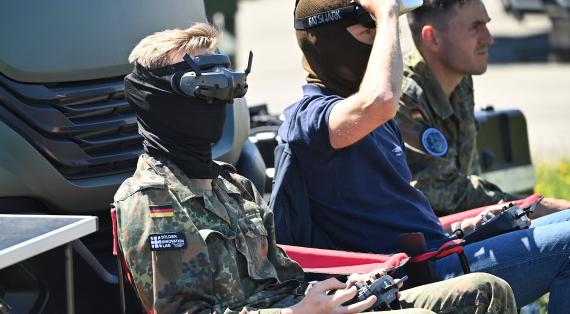
In cases of doubt, modern technologies can decide the advantage on the battlefield. Here, artificial intelligence (AI) above all has the potential to permanently change the way armed conflicts are observed, analysed and waged. From the Konrad-Adenauer-Stiftung’s perspective, the way in which AI can provide a military advantage, what role human component plays in its deployment and what absolutely must be taken into account from a moral and legal standpoint, urgently needs to become part of the thought process. In the defence technology sector, too, policy-makers and society are called upon not only to keep pace with digital transformation, but also to actively shape it. Here we must not forget: No matter whether aviation, the internet, digital photography or the GPS positioning system – armed forces and the defence technology sector have been and still are pioneers and drivers of civilian innovation and progress.
A high degree of legitimacy among the population: a prerequisite for an effective Bundeswehr
We also need a strategic culture in Germany, which, in addition to the national security strategy, should also encompass strategic communication. This means that the tasks, objectives and missions of the Bundeswehr must be communicated to the population in a way that it can understand, taking account of global dynamics and multiple crises. This is first and foremost a task of the Federal Government. It needs to present existing threat situations to the public, while also addressing challenges and problems. After all, we at the Konrad-Adenauer-Stiftung believe that democratic societies have a right to a transparent decision-making process and clear communication with regard to their own armed forces.
Acting on an equal footing in the NATO alliance and the EU as well as in other multilateral organisations, such as the United Nations, and being taken seriously in its interests and goals of protecting the international rules-based order, requires a deployable Bundeswehr that is supported by its citizens at home. For the Bundeswehr can only be effective and successful as a parliamentary army legitimised by the population at large.
In order to improve the reputation of the Bundeswehr, the Konrad-Adenauer-Stiftung aims to enhance citizens’ awareness of how important our armed forces are for our society and the prominent role they play in the defence of our freedom. Particularly important here is that: The more firmly the Bundeswehr is anchored and accepted in society, the more resilient the population is to disinformation and hybrid threats.
We support modernisation and structural realignment: this process is essential
We at the Konrad-Adenauer-Stiftung support the modernisation as well as the financial and structural reorientation of the Bundeswehr and want to promote greater acceptance and a better understanding among the population. We hold discussions on the relevance and special importance of the Bundeswehr for German and European security and explain why adequate and sustainable equipment for the troops is of great importance.
Furthermore, when dealing with this complex topic, we focus on the following sub-areas: equipping the armed forces for war, operational and cold-start capability, procurement, military use of AI, internal command and control and the relationship between the Bundeswehr and society. We also deal with the strategic orientation of German foreign and security policy, discuss the requirements for the capability profile of the Bundeswehr formulated therein, as well as the territorial defence and the role of the reserve in the event of national and alliance defence.
With our work on the overall social discourse about the Bundeswehr, which includes website projects in addition to publications, events, and multimedia contributions, we intend to stimulate discussion on and in particular with the Bundeswehras an essential tool for meeting the security and defence policy challenges of our time.
Our offers and projects on the topic
Interactive web publication
With our interactive web publication, we would like to discuss various issues pertaining to artificial intelligence. This is not about finding simple answers to complex questions. Rather, we aim to put various aspects of technology and their its possible applications into context.
The future of the Bundeswehr: AI in the world's armed forces
(Only in German)
indd.adobe.com
Didactic offers
So as to support the Bundeswehrin fulfilling its mission and as the backbone and guarantor of our liberal democracy and way of life, the Konrad-Adenauer-Stiftung is providing soldiers with suitable educational seminars.
Political Education Programmes for the Bundeswehr

We want to foster a better understanding among the troops of current political developments and backgrounds in Germany, Europe and the world and hope that they obtain maximum benefit from our long-standing experience and our wide range of topics. Our measures for political, historical, intercultural and ethical education usually take place as closed events for one military unit. We would be happy to send you a tailor-made programme!
Find out more about our educational programmes for the Bundeswehr

Publications on this topic
 IMAGO / Sven Simon
More AI for Defence and Resilience
New Ideas for an Agile and Future-proof German Military
 Imago/ Ipon
Does the new military service bring security and equality?
How the Military Service Modernisation Act will strengthen the Bundeswehr and German society
 picture alliance / Kay Nietfeld/dpa | Kay Nietfeld
Probleme deutscher und europäischer Sicherheitspolitik
Die Bundeswehr zwischen nationalen Interessen und internationaler Verantwortung

 IMAGO / Peter Homann
Youth protests against military service
Use school strikes against compulsory military service as a starting point for dialogue
 IMAGO / epd
A defiant church? The new Protestant peace ethic at the turn of the century
The Protestant Church commits to a new pragmatism in security policy – an important step for the success of the turning point
 IMAGO / Bihlmayerfotografie
Thank you for your service! – Levers for a Combat-Ready Bundeswehr
How can defence be ‘de-socialised’?
 Bundeswehr
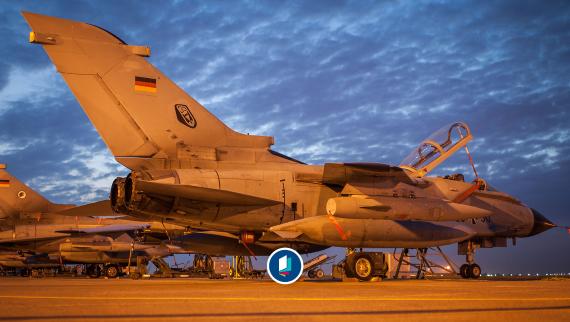
Deutschlands Position im westlichen System der nuklearen Abschreckung
Zur Bedeutung der nuklearen Teilhabe der Bundesrepublik seit der Ära Adenauer
 IMAGO / ZUMA Press Wire
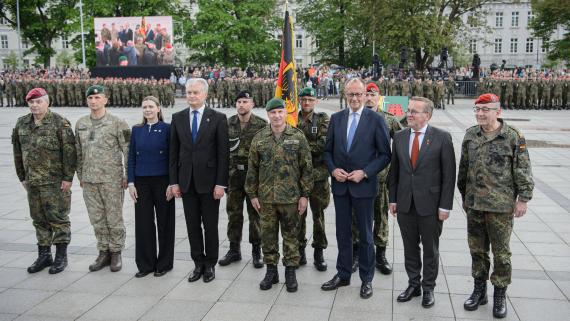
The security situation in Lithuania in spring 2025: threat and response on NATO's eastern flank
Lithuania relies on deterrence, armament and close partnerships
 Hauke-Christian Dittrich, dpa, picture alliance.
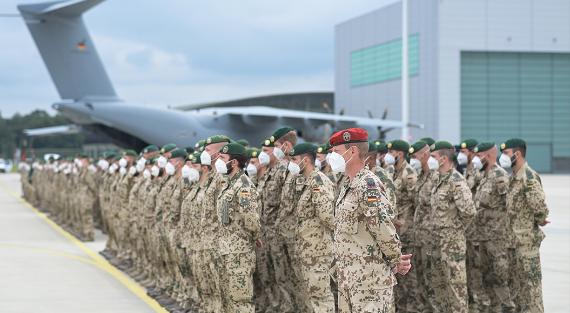
Ellinor Zeino on Lessons Learnt from Afghanistan and on the Future of German Crisis Missions Abroad
“Crises Don’t Just Go Away”
 Friedrich Bungert/Süddeutsche Zeitung Photo
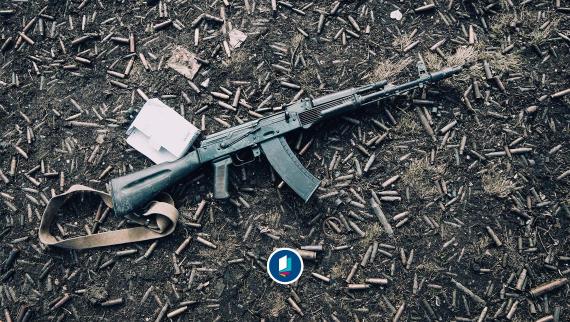
Die Rückkehr des Krieges
Alte und neue Formen militärischer Gewalt im 21. Jahrhundert

Event Reports on the topic

„Das neue Kriegsbild und die Folgen für die Bundeswehr“
Bericht zur Veranstaltung am 2. Juni 2026 an der Universität Potsdam
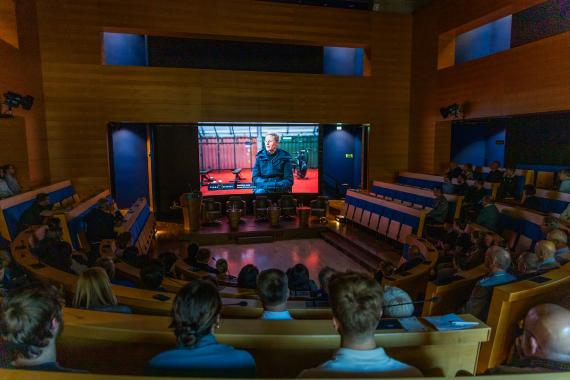 KAS/Wadim Lisovenko
Vorpremiere zur Dokumentation „Kriegstüchtig? 70 Jahre Bundeswehr“
„Die Soldaten schwören und legen einen Eid ab, bereit zu sein, alles zu geben – Leib und Leben. Dann muss die Politik auch bereit sein, ihr Bestes zu geben.“
Wir wählen die Freiheit
Von der wertebasierten Sicherheitspolitik Adenauers zur nationalen Sicherheitsstrategie
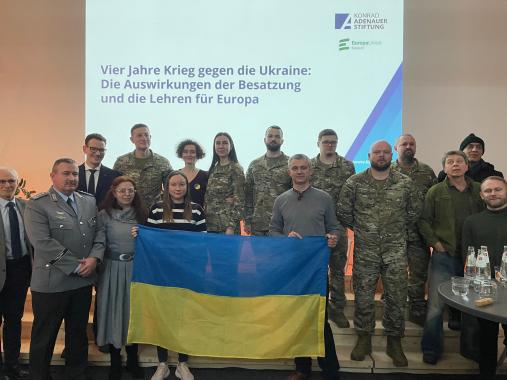
Vier Jahre Krieg gegen die Ukraine: Die Auswirkungen der Besatzung und die Lehren für Europa
Eine Veranstaltung in Kooperation mit der Europa-Union Kassel am 26.02.2026
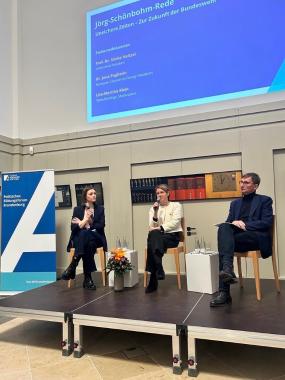
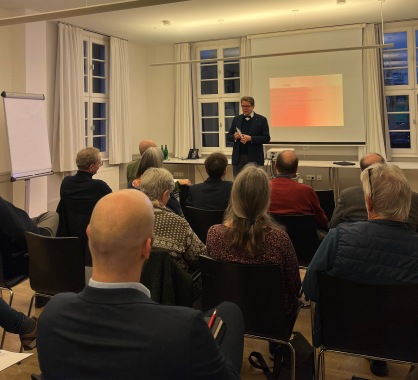

Transatlantischer und Europäischer Zusammenhalt unter Druck: Die Bündnisfrage unter Donald Trump
Bericht vom Cadenabbia-Seminar in Kooperation mit der Deutschen Atlantischen Gesellschaft e.V.
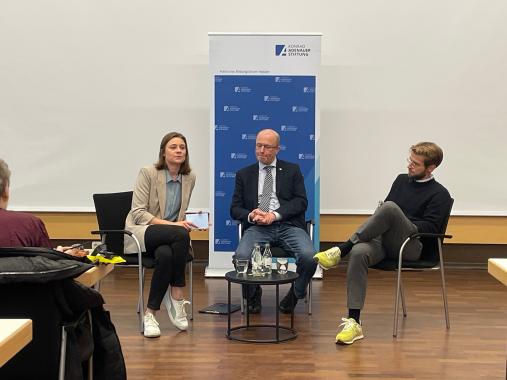
Kognitive Kriegsführung als neue Kriegsform in alten Krisengebieten
Bericht von der Veranstaltung in Kassel vom 11. Oktober 2025
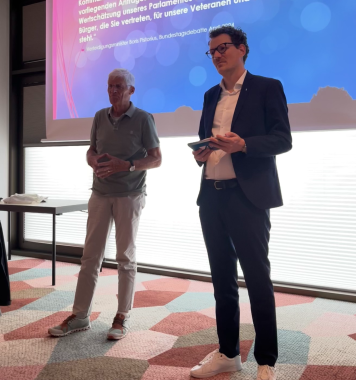
Gedient – vergessen? Veteranen im Schatten ihrer Einsätze
Gesellschaftlicher Dialog über Verantwortung, Dienst und Würdigung
 Jan Kulke/KAS
KSC 2025: The Baltic Sea – Connected, Congested, Contested
Looking back at the Kiel Security Conference 2025

70 Jahre NATO-Beitritt der Bundesrepublik Deutschland
70 Jahre NATO-Beitritt der Bundesrepublik Deutschland
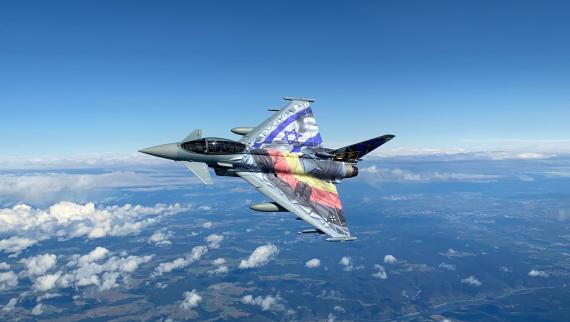 Bundeswehr
60 Jahre Deutsch-Israelische Beziehungen
Gemeinsame Sicherheitspolitik im Wandel der Zeit
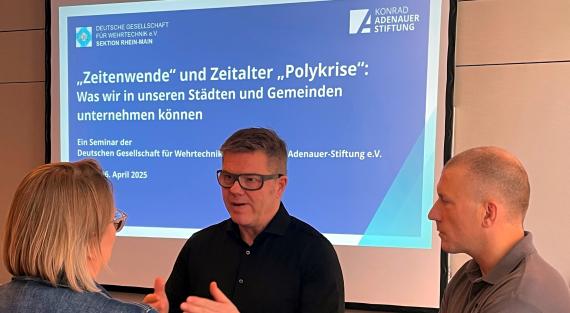 Thomas Ehlen / kas.de