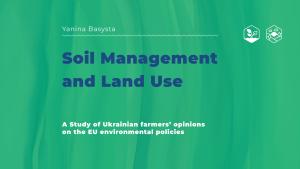
The first part of the study provides an overview of the key EU initiatives that shape the “soil” dimension of the EGD: the EU Soil Strategy for 2030, the reformed Common Agricultural Policy (CAP) 2023–2027, the Nature Restoration Law, and other interconnected strategic documents and legal acts. Particular attention is paid to the new EU Soil Monitoring and Resilience Directive, which lays the foundation for a unified soil monitoring system in the EU Member States.
The second part of the study analyses the Ukrainian context - the scale of soil degradation, the impact of the war on agricultural land, as well as Ukraine’s progress in approximation to EU policies in the field of environmental monitoring and land management. Institutional challenges are considered (enforcement capacity, transparency, risks of misuse), as well as positive steps towards harmonisation with the EU CAP, in particular the introduction of IACS, LPIS, FSDN and the State Agrarian Register.
A key part of the report presents the results of a study of Ukrainian farmers’ opinions regarding the implementation of the principles and standards of sustainable soil management and land use in line with the EGD in the coming years. Based on the data obtained, practical recommendations are formulated across several areas - from policies aimed at ensuring soil health and developing carbon farming to priority steps for the development of the circular economy in the agricultural sector.
A concept for a roadmap for the phased introduction in 2026–2027 of a national soil monitoring system integrated with EU approaches has also been prepared. The recommendations are aimed at supporting the European integration process, strengthening Ukraine’s negotiating position in dialogue with the EU, ensuring more effective consideration of national interests, and accelerating harmonisation with European standards.