






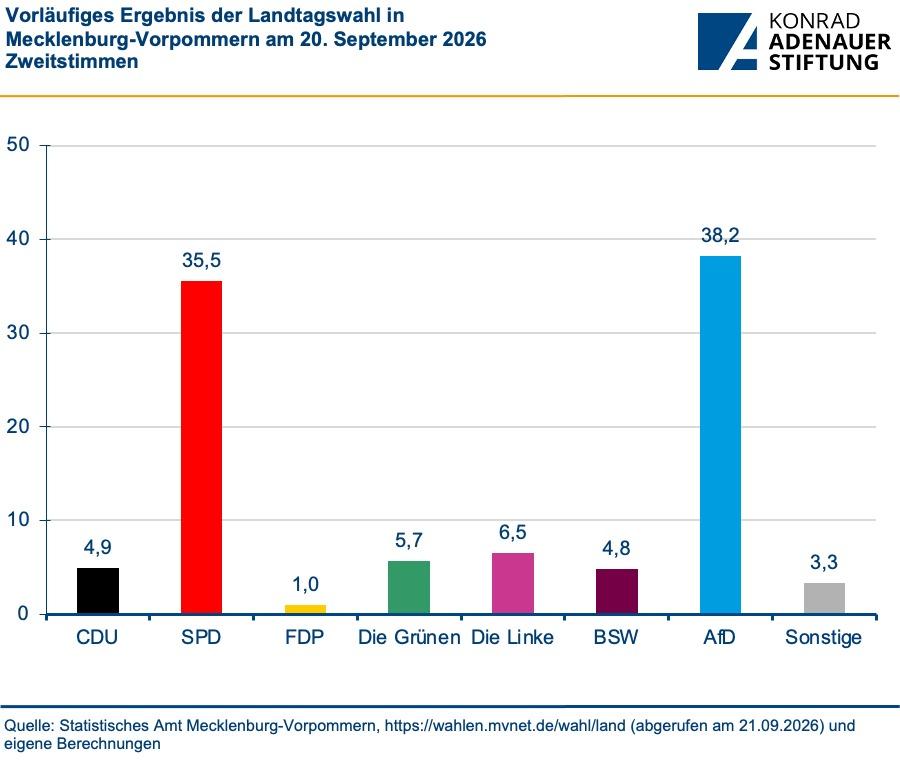
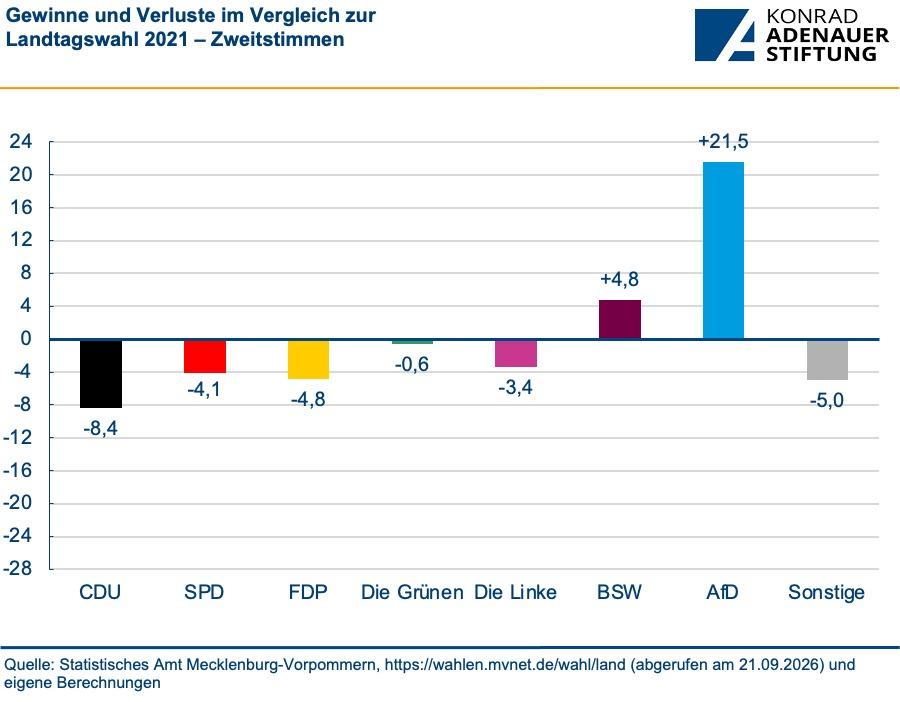
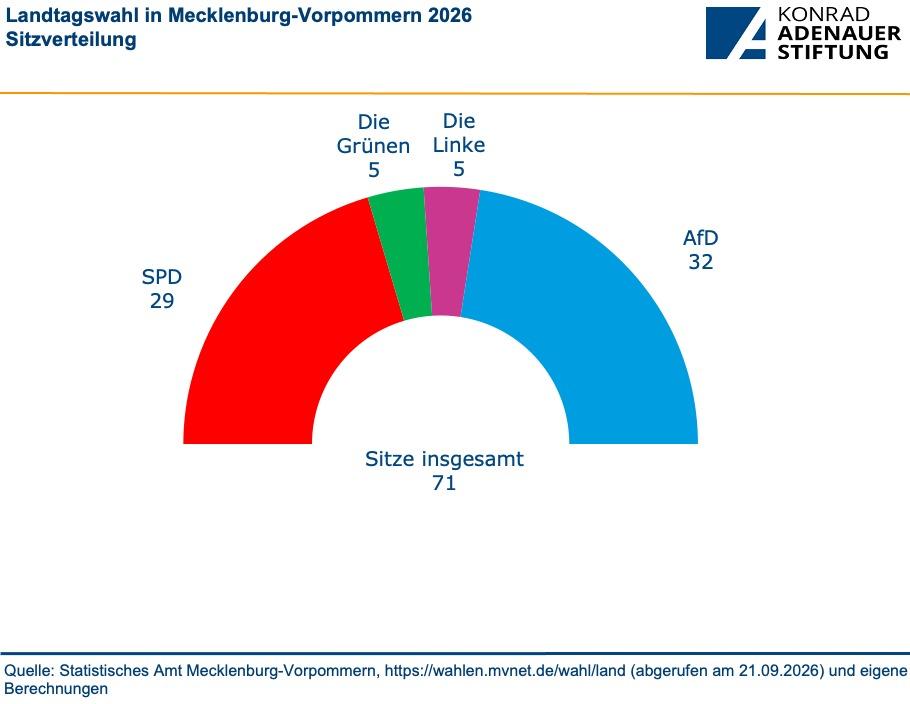
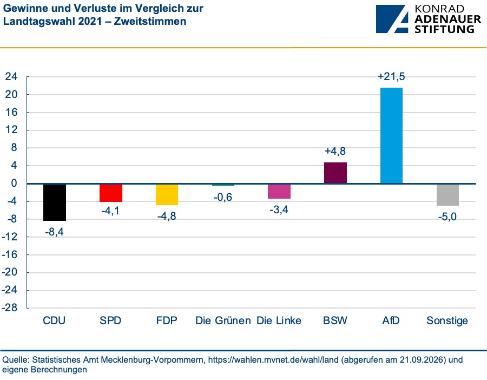
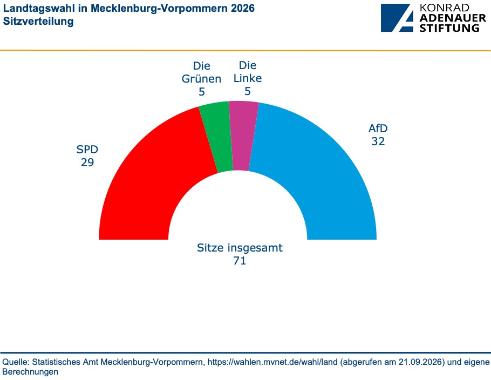
The election result in Mecklenburg-Western Pomerania differs from all other elections in the 2026 election year in one key respect: with Minister-President Manuela Schwesig in office, there was an incumbency advantage that candidates in Rhineland-Palatinate, Baden-Württemberg, Saxony-Anhalt and Berlin did not enjoy.
After the SPD achieved 39.6 per cent in the 2021 state election, there have been repeated credible opinion polls since 2024 which put the SPD at 19 per cent. Most recently in autumn 2025, according to data from Infratest dimap. The party’s poll ratings improved slowly but steadily. In the run-up to the election, 37 per cent of those surveyed could envisage voting for the SPD (Infratest dimap). It should be noted that neither federal politicians, the work of the federal government nor satisfaction with the federal SPD have shown any systematic improvement since that time; the same applies to the assessment of the CDU. The Forschungsgruppe Wahlen therefore points out that 59 per cent of eligible voters consider the state political situation to be decisive for their voting decision. These figures, incidentally, are similar in almost all state elections. Only in rare exceptional cases can a direct link be identified between the political mood at federal level and its impact on voting behaviour in a state election. This is also evident in Mecklenburg-Western Pomerania from the ratings given to parties and leading politicians at both federal and state level: Schwesig receives a rating of +1.3; Klingbeil, -1.6. The SPD in Mecklenburg-Western Pomerania scores +1.3, whilst the SPD at federal level scores -0.4 (on a scale ranging from +5 to -5; Forschungsgruppe Wahlen).
The elections in Saxony-Anhalt, Berlin and Mecklenburg are being met with a great deal of pessimism, which is, however, even more pronounced in Saxony-Anhalt and Berlin. Assessments of the economic situation and the outlook for the future have deteriorated significantly over time. Currently, 11 per cent of those surveyed say the economic situation in the state is good. Although this generally gloomy mood has fallen to a new low, it has been a feature of the state for some time. As early as 2016, only 25 per cent said the economic situation was good; by 2021, the figure had fallen to 16 per cent. The assessment of how well Mecklenburg-Western Pomerania is prepared for the future is also viewed more critically with each election. Whilst just under half said in 2016 and 2021 that the state was well prepared for the future, by 2026 only 35 per cent held this view (Forschungsgruppe Wahlen). This corresponds with the fact that AfD supporters, in particular, view the economic situation extremely negatively. Around 90 per cent say the economic situation is ‘not so good’ or ‘bad’. However, Mecklenburg-Western Pomerania has never been a land of optimists. From 1998 to 2016, the number of economic optimists outnumbered the pessimists – albeit only narrowly – (Infratest dimap).
Unlike in Saxony-Anhalt and Berlin, positive and negative assessments of satisfaction with the state government are roughly balanced. 51 per cent are very satisfied or satisfied, whilst 47 per cent are less satisfied or not at all satisfied. However, the significant deterioration in public perception is reflected here too. Satisfaction has fallen sharply by 13 percentage points compared with the previous election.
All graphs and tables on which the election analysis is based can be found at the end of the document. Please note, to date the study is only available in German.


Topics
About this series
Analysis of the state election in Mecklenburg-Western Pomerania on 20 September 2026
Analysis of the election for the Berlin House of Representatives on 20 September 2026
Analysis of the state election in Saxony-Anhalt on 6 September 2026
Voting behaviour by age and gender
Desire to emigrate among the population