






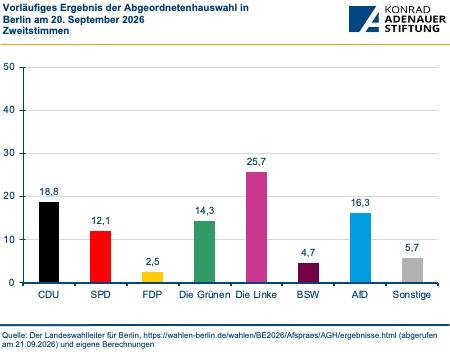
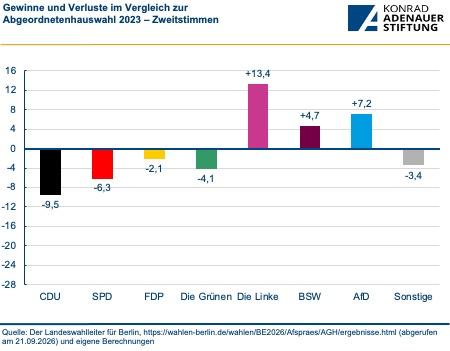
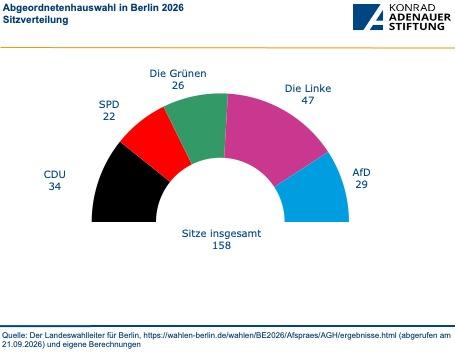
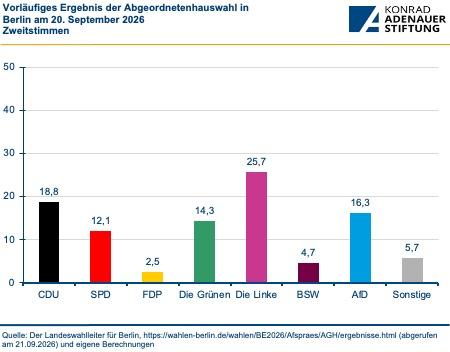
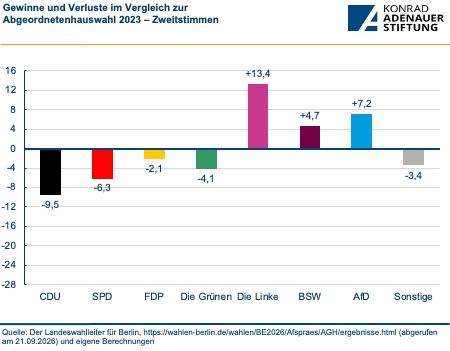
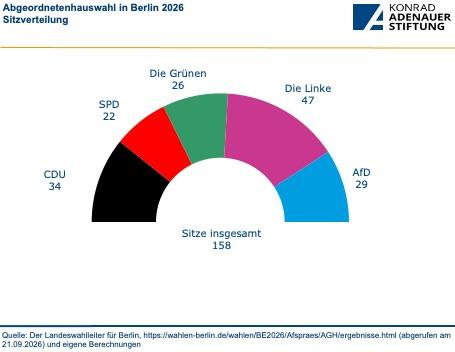
The election results in Berlin bear a closer resemblance to the parties’ performance in the 2025 federal election than to that of the last state election in 2023. In Berlin, Die Linke was already the strongest party in 2025, having made significant gains (2026: 25.7 per cent). At 18.3 per cent, the CDU’s result in the federal election in Berlin is almost on a par with its result in the House of Representatives election (18.8 per cent). The SPD’s result in the federal election, at 15.1 per cent, was slightly higher than its result in the House of Representatives election (12.1 per cent). The same applies to the Greens, who achieved 16.8 per cent in the federal election and 14.3 per cent in the House of Representatives election. The BSW recorded slight losses compared with the federal election (from 6.7 to 4.7 per cent). The AfD made only a marginal gain (federal election: 15.2 per cent; House of Representatives election: 16.3 per cent). Although the AfD made overall gains in all the 2026 elections, the results in Rhineland-Palatinate, Baden-Württemberg, Mecklenburg-Western Pomerania and Berlin – with the exception of Saxony-Anhalt – remained roughly at the same level as in the federal election.
Overall, the election result is characterised less by polarisation than by fragmentation. In no other federal state is the party system so fragmented, nor are the differences in the parties’ performance so small.
None of the candidates enjoys the benefit of incumbency. Consequently, satisfaction with the candidates is low. Elif Eralp of Die Linke fares relatively best, with a satisfaction rating of 27 per cent, followed by Stefan Evers of the CDU, with whom 21 per cent are satisfied. Twenty per cent are satisfied with Steffen Krach, the SPD’s lead candidate, and 11 per cent with Werner Graf of the Greens. Eleven per cent are satisfied with Kristin Brinker of the AfD. Satisfaction with Evers, who only became the lead candidate in July following Kai Wegner’s withdrawal, is roughly on a par with Kai Wegner’s levels in the 2021 and 2023 elections (2021: 19 per cent and 2023: 23 per cent).
The fragmentation of the party system and the low profile of the candidates were reflected in the run-up to the election by vague preferences for the office of Governing Mayor. SPD supporters favour Evers, whilst Green supporters prefer Graf (39 per cent) slightly more than Eralp (34 per cent). Among CDU and Die Linke supporters, just under two-thirds favour their own candidate (Infratest dimap).
There is a clear hierarchy among the most important political issues. 53 per cent cite the housing market and rents. The Left stands to benefit from this, as it is seen as the party most likely to solve the problem in the ‘housing’ sector, with 34 per cent. In 2023, 14 per cent cited the Left. On the issue of ‘housing’, the CDU, at 27 per cent, is just behind Die Linke, but has managed to increase its perceived competence in this area by 10 points compared with 2023, whilst the SPD (9 per cent) and the Greens (4 per cent) fail to score highly here. On the issue of ‘transport’, which 23 per cent of Berliners cite as the most important issue, the Greens lead in terms of problem-solving competence with 30 per cent of mentions, followed by 16 per cent who believe the CDU is best placed to tackle the issue. In 2023, 28 per cent still named the CDU and 22 per cent the Greens. Twenty-seven per cent believe the CDU is capable of tackling crime (2023: 31 per cent). Here, the AfD comes second with 19 per cent of mentions.
The CDU and SPD are suffering particularly badly from the still widespread dissatisfaction, especially with the economic situation and preparations for the future. However, in Berlin, both the Senate and the opposition are viewed critically, and 45 per cent believe that no party is capable of solving the problems. Federal political issues are therefore not the main focus in Berlin either. 27 per cent of those surveyed say that federal political issues were the deciding factor in their voting decision.
All graphs and tables on which the election analysis is based can be found at the end of the document. Please note, to date the study is only available in German.


Topics
About this series
Analysis of the state election in Mecklenburg-Western Pomerania on 20 September 2026
Analysis of the election for the Berlin House of Representatives on 20 September 2026
Analysis of the state election in Saxony-Anhalt on 6 September 2026
Voting behaviour by age and gender
Desire to emigrate among the population